
- News
- Women
- Magazine
- IndustryIndustry
- InsightsInsights
- Success Stories
- PublishPublish
- ContactContact
- Media KitMedia Kit

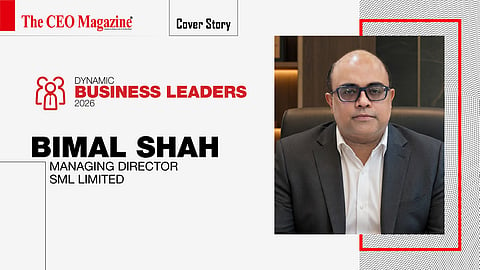
BIMAL SHAH - MANAGING DIRECTOR - SML LIMITED

As agriculture faces mounting pressure from shrinking arable land, rising input costs, volatile fertiliser supply chains, and growing demands for sustainability, the need for science-led and high-efficiency farming solutions has never been greater.
At a time when farmers are expected to produce more with fewer resources while reducing environmental impact, SML Limited has positioned itself at the intersection of innovation, sustainability, and farmer-centric growth. At the helm of this transformation is Bimal Shah, Managing Director of SML Limited, whose vision focuses on advancing nutrient efficiency, safer crop protection technologies, and long-term agricultural resilience.
From its beginnings as a sulphur-focused enterprise founded by Mr. Deepak Shah to its evolution into a globally recognised agri-solutions provider operating across more than 80 countries, SML’s journey has been shaped by a consistent commitment to science, innovation, and long-term value creation for farmers. Today, with a comprehensive portfolio spanning crop protection, crop nutrition, biologicals, and high Nutrient Use Efficiency technologies, the company is not only addressing modern agricultural challenges but also contributing to broader conversations around food security, soil health, and sustainable farming practices.
For Bimal Shah, leadership was never simply about inheriting a business; it was about carrying forward a larger mission rooted in innovation and responsibility. Growing up around the organisation gave him an early understanding of the company’s philosophy and its deep connection with Indian agriculture.
“My journey has really been about combining the privilege of a strong legacy with my own conviction that science-led, farmer-centric innovation can change agriculture at scale,” he says.
His exposure to the business began at a formative stage while observing his father build SML from a technocrat-led start-up into one of India’s respected agrochemical enterprises. The company’s long-standing “More from Less” philosophy left a lasting impression on him, particularly the idea of using technology not merely to increase volumes but to improve agricultural outcomes sustainably.
That philosophy later shaped his academic and professional direction. After formally training in agriculture and soil science in the United States, Bimal Shah returned to India and immersed himself in every aspect of the business, from formulations and manufacturing to understanding field realities across diverse agro-climatic zones. This hands-on exposure became instrumental in shaping his leadership perspective.
“One of the first defining moments was recognising what my father had actually built, an innovation-driven, debt-free agri-enterprise grounded in science and values, not just scale,” he shares.
As he stepped into leadership, the industry itself was entering a period of transition marked by tightening regulations, increasing environmental scrutiny, increasing competition and rapidly changing global supply chains. Rather than pursuing aggressive short-term expansion, he focused on strengthening differentiated technology platforms centred on crop protection and high nutrient-use efficiency solutions.
The emphasis, however, remained firmly on listening to farmers.
“A second pivotal moment came from repeated conversations with farmers who wanted longer control, safer handling and fewer applications, without compromising performance,” he explains. “That feedback led us to conceive innovative patented solutions, cementing my belief that real innovation starts with listening at the farm gate.”
Founded in 1971 as Sulphur Mills, SML began with a clear and focused vision: to use science to solve practical agricultural problems. Over the decades, the organisation steadily expanded its capabilities, evolving from a sulphur-focused business into a diversified agri-solutions company with strong expertise in formulation technologies.
Today, the company operates multiple state-of-the-art manufacturing plants in Gujarat and serves over one crore farmers globally. Its portfolio spans crop protection, crop nutrition, biologicals, advanced formulations, and sustainable nutrient platforms designed to improve productivity while reducing environmental impact.
At the core of the company’s growth story lies its formulation-led approach. Over the years, SML has pioneered technologies such as Water Dispersible Granules (WGs), DryCaps, suspension concentrates, micro-encapsulation and advanced high-NUE platforms, including SRT and ORT.
This strong technology foundation is supported by over 950 patents, seven manufacturing facilities, and one of the world’s largest WG and CS capacities. More importantly, it has helped position the company as a global innovation-led organisation rather than simply a volume-driven agri-input manufacturer.
“SML had always been an innovation-led enterprise,” says Bimal Shah. “A pivotal moment came from realising that we were working with ‘ahead-of-time’ formulation technologies in India, and in those times of limited global acceptance, it was a perfect opportunity to enhance the perception of Indian quality and technological credibility.”
That approach significantly strengthened the company’s international presence. Today, more than half of SML’s revenue is driven by exports, with active operations and offices in countries such as Brazil and Turkey, alongside a broad footprint across Asia, Europe, the United States, and Latin America.
The company has also established a dedicated Discovery Center focused on green chemistry and future-ready agricultural technologies like new chemical entities (NCEs), a move aligned with its long-term focus on reducing environmental impact while improving efficacy and safety standards.
At a time when farmers face rising input costs, soil degradation, water stress, and increasing uncertainty, SML’s innovation roadmap is designed around improving efficiency and resilience at the farm level.
The company’s integrated portfolio combines crop protection, crop nutrition, and biological solutions to help farmers achieve higher productivity with lower resource dependency.
Its crop protection segment includes fungicides, insecticides, and herbicides delivered through advanced formulations such as WGs and DryCaps, which improve field performance while enhancing safety and reducing solvent use.
Equally significant is the company’s work in innovative crop nutrition and high Nutrient Use Efficiency technologies. Through platforms such as SRT and ORT, SML has developed solutions that help reduce bulk NPK and water-soluble fertiliser use while still improving crop productivity.
According to the company, these technologies can enable farmers to reduce conventional fertiliser usage by 25–50% while delivering yield improvements ranging from 10% to 40%.
For Bimal Shah, the objective extends beyond product performance. “We are not just selling products; we are an innovation-led, formulation-driven partner focused on delivering measurable, sustainable outcomes for farmers and the food system,” he states.
The organisation has also strengthened its focus on biologicals and biostimulants aimed at improving stress tolerance, lowering chemical load, and supporting long-term soil and ecological health. Before technologies are commercialised at scale, the company continues to invest extensively in field engagement, multi-season testing, and scientific validation to ensure consistent performance under real agricultural conditions.
“I am deeply influenced by the ‘More from Less’ philosophy I inherited,” says Bimal Shah. “That translates into a leadership style where we invest patiently in R&D, multi-season trials and data-driven validation, and then scale only those ideas that stand up to scientific and field evidence.”
Beyond improving farm efficiency, SML’s long-term vision also centres around improving nutritional outcomes through agriculture. For the organisation, the Government of India’s SEHAT mission represents a broader direction the company has already been advancing for years through biofortified crops, nutrient efficiency technologies, and advanced formulations aimed at improving the quality of agricultural produce.
Bimal Shah says, “Our belief has always been simple: if what we eat matters, then how we grow it matters most. That is why formulation matters, because through the right science and the right nutrition, we have already been improving nutrient concentration across crops in India.”
Over the years, SML’s farmer engagement programmes, field demonstrations, and World Nutrition Day awareness initiatives have consistently focused on promoting biofortification and nutrition-led agriculture as part of a more sustainable farming ecosystem. “In that sense, SEHAT is not a new destination for us; it is a national validation of work we have been steadily advancing for years,” he adds.
The agricultural inputs industry has experienced significant disruption in recent years, driven by regulatory pressures, supply chain volatility, climate concerns, and changing sustainability expectations. For SML, these challenges became catalysts for accelerating innovation rather than slowing expansion.
The tightening of regulations around residues, resistance management, and environmental safety pushed the company to intensify its focus on safer and more sustainable technologies.
“We navigated this by doubling down on formulation science, DryCaps, advanced WGs, micronisation and biologicals so we could launch low-dose, safer, high-performance products that meet stricter norms while improving user safety and environmental footprint,” Bimal Shah explains.
Global supply-chain disruptions and fertiliser shortages also reshaped the agricultural landscape, creating uncertainty for both manufacturers and farmers. In response, the company accelerated the scaling of its high-NUE nutrition platforms, helping reduce dependence on imported fertiliser tonnage while improving yield efficiency.
Another major challenge involved adoption and awareness around innovative and balanced plant nutrition and biological solutions. Farmer risk aversion, limited extension support, and complex regulatory pathways often slowed acceptance of newer technologies.
To address this, SML invested in large-scale field demonstrations, collaborations with research institutions, and extensive farmer education initiatives aimed at building confidence through evidence-based results.
The company’s collaborative ecosystem approach has also become a defining part of its operating model. Rather than functioning in silos, SML actively works with policy bodies, research institutions, and industry partners to co-create practical agricultural solutions.
“In a volatile and regulated environment, this collaborative, transparent approach helps us stay ahead of change while keeping sustainability at the centre of every strategic choice,”
-Bimal Shah
Over the last five decades, SML has steadily transformed from a domestic enterprise into a globally recognised agri-solutions group with operations spanning more than 80 countries.
Its expansion strategy has combined manufacturing scale, innovation capabilities, strategic partnerships, and direct market presence. The company’s Brazil office in Campinas, inaugurated in 2024, marked another important step in strengthening its international distribution network and direct engagement in key agricultural markets.
At the same time, the organisation continues to deepen partnerships with global agrochemical and fertiliser companies through tailor-made formulation collaborations and long-term contract arrangements.
Recognition for the company’s innovation-driven approach has also grown steadily over the years. SML has received more than 40 awards, including FICCI’s Sustainable Agriculture Award and CII’s Industrial Innovation Award 2024, where it was recognised among India’s Top 75 Innovative Companies.
Individually, both generations of leadership have received notable recognition. While founder Deepak Shah earned recognition as the “Sulphur Man of India”, Bimal Shah was recently named “MD of the Year” at the Business Leader of the Year awards.
However, for him, the most meaningful achievement lies beyond recognition. “The achievement I value most is shaping SML’s transition from an Indian Agri-input player into an enterprise that is ‘Transforming Agriculture’ by delivering advanced, sustainable solutions to the global farming community,” he says.
For him, the significance of this transformation lies in proving that business growth, farmer prosperity, and environmental responsibility can coexist within the same model. “Knowing that this mindset will outlive any individual leader and continue to benefit farmers and the broader food system is the most satisfying part of my role.”
As agriculture increasingly moves toward precision farming, digital ecosystems, and AI-driven decision-making, SML is actively integrating technology into its broader operational and strategic roadmap.
The company closely monitors macro shifts such as green chemistry regulations, evolving fertiliser supply chains, and rising demand for sustainable agriculture. Insights gathered through R&D centres, research collaborations, farmer interactions, and global market engagement are then translated into scalable technology platforms.
Importantly, the organisation views innovation not as isolated products, but as integrated platforms capable of addressing long-term structural challenges.
“When we see structural shifts, such as the need for higher nutrient-use efficiency or safer formulations, we respond by building platforms like DryCaps, high-NUE SRT/ORT nutrition, biologicals and advanced WGs rather than just individual SKUs,” says Bimal Shah.
On the digital front, the company is steadily moving toward more data-driven agriculture using agronomic insights, soil information, and market intelligence to improve product targeting and farmer advisory services.
SML is also developing its own integrated application platform that will eventually support both internal teams and external stakeholders, including farmers and channel partners, through live data analysis and AI-driven insights.
“As AI, automation and digital tools mature, we see them as enablers to augment our core strengths in formulation science and field agronomy,” Bimal Shah explains. “Helping us predict needs better, personalise recommendations and improve operational efficiency, while keeping the farmer and real-world evidence at the centre of every decision.”
Alongside business growth, SML continues to place strong emphasis on talent development, culture building, and community impact. The organisation believes that attracting high-impact talent requires more than compensation alone. Its people’s philosophy centres around empowerment, flexibility, continuous learning, and meaningful contribution.
“We don’t just offer jobs; we offer a platform for meaningful contribution,” Bimal Shah states.
Internally, the organisation invests heavily in mentorship, upskilling, and personalised growth pathways while fostering a collaborative and inclusive culture designed to strengthen long-term retention.
Beyond business operations, SML has also expanded its community engagement efforts through grassroots sports development and youth empowerment initiatives.
Guided by its CSR philosophy of “from nurturing plants to nurturing dreams”, the company recently launched a cricket academy in partnership with ASK Foundation24 and Spin & Swing. The initiative focuses on supporting young cricketing aspirants, particularly from underprivileged backgrounds, through professional coaching and structured development opportunities.
The organisation is also associated with international cricket mentors through the Masterclass Classroom initiative, offering selected athletes advanced mentorship exposure and high-performance training.
These initiatives reflect the company’s broader belief that sustainable growth extends beyond business metrics and must create meaningful long-term impact across communities as well.
Looking ahead, Bimal Shah believes the agriculture industry will continue to become more complex over the next three to five years, shaped by growing food demand, shrinking arable land, stricter sustainability requirements, and rising demand for precision agriculture.
For SML, the next phase of growth will focus on three major levers: integrated solutions, digital agriculture, and execution capability. The company aims to move beyond standalone products toward integrated crop solutions that combine crop protection, nutrition, biologicals, and advisory services tailored to specific crops, soils, and microclimates.
At the same time, it plans to strengthen precision agriculture capabilities using digital tools that help farmers optimise dosage, timing, and application methods while reducing environmental footprint and cost per acre. Equally important will be deepening last-mile farmer engagement, expanding agronomy capabilities, and strengthening partnerships across research, ag-tech, and sustainability ecosystems.
Through it all, the company’s larger purpose remains unchanged. “We are not just selling products; we are helping farmers produce more with less – more yield, less risk, and less environmental footprint,” says Bimal Shah.
That philosophy continues to define SML’s journey as it works toward building technologies that improve farmer incomes, strengthen food security, restore soil health, and contribute to a more sustainable agricultural future.
Follow us on Google News