
- News
- Women
- Magazine
- IndustryIndustry
- InsightsInsights
- Success Stories
- PublishPublish
- ContactContact
- Media KitMedia Kit


After nearly two decades of addressing leaders across industries and cultures, one of India’s most sought-after corporate keynote speakers argues that enduring leadership rests on three deceptively simple disciplines: renew your energy, grow your people and guard your culture.
Leadership may be the only subject with thousands of books—and almost as many definitions.
Every year produces a new framework, acronym or promise to turn competent managers into visionary leaders. From Stephen Covey’s enduring principles to Simon Sinek’s advice to begin with “why”, the literature is extensive and useful. Yet leadership remains stubbornly difficult to define and considerably harder to practice.
Perhaps that is because leadership looks far tidier on a bookshelf than it does on a chaotic Monday morning. Shakespeare captured the burden centuries ago: “Uneasy lies the head that wears a crown.”
Leaders are expected to notice change before others, challenge assumptions and rally people towards a future that does not yet exist. They may receive some credit when things work, but they can be reasonably certain of receiving the blame when they do not. Investors, employees, customers, boards and society are all watching. Closely.
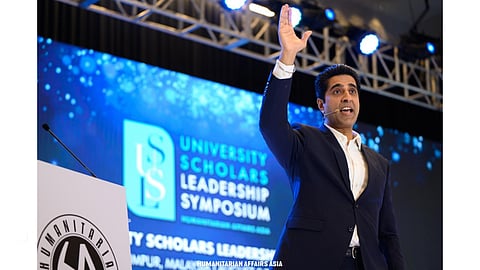
For nearly 20 years, Simerjeet Singh has been exploring this demanding human side of leadership with organizations across India and the world. Through corporate keynotes, leadership workshops, podcasts and videos that have collectively crossed 100 million views, he has consistently returned to an unfashionably simple argument: great leadership is not built on frameworks alone.
Featured by prominent publications and speaker bureaus among India’s best keynote and motivational speakers, Singh is known for addressing leadership, change, innovation, growth mindset and organizational transformation.
Yet beneath these themes sit three principles that recur in almost every conversation he has with leaders.
Mantra 1: Your Energy Enters the Room Before Your Strategy Does
A leader may have an excellent plan. But if that leader consistently appears depleted, cynical or emotionally absent, the organization receives a very different message.
Leadership advisers Jack Zenger and Joseph Folkman, studying feedback on thousands of leaders, identified lack of energy and enthusiasm among the recurring flaws associated with ineffective leadership. This is not an argument for theatrical positivity—or for pretending every quarter is wonderful. It is about the emotional signal a leader broadcasts when circumstances are difficult.
People turn towards sources of hope and steadiness. Just as plants orient themselves towards light, teams often gravitate towards leaders who radiate possibility, composure and the conviction that progress remains achievable.
“A leader’s energy functions almost like organizational Wi-Fi,” Singh says. “Everyone nearby is attempting to connect to it.”
This is why personal renewal is not a private luxury for leaders. It is part of the job.
Sleep, exercise, reflection, meditation, meaningful relationships or quiet time may not appear on a quarterly dashboard, but they influence what eventually does. Leaders who continually pour from an empty cup should not be surprised when exhaustion begins seeping into the culture.
It’s ironic that the prevalent hustle culture has made fatigue look strangely prestigious. Four hours of sleep, a dawn workout, three flights and a board meeting may produce an impressive social-media post. It is not necessarily a sustainable operating model.
Singh’s advice is practical: create a deliberate daily refueling mechanism. Protect something that restores your physical, emotional and mental energy before the day begins consuming it.
Singh believes that leaders do not merely announce culture; they embody it. And therefore, a leader who lives in permanent depletion quietly gives everyone else a poor example to follow.
On the contrary, a leader who demonstrates ambition with wellbeing and intensity with perspective sends out a more powerful signal: performance matters, but so does the person producing it.
Energy may help an organization move today. But sustaining that movement requires leaders who prepare others to carry it forward. And that brings us to Simerjeet Singh’s Leadership Mantra Number 2.
Mantra 2: Grow People Before You Need Them
A widely quoted Chinese proverb offers a useful lesson in corporate longevity: if you want prosperity for a year, grow grain; for ten years, grow trees; for a hundred years, grow people.
Succession planning, however, is frequently treated like emergency equipment. Everyone agrees it is important, but nobody goes looking for it until smoke enters the building.
That is a mistake.
According to Singh, a leader’s responsibility is not merely to deliver this quarter’s numbers. It is to leave behind stronger judgment, deeper capability and more leaders than existed when they arrived.
“The real test is not how indispensable you become,” he argues, “but how much capability continues to flourish without your constant intervention.”
This requires executives to rediscover roles that modern corporate life often pushes aside: the leader as teacher, mentor, coach, storyteller and custodian of institutional wisdom and values.
Revenue, profitability, compliance, cost control and market expansion keep an organization alive. But values guide decisions when the policy manual has no suitable paragraph. Stories transmit lessons that dashboards cannot. Purpose helps people understand why their work matters beyond another spreadsheet turning green.
These are routinely described as the “soft” dimensions of management. Yet during disruption, the soft becomes remarkably hard. Trust, courage, loyalty, shared meaning and sound judgment are difficult to measure precisely, but even harder to operate without.
Leaders cannot therefore reserve conversations about purpose and culture for the annual retreat or ceremonial CEO video message. They must translate the vision into everyday choices, share tacit knowledge and help emerging leaders understand not only what the organization does, but why it exists.
The expectations of younger professionals make this increasingly important. They want compensation and advancement, certainly, but also growth, mentorship, meaning and wellbeing.
As Simerjeet Singh likes to put it, “Profit gives an organization the ability to continue. Purpose gives its people a reason to care.”
The future-ready leader must remain close to the vision, and equally close to the people expected to bring it alive. A leader should stand for something so consistently that, over time, the organization begins to stand for it too.
And that is where people development becomes culture. Which brings us to Simerjeet’s Leadership Mantra Number Three.
Mantra 3: Culture Is the Precedent You Set
Culture is the invisible air of an organization. Nobody can point to it, yet everybody breathes it.
It lives in the unwritten rules: who gets heard, what gets rewarded, which shortcuts are overlooked, how mistakes are treated and what people feel safe enough to say when senior management is in the room.
Organizational psychologist Edgar Schein described culture through three levels: visible artefacts, declared values and the deeper assumptions that determine how work is actually done. The posters matter. The speeches matter. But neither matters as much as the choices leaders make when those values become inconvenient.
Culture researchers Steve Gruenert and Todd Whitaker expressed it bluntly: “The culture of any organization is shaped by the worst behavior the leader is willing to tolerate.”
Every act of tolerance sets a precedent.
If a high performer is permitted to disrespect colleagues, the message travels faster than any values campaign. If health and safety are compromised to meet a deadline, people notice. If leaders speak about diversity while repeatedly promoting familiar faces, the real policy becomes clear.
The same applies to integrity, sustainability, work-life balance and employee wellbeing. What leaders challenge, protect, reward and refuse to accept gradually becomes part of the organization’s operating DNA.
Singh considers this one of the most powerful—and neglected—forms of leadership. Markets will change. Strategies will be revised. Products will become obsolete. But a culture built around dignity, courage, accountability and learning can outlast the leader who helped create it.
This does not diminish the importance of profit, growth, market share or disciplined execution. It places them inside a larger responsibility.
Organizations need leaders who can deliver results without normalizing burnout; prepare successors without protecting their own indispensability; and build workplaces where performance and people can flourish together.
That is the thread running through Simerjeet Singh’s leadership message across stages, screens and boardrooms: replenish the source, develop the next line and set precedents worth following.
These ideas may sound simple in an era obsessed with complexity. But simple does not mean easy, and “soft” does not mean optional.
Perhaps that is the leadership legacy worth pursuing: not merely leaving behind a larger organization, but a healthier one; not only stronger numbers, but stronger leaders; not simply a successful business, but an institution capable of thriving long after its present custodians have moved on.
Because leadership, in the end, is not the crown you wear.
It is the energy you transmit, the people you grow and the culture you leave behind.
Follow us on Google News