
- News
- Women
- Magazine
- IndustryIndustry
- InsightsInsights
- Success Stories
- PublishPublish
- ContactContact
- Media KitMedia Kit
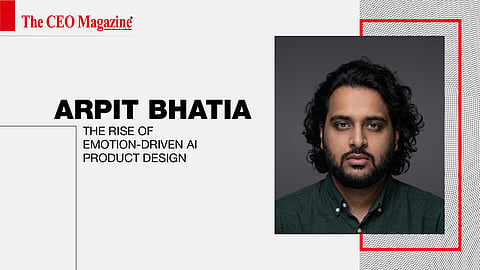
Arpit Bhatia

Arpit Bhatia, Head of Design at POP, is redefining contemporary product design through a distinctive blend of aesthetics, emotional intelligence, artificial intelligence, and technology-driven innovation. As one of the emerging creative leaders shaping the future of digital experiences, his work exists at the intersection of AI, commerce, human psychology, and cinematic storytelling. One of the defining milestones in his career has been leading the POP app’s rebranding, titled “Future Retro Noir,” a visually distinctive brand identity built on three key tenets: retro tech gadgets, cinematic lighting, and powder-room patterns. The rebranding introduced a premium and emotionally charged visual language that successfully blended nostalgia with futuristic digital aesthetics, establishing POP as a culturally expressive and high-taste consumer platform.
In an era where artificial intelligence can generate limitless content within seconds, Arpit Bhatia strongly believes that the true differentiator is not automation alone, but taste—the rare ability to create emotionally resonant, culturally relevant, and deeply meaningful user experiences. With over a decade of experience in product design, visual storytelling, and user experience strategy, he has developed a design philosophy that views design not merely as functionality or visual appeal but as a powerful expression of identity, aspiration, trust, and emotional connection.
His work consistently reflects the belief that exceptional digital products are not only useful but emotionally magnetic, capable of building long-term brand loyalty and cultural relevance within highly competitive digital ecosystems. Over the years, he has invested significant time studying human emotional dynamics, behavioural psychology, and the subtle ways people interact with digital environments. This understanding has enabled him to craft immersive experiences that combine strategic thinking with cinematic storytelling and scalable systems architecture.
At the foundation of his design philosophy are three defining principles. The first is First Principles Thinking, where complex problems are solved from their foundational root rather than through superficial adjustments. This enables him to create solutions that are strategically sound, structurally intelligent, and visually refined.
The second principle is Systems Thinking, which focuses on building scalable and adaptable design ecosystems capable of evolving alongside emerging technologies. In the age of AI-enabled architecture, he believes design systems must balance automation with human sensibility, ensuring scalability without sacrificing creativity or emotional depth.
The third pillar is Cinematic UX, a philosophy inspired by cinema, motion design, visual rhythm, and storytelling. Rather than designing static interfaces, he creates immersive digital experiences where movement, transitions, lighting, composition, and emotional cadence work together to create intuitive and memorable interactions. His cinematic perspective transforms products into experiences that feel alive, emotionally engaging, and culturally expressive.
Beyond design leadership, Arpit Bhatia is actively building at the atoms of agentic commerce platforms, where AI, automation, and user behaviour intersect to redefine the future of digital commerce. His AI-driven innovations include automated e-commerce photoshoots at scale, hyperreal AI influencer development indistinguishable from human creators, UI-to-code systems, and prompt-to-UI workflows that accelerate product development and creative execution. His work demonstrates how artificial intelligence can enhance creativity without replacing the emotional intelligence and discernment that define exceptional design.
Arpit Bhatia represents a new era of product leadership where technology, aesthetics, psychology, and AI coexist seamlessly. Through his evolving body of work, he continues to challenge conventional boundaries of design by proving that while AI can generate endlessly, true taste, emotional resonance, and cultural impact remain deeply human qualities.
Follow us on Google News