
- News
- Women
- Magazine
- IndustryIndustry
- InsightsInsights
- Success Stories
- PublishPublish
- ContactContact
- Media KitMedia Kit
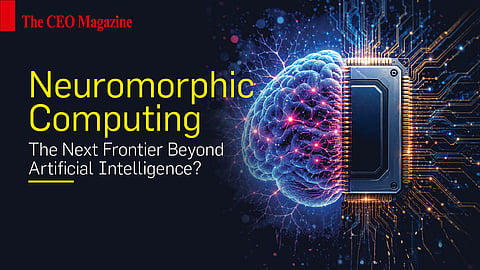
Neuromorphic Computing

For decades, computing has evolved by becoming faster, smaller, and more powerful. Yet despite remarkable advances in artificial intelligence, modern computers still process information very differently from the human brain. As AI systems grow increasingly complex and energy-intensive, researchers and technology companies are exploring a radically different approach—one that seeks inspiration from nature itself.
Known as neuromorphic computing, this emerging field aims to replicate the way biological brains process information, potentially opening the door to a new era of intelligent machines that are faster, more adaptive, and significantly more energy-efficient than today's systems.
The modern digital economy runs on conventional computing architectures that have powered innovation for decades. However, the explosive growth of artificial intelligence has exposed some fundamental challenges. Training and operating advanced AI models require enormous computational resources, vast data centres, and significant energy consumption. As organisations increasingly deploy AI across business functions, questions around scalability, sustainability, and cost are becoming more pressing.
This challenge has prompted researchers to ask a simple question: what if computers processed information more like the human brain? The answer may lie in neuromorphic computing.
The human brain remains one of the most efficient information-processing systems ever known. Despite containing approximately 86 billion neurons and trillions of neural connections, it operates using roughly the same amount of energy as a household light bulb. Neuromorphic computing seeks to emulate this efficiency by designing hardware that mimics the structure and behaviour of biological neural networks.
Unlike conventional computers that continuously process data through separate memory and processing units, neuromorphic systems rely on networks of artificial neurons and synapses that communicate through electrical signals known as "spikes". Information is processed only when necessary, significantly reducing energy consumption while enabling rapid decision-making. The result is a fundamentally different approach to computing—one that prioritises adaptability, parallel processing, and efficiency.
Most of today's artificial intelligence systems rely on deep learning models running on high-performance GPUs and cloud infrastructure. While powerful, these systems often require substantial computing power and large datasets. Neuromorphic systems offer an alternative pathway.
Because they process information through spiking neural networks, they can potentially perform certain tasks with dramatically lower energy requirements. They are also better suited for environments where real-time learning and immediate response are essential. Rather than replacing conventional AI, many experts believe neuromorphic computing could complement existing technologies, particularly in applications where power efficiency and autonomous decision-making are critical.
One of the most promising applications of neuromorphic computing lies at the network edge. As businesses deploy increasing numbers of connected devices, from industrial sensors and autonomous vehicles to smart cameras and wearable technology, the ability to process information locally becomes increasingly important.
Neuromorphic chips could enable devices to analyse data, detect patterns, and make decisions without constantly communicating with cloud servers. This would reduce latency, improve privacy, and lower bandwidth requirements. For industries such as manufacturing, logistics, healthcare, and transportation, these advantages could prove transformative.
Several organisations are already investing heavily in neuromorphic research. Technology giants, semiconductor companies, and leading universities have developed experimental processors designed to mimic neural activity. These systems are being tested for applications ranging from robotic control and computer vision to autonomous navigation and scientific research.
At the same time, startups are exploring commercial opportunities in edge AI, sensor intelligence, and ultra-low-power computing. Although the field remains in its early stages, investment activity suggests growing confidence that neuromorphic architectures may play an important role in the future technology landscape.
Despite its promise, neuromorphic computing is far from mainstream adoption. Developing software for neuromorphic hardware requires entirely new approaches to programming and system design. Existing AI frameworks are largely optimised for traditional computing architectures, creating a significant barrier to widespread deployment.
Researchers are also working to improve the performance and reliability of spiking neural networks, while industry standards and development ecosystems remain relatively immature. As a result, commercial applications are currently limited compared to conventional AI technologies.
History shows that transformative technologies often begin as research projects before becoming foundational business tools. Cloud computing, machine learning, and quantum computing all followed similar trajectories. Neuromorphic computing may be at a comparable stage today.
While widespread adoption may still be years away, the technology addresses some of the most important challenges facing modern AI: energy efficiency, real-time processing, scalability, and autonomous learning. For business leaders, the key question is not whether neuromorphic computing will replace existing systems but where it may create competitive advantages.
Organisations operating in robotics, smart manufacturing, autonomous systems, healthcare technologies, and edge computing may be among the first to benefit from this brain-inspired revolution.
As the world continues its pursuit of more capable artificial intelligence, the next breakthrough may not come from building larger models or more powerful processors. Instead, it may emerge from understanding and replicating the remarkable efficiency of the human brain.
Neuromorphic computing represents one of the most ambitious attempts to bridge biology and technology. Whether it ultimately becomes a niche solution or a foundational pillar of next-generation computing, it is already reshaping how researchers and business leaders think about the future of intelligence itself.
While AI dominates today's headlines, neuromorphic computing is quietly emerging as one of the most intriguing technologies of the coming decade – offering a glimpse into a future where machines think less like computers and more like living systems.
Follow us on Google News