
- News
- Women
- Magazine
- IndustryIndustry
- InsightsInsights
- Success Stories
- PublishPublish
- ContactContact
- Media KitMedia Kit
Solar Panel Installation

Imagine turning your rooftop into a private power plant that slashes your monthly electricity bills and runs completely on free, clean sunshine. With electricity prices steadily climbing, thousands of Indian households and businesses are doing exactly that. Thanks to recent government initiatives like the PM Surya Ghar: Muft Bijli Yojana, switching to solar energy has never been more affordable or accessible. India's rooftop solar capacity has recently surpassed 25.73 GW, underscoring how quickly the country is embracing this clean energy revolution.
But how exactly does a rooftop transform into a clean energy powerhouse? Going solar isn't just about throwing some panels on a roof; it requires smart planning, the right equipment, and proper execution.
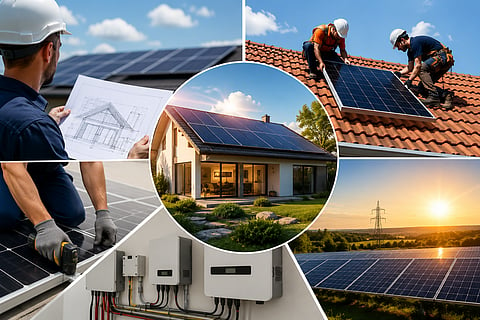
Whether you are looking to save money on your home electricity bill or secure reliable power for an industrial facility, here is exactly how a solar panel installation works, from the first site visit to the moment your lights switch on.
A solar system installation is the process of designing, mounting, wiring, testing, and commissioning a photovoltaic (PV) system that converts sunlight into electricity. Solar systems can be installed as:
Rooftop systems for homes and commercial buildings
Ground-mounted systems for large industrial and utility-scale projects
Floating solar systems on water bodies
Building-integrated photovoltaic (BIPV) systems
Depending on energy requirements, systems may be grid-tied, off-grid, or hybrid. Avaada Electro manages the entire process from design to installation of solar PV systems.
Installing a solar system involves several stages, from site assessment to final commissioning. Each step helps ensure safety, efficiency, and long-term performance.
Every solar installation starts with a site survey to evaluate roof condition, sunlight availability, shading, electrical infrastructure, and energy consumption. According to the Delhi Solar Portal, a 1-kilowatt solar plant installation requires 10 sqm, or approximately 100 sq feet, of area. As per this, a 3-kilowatt solar panel system would require around 30 sqm of area.
Based on the assessment, engineers determine system size and select the required components, including:
N-type TOPCon or bifacial solar modules
Inverters
Mounting structures
DC and AC cabling
Earthing and protection systems
High-wattage solutions such as Avaada Electro's N-Type TOPCon 720 Wp solar panels are helping homeowners generate more power with fewer panels, improving space utilization and overall system economics.
The mounting structure supports the entire solar array and is installed based on the roof type, location, and design specifications. It is necessary to ensure proper alignment, proper tilt-angle configuration, and waterproofing measures for long-term performance and structural durability.
Solar modules are secured to the mounting structure and connected using specialized connectors and cables. It is important to ensure that qualified professionals install grid-connected systems to ensure safety, regulatory compliance, and warranty protection.
The inverter converts the direct current generated by solar panels into alternating current used by electrical appliances. At this stage, technicians connect the inverter, complete the earthing arrangements, and install surge protection devices to safeguard the system against electrical faults and lightning strikes.
Grid-connected systems require multiple approvals from the local utility before they are approved for operation:
Net-metering application
Installation of a bi-directional meter
Utility inspection
Grid synchronization
Net metering allows consumers to export excess electricity and receive credits that help reduce future electricity bills.
Before activation, the system undergoes safety and performance checks, including insulation testing, polarity verification, and earth resistance measurement. Once approved, the system is commissioned and handed over, accompanied by warranty documentation and operating guidelines.
The cost of a solar installation depends on the system size, technology, and site requirements. Government incentives can significantly reduce the upfront investment for residential consumers.
Under the PM Surya Ghar: Muft Bijli Yojana, homeowners can receive a central subsidy of up to ₹78,000 for rooftop solar systems. In Delhi, an additional state subsidy of up to ₹30,000 is available, taking the total benefit to ₹1.08 Lakh for eligible systems.
Compliance supports safe operation and smooth utility approvals. Every PV panel installation should comply with applicable safety and quality standards, including:
BIS certification requirements
IEC standards for modules and inverters
Central Electricity Authority (CEA) regulations
Electrical grounding and protection requirements
Avaada Electro complies with the requested standards for its solar modules and system installations. Our equipment and processes align with these regulatory frameworks to ensure grid stability and safety.
Routine maintenance helps solar systems operate efficiently throughout their lifespan. Some of the recommended practices include:
Cleaning modules every 15–30 days based on local conditions
Monitoring energy generation
Inspecting electrical connections
Checking inverter performance
Conducting annual professional inspections
Most solar panels carry performance warranties of up to 25 years. They are designed to retain around a significant amount of their original output at the end of that period with proper maintenance.
Avaada Electro offers end-to-end support across the solar journey, from system design and installation to commissioning and post-installation assistance. Some of the key features include:
High-efficiency Made-in-India solar modules
Advanced bifacial and N-type TOPCon technologies
Integrated manufacturing ecosystem
BIS and IEC-compliant products
Assistance with subsidy and net-metering processes
A successful solar installation requires careful planning, quality components, and professional execution. From site assessment and system design to grid connection and commissioning, every stage contributes to reliable long-term performance and energy savings. With advanced module technologies and comprehensive project support, families and businesses can adopt solar power with ease.
Choose solar solutions built for long-term performance. Contact Avaada Electro today to get a certified site technical assessment and a personalized rooftop solar quote for your property.
Most Indian states have introduced net-metering policies that allow solar system owners to export surplus electricity to the grid and receive credits on their electricity bills. However, regulations, capacity limits, and approval procedures vary by state and local DISCOM, so it is advisable to verify the latest policy before proceeding with a solar installation.
The roof space required depends on the system size and panel efficiency. According to the Delhi Solar Portal, a rooftop solar system requires approximately 100 square feet of shadow-free space per kilowatt.
Solar panels continue generating electricity even during cloudy weather and monsoon seasons. Although energy production is lower than on bright sunny days, modern bifacial and N-Type TOPCon modules used by Avaada Electro can capture diffused sunlight and continue producing useful amounts of electricity.
Solar systems require regular maintenance every 15–30 days, monitoring energy generation, checking inverter alerts, and conducting annual inspections of electrical connections and earthing systems can help maintain efficiency and support long-term performance.
Batteries can be added to an existing solar system. If the system uses a hybrid inverter, battery integration is often straightforward. For systems with standard string inverters, additional equipment or inverter replacement may be necessary to enable energy storage capabilities.
Follow us on Google News




