
- News
- Women
- Magazine
- IndustryIndustry
- InsightsInsights
- Success Stories
- PublishPublish
- ContactContact
- Media KitMedia Kit

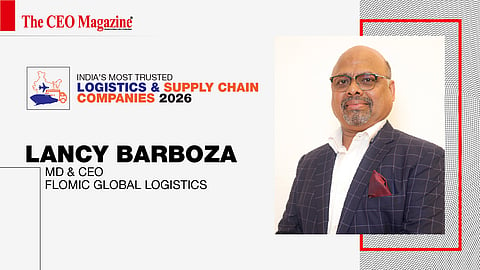
Lancy Barboza - Managing Director & CEO - Flomic Global Logistics

Freight volatility, infrastructure gaps, compliance complexities, and rapidly evolving customer expectations are reshaping the logistics industry at an unprecedented pace. As businesses demand faster, more flexible, and technology-driven supply chain solutions, logistics providers are being pushed to evolve beyond traditional operating models. Recognising this shift early on, Mr. Lancy Barboza has spent over three decades building Flomic Global Logistics into an integrated logistics platform with pan-India presence and global reach.
For Mr. Barboza, the journey into logistics began in Mangalore, a city that has long been a gateway for trade and commerce along India’s western coast. Recognising the importance of reliable logistics in enabling business growth, he founded Flomic in 1988 with a vision to build a company rooted in trust, service excellence, and long-term customer relationships.
Over the decades, he has guided the company through the industry’s transformation from paper-based documentation to technology-driven operations, steadily expanding Flomic’s capabilities across evolving logistics requirements.
“What has remained constant is our commitment to treating every shipment with the same seriousness, whether it is for a small enterprise or a multinational corporation.”
-Lancy Barboza
Founded in 1988 as a regional logistics operator in Mangalore, Flomic Global Logistics has steadily evolved over the past 38+ years into a diversified, asset-light logistics business serving customers across air, sea, land, and specialised logistics verticals. A major milestone in the company’s journey came in 2000 with its expansion into global freight forwarding, significantly broadening its service capabilities.
Between 2018 and 2020, the company further diversified into warehousing and event logistics, followed by its listing on the BSE Main Board in 2020, reflecting its focus on governance and transparency. From 2022 to 2024, Flomic strengthened its capabilities in courier services, transportation, and ERP-led digital transformation, while 2025 marked another significant phase with WCA Events and Projects registrations and the expansion of its workforce to over 500 professionals.
Today, Flomic offers end-to-end logistics and supply chain solutions across freight forwarding, transportation, warehousing, project cargo, and specialised logistics segments. The company operates through a network of 30 branches and 35+ warehouses spanning 13.8 lakh sq. ft., serving more than 5,000 active customers across domestic and international markets. Under the leadership of Mr. Barboza, the company continues to focus on strategic growth, operational discipline, and long-term value creation.
As the logistics industry continues to evolve, companies are navigating increasing operational complexity, shifting freight cycles, and rising customer expectations. “Our response to these challenges is built on three pillars: technology, network strength, and a diversified service portfolio,” says Mr. Barboza.
Flomic’s service portfolio today spans freight forwarding, warehousing, project cargo, event logistics, hazardous cargo handling, and specialised logistics solutions, enabling the company to cater to varied customer requirements while reducing dependence on any single freight segment or market cycle. Its pan-India branch network and global partner ecosystem further strengthen operational resilience and cross-border connectivity.
The company’s long-standing customer relationships and strong repeat business continue to reflect its focus on service consistency and reliability. Relationships with companies such as Sun Pharma, Piramal Pharma, Godrej, CEAT, and Essilor, along with global accreditations including IATA, WCA World, JCTrans, FIATA, and AEO certifications, further strengthen Flomic’s positioning within the industry.
Technology remains at the core of Flomic’s operational strategy. Through its proprietary cloud-based ERP platform, Logi-Sys, the company has integrated air freight, ocean freight, land transport, warehousing, customs broking, transportation, and financial accounting onto a single platform, creating greater operational visibility and coordination across functions.
The platform has enabled workflow automation and process standardisation across operations, contributing to nearly a 50% reduction in turnaround time. Real-time MIS, analytics, BI dashboards, and integrated CRM and billing modules further support faster decision-making, operational discipline, and improved customer service quality.
Flomic also follows standardised operational workflows to ensure consistency across shipments, helping reduce human error and improve predictability throughout the supply chain process.
According to Mr. Barboza, India’s logistics sector is entering a transformative phase driven by policy reforms, multimodal infrastructure development, growing e-commerce demand, and rising global trade diversification. As India strengthens its position as a manufacturing and export hub, organised logistics players are expected to benefit from expanding outsourcing opportunities and increasing EXIM volumes.
Adaptability continues to remain central to Flomic’s business model. The company is actively strengthening its warehousing capabilities, supported by a warehousing footprint of 13.8 lakh sq. ft. At the same time, Flomic is expanding across key logistics hubs in India and selected overseas markets to strengthen global connectivity and deepen its presence across the supply chain value chain.
The company is also scaling higher-margin segments such as warehousing, project logistics, and breakbulk operations while further expanding its CFS and air cargo capabilities. Alongside expansion, Flomic continues to invest in digital capabilities and infrastructure. “Our long-term vision is to be India’s most trusted technology-integrated logistics partner,” says Mr. Barboza. As part of the company’s broader succession planning, Alan Barboza has recently joined the business and is leading the International Business and People Management division, supporting Flomic’s next phase of growth.
For aspiring entrepreneurs and professionals entering the logistics industry, Mr. Barboza believes consistency, reliability, and long-term relationship building remain the foundation of sustainable growth. “Invest in technology early. Companies with strong digital infrastructure are the ones that scale most effectively. Technology is not a cost; it is the backbone of operational efficiency and customer trust,” he says.
He also believes service reliability remains critical in building customer trust. “The trust of a customer, built over years of consistent service, is your most valuable asset. Never compromise on delivery commitment.”
According to him, diversification, strong teams, and compliance are equally important in building a resilient business. “Dependence on a single freight segment makes you vulnerable to market cycles. An integrated service offering gives you resilience and more avenues for growth. At the same time, logistics is ultimately a people business. Invest in your team, build a strong culture, and the performance will follow.”
“Compliance is non-negotiable in this industry. Global accreditations and regulatory standing are trust signals that customers value deeply,” concludes Mr. Barboza.
Follow us on Google News