
- News
- Women
- Magazine
- IndustryIndustry
- InsightsInsights
- Success Stories
- PublishPublish
- ContactContact
- Media KitMedia Kit
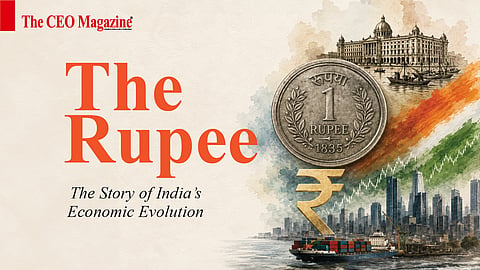
The Rupee: The Story of India's Economic Evolution

On most trading days, the Indian rupee moves only a few paise against the US dollar. These fluctuations rarely attract public attention. But whenever the currency approaches a new low, familiar questions return: Why is the rupee falling? Is India's economy weakening? Should we be worried?
The answers usually focus on immediate triggers. Rising crude oil prices, geopolitical tensions, foreign institutional investor (FII) outflows or a strengthening US dollar are often cited as the reasons behind the rupee's weakness. While these factors influence short-term movements, they do not explain why the currency remains vulnerable to external shocks.
A currency is more than a market price. It reflects decades of economic choices—what a country produces, what it imports, how competitive its industries are, how dependent it is on foreign capital and how deeply it is integrated into the global economy. In that sense, the exchange rate is less a daily statistic than a long-term reflection of a nation's economic evolution.
To understand why the rupee has steadily weakened despite India being one of the world's fastest-growing major economies, we must look beyond today's headlines. The story begins nearly two centuries ago, long before Independence and long before the US dollar became the centre of the global financial system.
Although the rupee existed in various forms for centuries, the modern currency took shape under the Coinage Act of 1835, when the British East India Company introduced a uniform silver-based currency across much of British India.
As the global monetary system evolved, that decision became increasingly significant. While major economies gradually adopted the gold standard, India remained tied to silver. When silver prices collapsed in the late nineteenth century, the rupee depreciated sharply against gold-backed currencies, highlighting an enduring reality: a currency's value is shaped not only by domestic conditions but also by changes in the international financial system.
Following the Second World War, the Bretton Woods Agreement established the US dollar as the anchor of the global monetary system. Independent India inherited a tightly managed exchange-rate regime in which the rupee was effectively linked to the British pound. Strict capital controls and government intervention provided stability during the country's early years, but they also concealed growing structural imbalances. Industrialisation increased the demand for imported machinery, technology and capital goods much faster than export earnings, making foreign exchange an increasingly scarce resource.
These pressures culminated on 6 June 1966, when India devalued the rupee by nearly 36.5%, from ₹4.76 to around ₹7.50 against the US dollar. Policymakers hoped that a weaker currency would improve export competitiveness while unlocking financial assistance from the World Bank and the International Monetary Fund.
The outcome was disappointing. India's industrial base lacked the capacity to respond quickly, imports became more expensive and inflation accelerated. The episode demonstrated a lesson that remains relevant today: exchange-rate adjustments alone cannot strengthen an economy. A weaker currency can support exports only when productive capacity, competitiveness and global demand already exist.
The collapse of the Bretton Woods system in the early 1970s gradually pushed India towards a more flexible exchange-rate framework. At the same time, the global oil shocks of 1973 and 1979 exposed another structural challenge. As India's dependence on imported crude oil increased, every surge in oil prices raised demand for US dollars, widening the current account deficit and placing sustained pressure on the rupee—a relationship that continues to influence the currency today.
If one event fundamentally changed the rupee's future, it was the balance-of-payments crisis of 1991.
Years of fiscal deficits, weak export growth, rising oil prices and persistent external imbalances pushed India to the brink of default. Foreign exchange reserves had fallen to levels sufficient to finance only a few weeks of imports, forcing the government to pledge gold to secure emergency funding.
The crisis triggered sweeping economic reforms under Prime Minister P. V. Narasimha Rao and Finance Minister Dr. Manmohan Singh. Trade was liberalised, industrial licensing dismantled, foreign investment encouraged and the economy gradually opened to global markets.
Equally significant was the transformation of the exchange-rate regime. Through the Liberalised Exchange Rate Management System (LERMS) in 1992 and the adoption of a unified market-determined exchange rate in 1993, India moved away from administratively fixing the rupee. Market forces began playing the central role in determining its value, while the Reserve Bank of India shifted its focus towards managing excessive volatility rather than defending a predetermined exchange rate—a framework that continues today.
Liberalisation fundamentally changed what the rupee represented.
Before the 1990s, the exchange rate largely reflected government policy. Today, it responds to the combined influence of exports and imports, capital flows, commodity prices, global interest rates, investor sentiment and geopolitical events. The rupee has become a real-time indicator of India's interaction with the global economy rather than simply a policy instrument.
This explains why today's debate extends far beyond crude oil prices or portfolio outflows. India's macroeconomic fundamentals remain relatively strong, supported by robust growth, resilient services exports and substantial foreign exchange reserves. Yet the economy continues to depend on external capital while remaining exposed to imported energy and global financial conditions.
The story of the rupee, therefore, is not simply about whether the currency rises or falls. It is about how the structure of the Indian economy has evolved over nearly two centuries—and why that evolution continues to shape its place in the global financial system.
"Markets rarely predict the future perfectly. But they often recognise structural weaknesses long before governments are willing to acknowledge them."
If exchange rates simply reflected economic growth, India's currency should have been among the strongest in the world.
Over the past three decades, India has undergone a remarkable transformation. It has emerged as a global technology powerhouse, built one of the world's most advanced digital public infrastructures, expanded its physical infrastructure and consistently ranked among the fastest-growing major economies. Institutions including the IMF, the World Bank and the OECD expect India to remain one of the principal drivers of global growth in the years ahead.
Yet the foreign exchange market tells a more nuanced story.
While the economy has grown larger, the rupee has gradually weakened against the US dollar. The depreciation has not been dramatic, but it has been persistent, interrupted by periods of heightened volatility during events such as the Asian financial crisis, the global financial crisis, the 2013 "taper tantrum", the pandemic and more recent geopolitical conflicts. Each episode revives familiar explanations—higher oil prices, capital outflows or a stronger dollar—before the debate fades until the next bout of weakness.
If the same reasons keep returning, however, they are probably symptoms rather than the underlying cause.
One of the biggest misconceptions in public discourse is that a currency is a report card on an economy. In reality, exchange rates measure something much narrower—and far more revealing. They reflect an economy's ability to earn foreign currency relative to how much foreign currency it needs.
Consider two economies growing at the same pace. One exports advanced machinery, semiconductors and industrial equipment, consistently generating more foreign exchange than it spends. The other relies primarily on domestic consumption while importing energy, technology and capital goods, exporting comparatively fewer high-value products. Both may post similar GDP growth, yet their currencies are unlikely to perform in the same way because the source of that growth is fundamentally different.
GDP is measured in domestic currency. Exchange rates are determined in international markets. The two are related, but they are not the same.
India illustrates this distinction particularly well. Much of its post-liberalisation growth has been driven by rising incomes, urbanisation, digitalisation, infrastructure investment and private consumption, creating one of the world's most dynamic domestic markets. But sustaining that growth also requires importing energy, advanced technology, machinery and industrial inputs while earning sufficient foreign exchange through exports, services, remittances and investment.
The exchange rate is therefore best understood as the price of external balance. Every crude oil shipment, semiconductor import or industrial machine increases demand for dollars. Every software export, pharmaceutical shipment or remittance adds to their supply. The value of the rupee ultimately reflects the balance between these opposing forces.
This also explains why the stock market and the currency often tell different stories. Indian equities can reach record highs even as the rupee weakens because they measure different aspects of the economy. Equity investors focus on corporate profitability and future earnings, whereas currency markets assess whether the economy is generating enough internationally accepted purchasing power to meet its external obligations.
Nor should depreciation always be viewed as evidence of economic decline. Several export-oriented economies, including Japan, South Korea and China, have at different stages benefited from relatively weaker currencies that supported manufacturing competitiveness. The distinction lies between a currency that weakens as part of an export-led strategy and one that reflects persistent imbalances between an economy's demand for foreign currency and its capacity to generate it.
India's exchange-rate framework increasingly reflects the latter reality. Rather than defending a fixed value, the Reserve Bank of India generally allows the rupee to adjust gradually while intervening to prevent excessive volatility. The currency has therefore become less a policy target and more a reflection of the country's underlying external position.
The foreign exchange market, in other words, is not passing judgement on a single government decision or global event. It is continuously evaluating the structure of the Indian economy.
That structure reveals a defining contradiction. India has become exceptionally successful at creating wealth within its borders, but it has been less successful at generating foreign exchange at the same pace as its growing external requirements.
Understanding that imbalance requires looking beyond economic growth itself and following the path of every dollar that enters—and every dollar that leaves—the country. That is where the story of the rupee truly begins.
"Every economy has two balance sheets. One is written in its own currency. The other is written in someone else's."
The Indian economy conducts almost all its daily business in rupees. Salaries are paid in rupees, taxes are collected in rupees and businesses operate largely in the domestic currency. But the moment India steps into the global marketplace, the rules change. Crude oil from Saudi Arabia, semiconductor equipment from the Netherlands, aircraft from the United States and precision machinery from Germany are purchased largely in US dollars. International trade still runs overwhelmingly on the dollar, making foreign exchange the currency of global commerce.
This distinction is rarely visible in everyday life, yet it lies at the heart of the rupee's behaviour. Every import creates demand for dollars, while every export, remittance or foreign investment adds to their supply. The exchange rate is determined by the balance between these two forces.
India's external economy is unusual because it generates enormous amounts of foreign exchange while simultaneously requiring enormous amounts to sustain its growth. The story of the rupee is therefore one of constant balancing.
The most visible source of foreign exchange is merchandise exports. Engineering goods, pharmaceuticals, petroleum products, chemicals, automobiles, textiles and electronics generate hundreds of billions of dollars every year.
Increasingly, however, India's greatest strength lies in services exports. Software development, business process management, engineering, consulting, financial services and Global Capability Centres have made India one of the world's largest exporters of professional services. Unlike manufactured goods, these exports travel through fibre-optic cables rather than shipping lanes, generating a substantial surplus that offsets a significant part of the merchandise trade deficit.
Remittances form another important pillar. Millions of Indians working overseas send money home each year, making India the world's largest recipient of inward remittances. Unlike financial investments, these inflows are relatively stable and provide an important cushion during periods of global uncertainty.
The fourth source is foreign investment, though not all investment behaves in the same way. Foreign Direct Investment (FDI) creates factories, research centres and productive assets, reflecting long-term confidence in the economy. Foreign Portfolio Investment (FPI), by contrast, is far more mobile, responding quickly to changes in global sentiment and financial conditions.
Together, exports, services, remittances and investment provide India with one of the most diversified sources of foreign exchange among emerging economies.
Earning dollars, however, is only half the equation.
India's import bill reflects the needs of a rapidly modernising economy. Crude oil remains the largest component, but the country also imports advanced machinery, electronic components, semiconductor equipment, fertilisers, defence equipment, medical technology and gold. As incomes rise, overseas travel and foreign education create additional demand for foreign currency.
This creates one of the central paradoxes of India's growth story.
A faster-growing economy often becomes a larger importer.
New factories require imported machinery before they can begin producing. Renewable energy projects depend on sophisticated equipment sourced from global supply chains. Electronics manufacturing relies on advanced components that are still largely imported. Growth therefore increases both the ability to earn foreign exchange and the need to spend it. Whether the rupee strengthens or weakens depends on which side expands faster.
An equally important distinction lies between exporting products and exporting value.
A smartphone assembled in India may be counted as an export, but many of its most valuable components—the processor, display, camera sensors and manufacturing equipment—are imported. Much of the economic value has already been created elsewhere before the finished product leaves an Indian port.
This is not unique to India. Modern manufacturing operates through global value chains. The difference is that economies such as South Korea and Taiwan gradually moved beyond assembly into higher-value activities such as semiconductor fabrication, advanced materials and precision engineering, allowing them to retain a much larger share of export earnings. India has made significant progress in electronics manufacturing, but increasing domestic value addition remains one of its most important long-term challenges.
Ultimately, exchange rates respond not to the gross value of exports but to the foreign exchange retained after accounting for imported inputs. In an increasingly interconnected world, competitiveness depends not only on producing more, but also on creating more of the value embedded within what is produced.
That shift—from participating in global value chains to capturing a larger share of their value—will increasingly determine both India's external resilience and the long-term trajectory of the rupee.
"Every era rewards a different economic strength. The question facing India is whether the world has begun rewarding a different kind of economy."
For much of the past three decades, India's economic rise mirrored the direction of globalisation. As companies in North America and Europe searched for lower costs and larger talent pools, India offered a compelling combination of skilled English-speaking professionals, competitive costs and a rapidly expanding technology sector. Software development, business process management, engineering services, consulting and financial analytics evolved into globally competitive industries, making services exports one of India's strongest sources of foreign exchange.
Unlike East Asian economies that integrated into the global economy through manufacturing, India built its global presence through knowledge-based services. It was a model that generated growth, employment and foreign exchange without requiring the vast industrial base that powered countries such as China, South Korea or Taiwan.
For nearly three decades, that model served India exceptionally well.
But globalisation has entered a new phase.
Artificial intelligence, semiconductors, advanced manufacturing, supply-chain resilience and geopolitical competition are reshaping the global economy. Increasingly, countries are competing not merely to participate in global value chains but to control their most valuable segments. Investors are placing a premium on economies that own critical technologies, intellectual property and specialised manufacturing capabilities rather than those that primarily provide skilled labour.
This shift has altered the geography of economic power. The United States dominates much of the world's chip design, cloud infrastructure and frontier AI development. Taiwan leads advanced semiconductor manufacturing, South Korea remains a global leader in memory chips, while the Netherlands occupies a strategic position through lithography technology essential to semiconductor production. Their advantage lies not simply in manufacturing products but in controlling technologies that the rest of the world depends upon.
India enters this landscape with significant strengths of its own. Its software industry continues to evolve, Global Capability Centres have become centres for engineering, product development and artificial intelligence, and the country possesses one of the world's deepest pools of technology talent. Yet participation in these industries is not the same as controlling them.
The distinction matters because the greatest value in today's economy increasingly accrues to those who design technologies, own intellectual property and develop indispensable industrial capabilities. Manufacturing remains important, but long-term competitiveness depends just as much on innovation, research and technological leadership.
For India, this represents both the next opportunity and the next challenge.
The country has already demonstrated that it can become an indispensable provider of global digital services. The next stage of development will depend on strengthening capabilities in advanced manufacturing, semiconductor design, deep technology, research and high-value engineering while increasing the share of value retained within the domestic economy.
This transition is already underway. Production Linked Incentive (PLI) schemes, semiconductor initiatives, defence manufacturing, renewable energy investments and the expansion of Global Capability Centres reflect a broader effort to strengthen India's position in higher-value segments of the global economy. The objective is no longer simply to produce more, but to create more of the value embedded within what the country produces.
That distinction extends far beyond industrial policy. Economies that generate higher-value exports, own globally competitive technologies and attract long-term investment tend to build stronger external positions over time. Their currencies increasingly reflect productive strength rather than short-term movements in commodity prices or financial markets.
The first phase of globalisation rewarded countries that supplied skilled labour to the world. The next phase is increasingly rewarding those that create the technologies, intellectual property and industrial capabilities the world cannot easily replace.
India has already proved that it can participate successfully in the global economy.
The defining challenge of the next two decades is whether it can help shape it.
"Trade built the modern global economy. Capital now decides who prospers within it."
For centuries, a nation's external strength was determined largely by the balance between its exports and imports. Countries that consistently sold more to the world than they bought accumulated wealth, while exchange rates broadly reflected those trade balances.
That relationship still matters, but it is no longer the whole story.
Over the past four decades, global finance has transformed the international economy. Every day, trillions of dollars move across borders—not because goods are being traded, but because investors, pension funds, multinational corporations and central banks are constantly reallocating capital. As a result, currencies today respond not only to trade, but also to the movement of global money.
For emerging economies such as India, this has fundamentally changed the meaning of external stability. Financing imports and sustaining growth depend not only on export earnings but also on the ability to attract and retain international capital. A country can run trade deficits for years if investors remain confident. Conversely, even manageable external imbalances can become difficult when global capital begins to leave.
Not all capital, however, behaves in the same way.
Foreign Direct Investment (FDI) reflects long-term confidence by creating factories, research centres and productive assets. Foreign Portfolio Investment (FPI), in contrast, is highly mobile. Investors buying shares or bonds can reduce their exposure within hours as global conditions change. The same capital that strengthens the rupee during periods of optimism can amplify its weakness when uncertainty rises.
India's experience since liberalisation illustrates this clearly. Portfolio inflows have deepened financial markets, improved liquidity and helped finance growth. But they have also increased periods of volatility. During the global financial crisis, the 2013 "taper tantrum", the pandemic and more recent geopolitical tensions, foreign investors reduced exposure to emerging markets, increasing demand for dollars and placing pressure on the rupee.
The first half of 2026 provided another reminder. Foreign investors withdrew billions of dollars from Indian equities as higher oil prices, geopolitical uncertainty and a stronger US dollar reshaped global investment flows.
Such movements are often interpreted as a loss of confidence in India. In reality, capital usually responds to relative opportunity rather than absolute performance.
An international fund manager is rarely deciding whether India is a good economy. The more relevant question is whether another market currently offers better risk-adjusted returns. If technology companies in another country or safer dollar-denominated assets appear more attractive, capital naturally shifts. These decisions often reflect changing global preferences rather than a negative assessment of India itself.
This is why currencies increasingly reflect expectations about the future as much as economic conditions today. Investors allocate capital not only according to current growth but also according to where they believe future productivity, innovation and profitability will emerge.
At the same time, India's financial markets have become more resilient. Even during periods of significant foreign selling, domestic institutions and retail investors have continued investing steadily through mutual funds and systematic investment plans, reducing the stock market's dependence on overseas portfolio flows.
That resilience, however, has its limits.
Domestic investors can provide liquidity to financial markets, but they cannot generate the foreign exchange required to pay for imported energy, advanced technology or external obligations. Ultimately, only exports, remittances and long-term foreign investment strengthen the country's external balance.
The challenge, therefore, is no longer simply attracting capital. It is building an economy that consistently attracts long-term investment because of its productive strength, technological capability and global competitiveness.
In the twenty-first century, the value of a currency depends not only on what an economy produces today, but also on what the world believes it will become.
"Central banks influence currencies. They rarely control them."
Whenever the rupee approaches a record low, a familiar question resurfaces: Why doesn't the Reserve Bank of India simply stop the currency from falling?
It is an understandable assumption. The RBI manages one of the world's largest foreign exchange reserve portfolios, regulates the banking system, sets monetary policy and safeguards financial stability. Yet the role of a modern central bank is often misunderstood.
The RBI does not exist to maintain a particular exchange rate. Its objective is to preserve monetary and financial stability. While it can smooth volatility, discourage speculative attacks and ensure orderly market conditions, it cannot indefinitely hold a currency at a level that is inconsistent with economic fundamentals.
History offers plenty of examples. Britain abandoned its defence of the pound during the 1992 Exchange Rate Mechanism crisis. Several Asian economies exhausted foreign exchange reserves during the 1997 financial crisis trying to defend fixed exchange rates. More recently, countries such as Argentina and Turkey have shown that intervention alone cannot offset persistent inflation, external imbalances or declining investor confidence.
India adopted a different approach after the balance-of-payments crisis of 1991.
Instead of fixing the rupee, it moved to a managed float. Under this framework, market forces determine the currency's broad direction, while the RBI intervenes selectively to prevent excessive volatility or disorderly movements. The emphasis is on maintaining stability, not defending a predetermined value.
This distinction is important.
If the rupee moves so sharply that importers struggle to price contracts, exporters cannot hedge revenues or financial markets become unsettled, the RBI steps in. But when the currency adjusts gradually to changes in oil prices, trade balances or capital flows, intervention is generally limited. The objective is to ensure an orderly adjustment rather than resist it.
India's foreign exchange reserves play a central role in this strategy.
They are not maintained to defend a fixed exchange rate. Instead, they reassure investors, support import financing during periods of stress and give the RBI the flexibility to intervene when markets become excessively volatile.
A useful analogy is a reservoir during a drought. It can ease temporary shortages, but it cannot solve a long-term problem if inflows remain inadequate. Foreign exchange reserves work in much the same way. Selling dollars may reduce immediate pressure on the rupee, but unless exports strengthen, imports become less dependent on foreign currency or capital inflows improve, the underlying demand for dollars eventually returns.
Intervention, therefore, buys time. It does not change economic fundamentals.
This makes currency management one of the most delicate tasks in economic policymaking. Intervening too aggressively can encourage speculation and erode reserves, while intervening too little can unsettle markets. Every decision also interacts with inflation, interest rates and domestic liquidity, requiring the RBI to balance multiple objectives simultaneously.
The challenge becomes even greater in an interconnected global economy. Rising US interest rates, for example, often strengthen the dollar and draw capital away from emerging markets. Raising Indian interest rates to defend the rupee could slow depreciation, but it might also reduce investment and weaken economic growth.
The RBI therefore focuses less on defending a number and more on maintaining credibility through consistent and predictable policy. Over the past three decades, this approach has helped India avoid the repeated currency crises experienced by many emerging economies while allowing the rupee to adjust gradually to changing economic conditions.
But no central bank can create lasting currency strength on its own.
Over the long term, a stronger rupee depends on an economy that exports more competitively, attracts stable investment, reduces structural external vulnerabilities and builds greater technological and industrial capability.
The RBI can manage volatility.
It cannot determine the long-term direction of the currency.
That responsibility rests with the economy itself.
"Currencies do not decide a nation's future. They reveal the consequences of the choices that shape it."
Every generation inherits a different economic challenge.
For the generation that led India through Independence, the priority was nation-building. Institutions had to be created, industries established and a fragmented economy brought under a common framework. The decades that followed were defined by self-reliance and economic stability. By the early 1990s, the challenge had become survival. The balance-of-payments crisis forced India to abandon an inward-looking model and embrace liberalisation, fundamentally reshaping its relationship with the global economy.
The three decades since have transformed India into one of the world's fastest-growing major economies. Its companies compete globally across information technology, pharmaceuticals, financial services and automotive components. Public digital infrastructure, modern highways, ports and logistics networks have expanded the country's productive capacity, while the ambition of becoming a developed nation by 2047 reflects a confidence that would once have seemed unimaginable.
Yet every stage of development creates new demands.
A larger economy consumes more energy, imports more advanced technology and competes in increasingly sophisticated global markets. Growth expands opportunity, but it also deepens integration with the world economy. As a result, the strength of a currency depends not only on domestic success but also on how effectively an economy creates internationally valued goods, services and technologies.
This is where the story of the rupee is often misunderstood.
The currency is frequently discussed as though it were the problem itself. In reality, it is the outcome of deeper economic forces. Every movement in the exchange rate reflects countless decisions made across factories, laboratories, universities, businesses and government institutions. It measures how effectively India converts domestic growth into sustainable external strength.
The challenge before India is therefore larger than managing the rupee.
It is about building an economy that creates greater value through technology, innovation, advanced manufacturing and globally competitive enterprises. The countries that strengthened their currencies over time did so because they became indispensable to the global economy. Their productive capabilities, technological leadership and export competitiveness created the foundations upon which stronger currencies eventually rested.
India's journey will follow its own path.
Its vast domestic market, entrepreneurial ecosystem, digital public infrastructure and globally competitive services sector provide advantages that few countries possess. The next phase of development will depend on complementing those strengths with greater technological capability, deeper manufacturing ecosystems, stronger research and innovation, and higher domestic value addition.
Success should therefore be measured not by whether the rupee reaches a particular exchange rate, but by whether the economy becomes more resilient, more productive and more competitive over time. A country that consistently earns foreign exchange through innovation, exports and long-term investment gains something far more valuable than a stronger currency—it gains greater economic freedom.
That is why the debate surrounding the rupee is ultimately a debate about India's future.
The exchange rate will continue to fluctuate with oil prices, capital flows, geopolitical events and global financial conditions. Those movements will always matter. But they should not distract from the larger structural question that has run through this story from the very beginning.
The answer will not be determined by tomorrow's exchange-rate movement. It will emerge over years through investments in education, science, infrastructure, entrepreneurship, manufacturing and institutions.
The story of the rupee, then, has never really been about the rupee.
It is the story of a nation that has learned how to build one of the world's largest economies—and now faces the more demanding challenge of building one of the world's most competitive ones.
India has already mastered the first task.
The second has only just begun.
Follow us on Google News




