
- News
- Women
- Magazine
- IndustryIndustry
- InsightsInsights
- Success Stories
- PublishPublish
- ContactContact
- Media KitMedia Kit

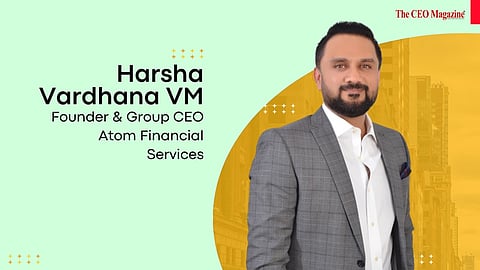
As India prepares for a historic wave of intergenerational wealth transfer, the focus is shifting from simply creating wealth to preserving it across generations. The CEO Magazine (TCM) spoke with Harsha Vardhana VM, Founder & Group CEO, Atom Financial Services, about why succession planning, governance, and relationship-driven advisory will define the future of wealth management in India.
Harsha Vardhana: India is entering a period where an estimated US$1.3–1.5 trillion of wealth is expected to change hands by 2030, and that is changing the expectations placed on advisors. The conversation is gradually moving beyond investment performance to continuity, governance and long-term decision-making.
Many affluent families today have investments, operating businesses, global assets and multiple generations involved in financial decisions. Advising one individual is often no longer enough. Increasingly, advisors are expected to facilitate conversations across the family, help align differing perspectives, and ensure that financial decisions support broader family objectives.
The challenge is not simply preserving wealth but helping families navigate transition in a structured and thoughtful manner. As wealth becomes more complex, advisory naturally becomes more interconnected.
Harsha Vardhana: The shift is real, but it is not happening evenly across the board. For generations, Indian business families ran on informal, trust-based arrangements, where continuity was something everyone assumed would work itself out rather than something anyone actually planned for. That assumption is starting to crack under its own weight as families get bigger, wealth spreads across countries and asset types, and more people end up with a say in decisions.
What has genuinely changed is timing. Transition planning used to be something families dealt with later, almost reluctantly. Now it is happening earlier, and often deliberately. India already has over 300 professionally structured family offices, and that number alone says something. Wealth transition has stopped being an afterthought and started becoming a discipline that families actually invest in.
Some of that push is coming from the younger generation itself. As they get more involved in investment decisions, they are asking sharper questions about governance, about timelines, and about who actually holds what authority. Those questions tend to force conversations that the older generation would probably have preferred to delay a bit longer.
Still, this is not universal. The shift is concentrated among the wealthiest, most sophisticated families who have the resources and exposure to think this way. For a large chunk of India's affluent population, wealth creation still comes first. Transition planning tends to become urgent only when something forces it, a health scare, an unexpected gap in leadership, or something that makes waiting no longer an option.
Harsha Vardhana: The most common mistake is silence. Families put off the conversation about transition until something forces their hand, such as an illness, a sudden death, or a business crisis, and by then, decisions get made in a hurry rather than with any real thought. The second mistake is treating wealth transfer as if it were purely a legal or tax exercise. Documentation matters, sure, but plenty of families get the trust structures and estate instruments right while completely ignoring the relational side of things. The paperwork holds up fine. The family does not.
The third mistake, and probably the one that gets underestimated the most, is leaving the next generation out of the process entirely. When an advisor only ever builds a relationship with the person who created the wealth and never bothers with the children or grandchildren who will eventually inherit it, the numbers tell you exactly what happens next. Roughly 55% of next-generation heirs globally say they plan to move away from their parents' advisor once they inherit. Some estimates put actual retention even lower, closer to one in three heirs staying with the family's original advisor at all. That is not a coincidence. That is what happens when the relationship is built with one person instead of the whole family.
The families who get this right tend to start years before any transfer is actually imminent. They treat it as something ongoing, not a single event you tick off a checklist once and move on from.
Harsha Vardhana: The difference here is structural, not just a matter of style. The generation that built the wealth leaned heavily on capital preservation, real estate, gold, and blue-chip stocks held for years without much fuss. The next generation sees volatility differently. They are far more comfortable with it and tend to treat it as something to lean into rather than something to avoid.
In India, more than half of family offices now have millennial or Gen Z members sitting at the table for investment decisions, and a good chunk of them are putting money into startups, particularly in health tech, fintech and AI, instead of the real estate and gold their parents always defaulted to.
There is also a real difference in how they think about diversification. The older generation mostly stayed within domestic asset classes. Younger heirs are much more at ease with global exposure, private markets, and instruments that simply did not exist in any meaningful way when their parents were building this wealth in the first place. This is not just about risk appetite. It comes down to a different relationship with information and access, tools that let them evaluate opportunities their parents never had a real shot at as individual investors.
Harsha Vardhana: Wealth rarely survives across generations because of documentation alone. It endures when the next generation understands not only what they have inherited but also how that wealth was created, why certain decisions were made, and what the family hopes it will achieve in the future.
Financial education and value alignment are, therefore, just as important as legal structures. Research consistently shows that advisors who retain relationships across generations are rarely those who focus only on investment performance. They are the ones who invest time in educating, engaging and building trust with the wider family long before wealth changes hands.
Equally important is open communication. Families need to have honest conversations about the purpose of their wealth – whether it is to support the business, preserve a legacy, enable philanthropy or provide financial independence. When those expectations remain unspoken, differences often surface only during a transition, when decisions are at their most emotional and difficult. Starting those conversations early gives families the best chance of preserving both their wealth and their relationships.
Harsha Vardhana: The conversation families put off the most is the one about roles. Everyone just assumes ownership, management, and decision-making will sort themselves out eventually. They almost never do. Only 15 to 21% of Indian family businesses actually have a documented succession plan, which is a big reason for 70% not making it past the second generation and only 13% reaching the third.
Three questions need to be pulled apart early: who owns the equity, who runs things day to day, and who gets final say on the big calls. These do not have to sit with the same person. Mixing them up is where most of the friction starts.
There is a second conversation families skip just as often: about the kids who do not want to join the business at all. HSBC's 2025 study found that while 88% of business owners trust their children with the family's wealth, only 7% of heirs feel a strong obligation to take over the business. That's a reality families have to acknowledge. Not every successor wants to be an operator, and that's perfectly fine. Good succession planning should create options for those who want to lead the business as well as those who would rather remain owners.
We're already seeing many families monetise the business and bring in professional management, while the next generation focuses more on ownership and capital allocation than day-to-day operations. That's a perfectly valid path, but it only works if families are honest about what the next generation actually wants. Not every heir wants to run the business, and succession plans need to reflect that reality rather than assume otherwise.
There isn't a single formula that works for every family. The important thing is to have these conversations early, while there is time to align expectations and make thoughtful decisions, rather than waiting until circumstances force them.
Harsha Vardhana: I don't think this is really a choice between preserving a legacy and embracing new ideas. The families that manage this transition well recognise that different parts of the portfolio can serve different purposes.
The family's core wealth, which underpins long-term financial security and continuity, should continue to be managed with discipline and a long-term perspective. At the same time, there should be room for the next generation to explore opportunities they feel strongly about, whether that is startups, global investments or private markets.
Investment decisions rarely exist in isolation. They are closely linked to the family's business interests, long-term objectives and the legacy they hope to create. The advisor's role is to bring those different considerations together, rather than looking at each decision independently.
That approach gives the next generation meaningful participation without putting the family's long-term objectives at unnecessary risk. It also changes the conversation from deciding whose investment philosophy is right to building a portfolio that reflects the priorities of both generations.
Ultimately, the advisor's role is not to take sides. It is to help families build a framework that respects what has already been created while giving the next generation the confidence and flexibility to shape what comes next.
Harsha Vardhana: We've created wealth in India much faster than we've planned for its transition. Estate planning is still underpenetrated because many families continue to see succession as a legal process rather than an ongoing strategic conversation. In reality, ownership, governance, investments and family expectations are all connected, and planning is far more effective when those discussions happen together.
The first step is simply getting the basics right. Wills, trusts and shareholder agreements should reflect the family's current realities, not the circumstances that existed ten or fifteen years ago when they were first drafted. As families grow, businesses evolve, and assets become more global, those documents need to evolve as well.
The second is governance. Once multiple generations are involved, families benefit from having a clear framework for how decisions are made, how disagreements are resolved and how future generations are brought into the process. Those conversations are much easier to have before a transition than during one.
Finally, families should work with advisors who can see the bigger picture, particularly where businesses, investments or family members span multiple jurisdictions. Succession is not a one-time event. It is an ongoing process that should evolve alongside the family, adapting to changing circumstances, aspirations and future generations.
Harsha Vardhana: That shift is already underway. As wealth passes from one generation to the next, the role of the advisor is naturally expanding beyond managing portfolios to helping families navigate continuity, governance and long-term decision-making.
Research consistently shows that advisors who retain relationships across generations are rarely those who focus only on investment performance. They are the ones who invest time in educating, engaging and building trust with the wider family long before wealth changes hands. By contrast, where the relationship is built solely with the wealth creator, continuity often becomes far more difficult after a generational transition.
Increasingly, good advisory is about connecting the dots. Families no longer make financial decisions in isolation. An investment decision may influence succession planning, a business expansion could reshape ownership structures, and a liquidity event might change a family's long-term priorities. Advisors are expected to understand those connections and help families make decisions with the bigger picture in mind.
That is why wealth management is moving beyond transactions towards long-term relationships. The firms that will remain relevant are not necessarily those offering the widest range of products but those that can guide families through important decisions across generations with context, continuity and perspective.
Harsha Vardhana: I think the next decade will be defined by the increasing professionalisation of family wealth. As businesses grow larger and families become more geographically dispersed, informal arrangements will increasingly give way to structured governance, dedicated family offices and more deliberate succession planning. We are already seeing that shift, with over 300 professionally managed family offices in India overseeing more than US$30 billion in assets.
A second trend will be the gradual separation of ownership from management. More business families are recognising that preserving ownership does not necessarily mean managing the business day to day. Professional leadership, combined with family oversight and capital allocation, is likely to become a far more common model.
The next generation will also have a much greater influence on investment decisions. They are bringing a more global perspective, greater comfort with technology and private markets, and different expectations around how capital should be deployed. The challenge for families will be balancing that fresh perspective with the discipline that helped create the wealth in the first place.
More broadly, I think we'll see a shift from managing individual financial decisions to connecting the dots between them. Investments, business ownership, succession, governance and legacy will increasingly be viewed as part of the same conversation rather than separate ones. The families that embrace that way of thinking early will be better positioned to preserve not just their wealth, but the continuity and purpose behind it.
Follow us on Google News
