
- News
- Women
- Magazine
- IndustryIndustry
- InsightsInsights
- Success Stories
- PublishPublish
- ContactContact
- Media KitMedia Kit


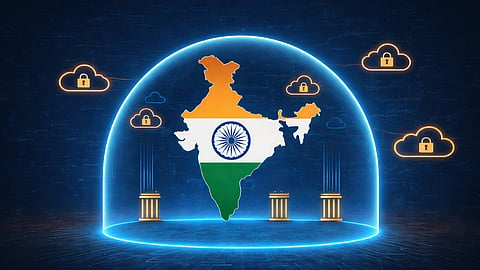
As India accelerates its digital transformation, data sovereignty has become a central priority for the government, regulators, and enterprises. With millions of citizens and businesses moving online, cloud-native adoption is expanding rapidly. The Digital Personal Data Protection (DPDP) Act, 2023 marks a landmark in India’s data governance framework, placing explicit accountability on organizations to protect personal data, ensure transparency, and align digital operations with India’s sovereign legal standards.
This evolving regulatory landscape is reshaping enterprise strategies across cloud computing, data storage, AI infrastructure, and compliance. For growing enterprises and MSMEs, data sovereignty is no longer a technical preference—it is a strategic imperative. At the Hindustan Times Leadership Summit 2025, Prime Minister Narendra Modi emphasized that India’s confidence to “transform tomorrow” is built on the strong digital foundations being laid today, with ongoing reforms paving the way for the next phase of India’s digital transformation.
Why is Data Sovereignty Important for India's Digital Economy?
Data sovereignty is increasingly critical in India, ensuring that sensitive data generated within the country is stored, processed, and governed under Indian laws. With sectors such as fintech, banking, healthcare, and defense relying heavily on cloud infrastructure, data sovereignty addresses key challenges:
National security & digital autonomy
Regulatory compliance
Enterprise data privacy
AI readiness & trustworthy innovation
Consumer confidence in digital services
The Prime Minister emphasized that progress is visible across sectors, with India maintaining steady momentum, a clear direction, and a “Nation First” approach. Key areas highlighted include defense manufacturing, solar energy, semiconductors, shipbuilding, as well as startups and MSMEs, particularly in eastern India.
MSMEs are increasingly seeking secure, enterprise-grade cloud infrastructure compliant with the DPDP Act. This has fueled interest in sovereign cloud adoption, including private cloud hosting, cloud disaster recovery, and compliance-focused cloud services for regulated industries.
The Role of Indian Cloud Providers in Strengthening Sovereignty
As businesses evaluate long-term digital strategies, the need for India-based cloud partners has become more prominent. Cloud providers are capable of offering low-latency cloud, multi-tenant public cloud, and enterprise cloud managed services are now central to enterprise digital planning.
Speaking on this, Padma Reddy Sama, Co-founder of BharathCloud, comments, "As the Prime Minister highlighted, India’s journey today is not just about development but a shift in mindset—a psychological renaissance. Sovereign cloud is no longer optional. With the DPDP Act, organizations seek cloud solutions that keep data within India while delivering international-grade performance. The future of trust hinges on data sovereignty and the security with which it is managed."
Cloud providers like BharathCloud are strengthening India's digital resilience through services such as GPUs, AI, cloud SOC as a service, cloud security services, and highly available cloud backup and recovery environments. Their community clouds, like community cloud for healthcare and secure cloud for accounting firms, support industries related compliance in sectors while following strict regulatory needs.
AI Growth Depends on Sovereign Cloud Infrastructure
It is India's ambition to become an AI-driven Economy, which needs sovereignty, scalability, and cloud infrastructure. AI transformation in India is dependent heavily on domestic providers to get:
GPU cloud for AI training
GPU for ML training
On-demand GPU compute
Render farm cloud
Regional GPU infrastructure
Edge AI cloud
These capabilities allow startups, enterprises, and research institutions to train models without exporting sensitive datasets abroad.
Rahul Takkallapally, Co-Founder of BharathCloud, emphasizes on AI-sovereignty connection, “If India wants to lead in AI, we must build AI infrastructure within our borders. Our goal at BharathCloud is to democratize AI infrastructure so that even the smallest companies have access to GPUs, sovereign data storage, and secure computers without depending on overseas platforms.”
BharathCloud's BharathAI platform and GPU-powered environments help enterprises move forward in innovation while still remaining compliant with the DPDP Act and sectoral guidelines.
Sovereignty, Compliance & the Future of Enterprise Cloud
As India accelerates its digital public infrastructure through initiatives like Digital India and Make in India, the nation is taking strategic steps to strengthen technological sovereignty. As Lieutenant General M. Unnikrishnan Nair (Retd.), Former National Cyber Security Coordinator and former Signal Officer-in-Chief of the Indian Army, noted, India’s independent national cloud initiative is reducing dependency on global hyperscale’s and creating a robust Indian layer of compute infrastructure.
This shift is reshaping enterprise priorities, influencing:
Digital transformation cloud roadmaps
In-house Expertise & Strategic Cloud Partnerships
Adoption of AI-native Softwares
Cost management for scaling AI workloads
Lieutenant General Nair emphasized that while the last decade focused on building digital infrastructure, this decade is about digital trust. Initiatives like the Health Stack and National Data Exchange give citizens sovereign control over their data, enabling services—from healthcare to logistics—without relying on foreign datasets. With a sovereign-first architecture, local availability zones, and strategic cloud partnerships, platforms like BharathCloud are emerging as key enablers of digital security and data sovereignty in India’s enterprise cloud ecosystem.
Future Outlook
The DPDP Act is accelerating India’s shift toward secure cloud hosting, sovereignty-driven architectures, and AI-ready infrastructure. As data becomes the core asset powering the digital economy, organizations will prioritize cloud partners who can deliver sovereignty, compliance, and modern workloads on a unified platform. Data sovereignty is no longer just a policy goal—it is the foundation for the next decade of cloud, AI, and enterprise growth in India.
Follow us on Google News