
- News
- Women
- Magazine
- IndustryIndustry
- InsightsInsights
- Success Stories
- PublishPublish
- ContactContact
- Media KitMedia Kit

There's this quiet confidence that comes with walking out in a well-draped saree. The light, breathable kind that moves with you, doesn't need ironing every hour, and somehow still makes you look like you have your life together.
Getting that balance right, though? That's where most women get stuck.
Too casual and it reads as careless. Too dressy and you look like you've arrived at the wrong venue. The sweet spot is somewhere in between, and honestly, it comes down to three things: fabric, print, and how you drape it.
Why the right saree works
A well-chosen saree is still one of the most put-together things you can wear, wherever you're headed. It reads polished without being stuffy. It's cultural without being costumey. And when the fabric is right, it's genuinely comfortable for eight hours straight.
The women who pull this off best aren't the ones spending thousands on heavy embroidered pieces. They're wearing simple georgette and chiffon sarees in muted tones, paired with neat blouses, and they look effortlessly sharp.
The fabric decision
Georgette
Printed georgette is probably the most practical saree fabric going. It has a slight texture that keeps it from looking flimsy, drapes cleanly, and doesn't cling. The weight is right — not so light that every breeze makes a scene, not so heavy that you're sweating by 10 AM.
The floral georgette options in black and blue are particularly versatile. They work across different days and occasions without looking repetitive, especially if you're rotating blouse colours.
In humid cities like Mumbai, Chennai, or Kolkata, georgette is your friend. It doesn't absorb heat the way silk blends can.
Chiffon
Chiffon is beautiful. It flows, it's airy, and it photographs really well. The slight catch? It's slippery, so draping it tight at the waist takes some practice. Once you've got that down, though, a chiffon saree feels almost luxurious.
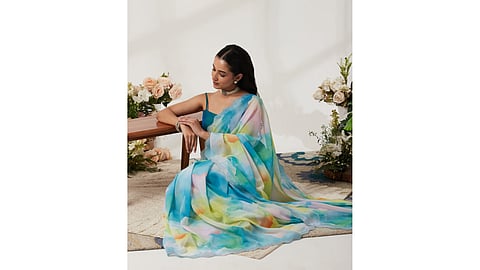
The all-over floral print chiffon sarees (the teal and violet ones especially) have that soft, non-rigid quality that works beautifully across settings. The fabric moves naturally rather than holding a stiff drape, which actually looks more relaxed and polished at the same time.
Wear a well-fitted, plain blouse with these. Let the fabric do the work.
Crepe
Crepe falls somewhere between georgette and silk. It has a slight sheen but isn't overtly shiny. It holds its shape well, drapes cleanly, and is one of the more forgiving fabrics to work with if you're still getting comfortable with sarees.
If you're new to wearing sarees regularly, crepe is a great place to start. It doesn't shift around as much as chiffon, so you spend less time fussing with it.
Print rules
The easiest mistake is choosing a print that's either too loud or too bridal. Neither works for most of the occasions you're actually dressing for.
Small florals, geometric patterns, and tone-on-tone prints are all safe. They read as intentional without demanding attention.
An all-over small floral on a dark base (black, navy, deep teal) is particularly easy to wear. The dark ground keeps it looking composed; the pattern keeps it from looking dull.
Plain blouses
A plain, well-tailored blouse in a solid colour that either matches or complements your saree is the cleanest choice. No embellishments. No net panels. Just a good fit and the right neckline.
Round necks and boat necks are the most versatile. V-necks work if they're not too deep. Avoid heavy decorative necklines for day wear. They tip the outfit toward formal occasion territory.
Cotton, cotton-silk, and polyester blouses all work well for daily wear. Cotton breathes; polyester is easier to maintain. Both are valid.
Sleeve options
Three-quarter sleeves or short sleeves are both fine. If you tend to run cold, a light three-quarter sleeve blouse is practical. For warm days, short sleeves are the obvious choice.
Get your blouses stitched properly. A blouse that fits well makes any saree look more expensive and more intentional. A poorly fitted blouse is the thing that actually makes an outfit look "off."
Draping styles
The Nivi drape is the standard and honestly the most practical. Clean pleats, pallu pinned at the shoulder, and you're done. It holds well through a full day of sitting, standing, and walking.
A few small adjustments make a real difference.
The pallu pin is non-negotiable. Pinning it at the shoulder means you're not constantly catching it on chair backs or adjusting it mid-conversation. One pin at the shoulder, maybe a second at the hip if it's a slippery fabric like chiffon.
Keep the pleats tight and even. Loose pleats that fan out look great in photoshoots but are annoying in practice. They widen as you move and end up looking dishevelled by afternoon.
Tuck the waistband firmly. This is the one adjustment that has the most impact on how the saree looks at the end of the day. A loose tuck at the waist shifts everything.
Deep tones, navy, charcoal, forest green, burgundy, deep teal, are the easiest to get right. They're easy to pair, they photograph well, and they don't overwhelm in close quarters.
Pastels work too, especially the muted versions. Dusty pink, powder blue, sage green, these all read neat and considered without being dull.
What requires more thought: very bright single-colour sarees (electric orange, hot pink) and very pale whites or creams, which tend to look great until your 11 AM coffee.
Wearing a saree by Garden Vareli is about finding a style that genuinely suits you and the occasion you're dressing for. The women who look best in sarees aren't the ones who've followed a rulebook. They're the ones who've figured out which fabrics feel good, found a drape that stays put, and stopped overthinking the rest.
Start with one good georgette or chiffon saree. Pair it simply. Wear it. Adjust what doesn't work. That's the whole process.
Follow us on Google News