
- News
- Women
- Magazine
- IndustryIndustry
- InsightsInsights
- Success Stories
- PublishPublish
- ContactContact
- Media KitMedia Kit
Anant Chaturdeshi

Anant Chaturdashi is an important religious observance celebrated by Hindus and Jains. In Hindu tradition, the day is associated with the worship of Lord Vishnu in his Ananta form, representing the eternal and infinite nature of the divine.
The occasion is observed on the fourteenth day (Chaturdashi) of the Shukla Paksha of Bhadrapada, according to the Hindu calendar. Devotees traditionally observe the Anant Vrat, perform puja and offer prayers seeking peace, prosperity and protection.
The day has an additional significance in several parts of India because it marks the culmination of Ganeshotsav. The Ganesha idols installed during Ganesh Chaturthi are ceremonially immersed on Anant Chaturdashi in what is popularly known as Ganesh Visarjan.
As a result, the day brings together two important traditions: devotion to Lord Vishnu in his Ananta form and the farewell to Lord Ganesha after days of celebration.
In 2026, Anant Chaturdashi will be observed on Friday, 25 September. The Chaturdashi tithi begins at 11:18 PM on 24 September and ends at 11:06 PM on 25 September, according to the cited panchang calculation.
The same day is also the principal occasion for Ganesh Visarjan, marking the traditional conclusion of the 10-day Ganeshotsav that begins with Ganesh Chaturthi on 14 September 2026.
The word Ananta means “endless” or “infinite”, while Chaturdashi refers to the fourteenth lunar day. The name therefore reflects the central association of the festival with the eternal form of Lord Vishnu.
Anant Chaturdashi holds a special place in the Hindu religious calendar because of its association with Lord Vishnu as Ananta, the infinite and eternal form.
Devotees observing Anant Vrat traditionally undertake a fast and perform a dedicated puja. A sacred thread, generally known as the Anant Sutra, is also associated with the observance. The thread traditionally contains fourteen knots, symbolising Ananta and the fourteen realms described in Hindu cosmology.
The rituals associated with the day vary across families and regions. In many traditions, devotees listen to or recite the Anant Vrat Katha, offer prayers and seek divine blessings for the well-being and prosperity of their families.
The observance is therefore not simply about following a set of rituals. At its heart is the idea of placing one's faith in the eternal and seeking strength, stability and protection through devotion.
Anant Chaturdashi is observed through a combination of fasting, prayers and puja rituals. Devotees prepare the required puja materials and create a sacred space for the worship of Lord Vishnu in his Ananta form.
During the puja, offerings are made to the deity, and devotees recite prayers and listen to the Anant Vrat Katha. In traditions where the sacred thread is observed, the Anant Sutra is tied after the completion of the rituals.
The fourteen knots of the thread carry symbolic significance and are traditionally associated with Lord Ananta. The thread is worn as a sacred symbol of devotion and protection, although the exact customs surrounding its preparation and duration of wearing can differ between communities.
Fasting is another important part of the observance for devotees who undertake the Anant Vrat. The nature and duration of the fast may vary according to family tradition and regional practice.
One of the most distinctive features of Anant Chaturdashi is its connection with Ganesh Visarjan.
Ganesh Chaturthi in 2026 falls on 14 September, beginning a period of worship and celebration dedicated to Lord Ganesha. Homes, temples and community pandals welcome Ganesha idols, and devotees participate in prayers, cultural programmes and festive gatherings.
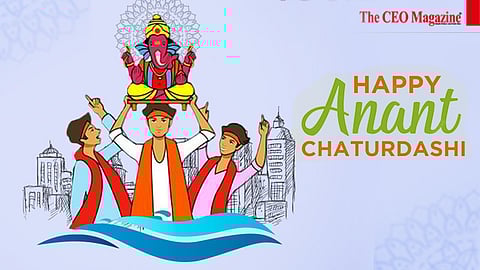
The celebrations traditionally culminate on Anant Chaturdashi, which is the most significant day for Ganesh Visarjan. On 25 September 2026, devotees will carry Ganesha idols in processions before ceremonially immersing them in water.
The farewell is accompanied by devotional songs, music, dancing and community participation. In cities where Ganeshotsav is celebrated on a large scale, the final procession can become one of the most spectacular public expressions of faith and community spirit.
The immersion carries a deeper symbolic message as well. After welcoming and worshipping Ganesha in physical form, devotees return the idol to the elements, reflecting the belief that forms may be temporary while faith continues.
Ganeshotsav traditionally spans ten days, beginning with Ganesh Chaturthi and culminating on Anant Chaturdashi.
While some families and communities perform Ganesh Visarjan earlier—such as on the third, fifth or seventh day—the Anant Chaturdashi immersion is regarded as the most significant and widely recognised conclusion of the festival.
This gives Anant Chaturdashi a distinctive place in the festive calendar. The day simultaneously carries the religious significance of Anant Vrat and the emotional and celebratory conclusion of Ganeshotsav.
Ganesh Visarjan is often one of the most emotional moments of Ganeshotsav.
For several days, families and communities worship Ganesha as a beloved guest. On the final day, the idol is carried out in a procession, accompanied by prayers, music and traditional chants.
The immersion represents a return to nature and a reminder of the cyclical nature of creation. The celebration may come to an end, but devotees carry forward the blessings, memories and spiritual significance associated with the festival.
This balance between celebration and farewell is one of the reasons Ganesh Visarjan holds such a powerful place in India's cultural imagination.
Anant Chaturdashi is observed in different ways across India. The rituals associated with Anant Vrat are particularly prominent in several northern and western parts of the country, while the connection with Ganesh Visarjan makes the day especially significant in states such as Maharashtra, Gujarat and Karnataka.
In Maharashtra, where Ganeshotsav has become an integral part of public and community life, Anant Chaturdashi is marked by large-scale processions and immersion ceremonies.
Elsewhere, the day may be observed more quietly within homes through fasting, puja and the tying of the sacred Anant Sutra.
These regional variations demonstrate the richness of India's festival traditions, where a single occasion can carry different customs while retaining its central spiritual meaning.
Anant Chaturdashi brings together two very different yet deeply meaningful expressions of faith.
On one side is the quiet devotion of Anant Vrat, through which devotees worship Lord Vishnu in his infinite form and seek peace, stability and protection. On the other is the vibrant celebration of Ganesh Visarjan, when communities come together to bid farewell to Lord Ganesha after days of worship and festivities.
In 2026, the occasion will be observed on 25 September, making it an important date for devotees observing Anant Vrat as well as communities preparing for the culmination of Ganeshotsav.
More than a religious date, Anant Chaturdashi reflects ideas of faith, impermanence and continuity. It reminds devotees that celebrations may have an ending, physical forms may return to nature, but traditions and devotion continue from one generation to the next.
May the blessings of Lord Ananta and Lord Ganesha bring peace, prosperity and happiness to all.
Happy Anant Chaturdashi 2026!
Follow us on Google News