
- News
- Women
- Magazine
- IndustryIndustry
- InsightsInsights
- Success Stories
- PublishPublish
- ContactContact
- Media KitMedia Kit
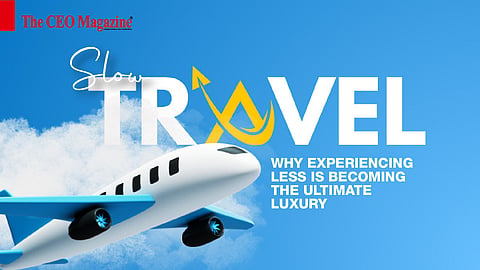
Slow Travel: Why Experiencing Less Is Becoming the Ultimate Luxury

For years, travel was measured in numbers. The number of cities visited, countries ticked off, landmarks photographed, and itineraries completed. A successful trip was one that looked full—packed schedules, early mornings, late nights, and a constant rush from one destination to another.
It was exciting, but it was also exhausting.
Today, that definition is beginning to shift. Travellers are no longer asking how much they can see in a limited time. Instead, they are asking how deeply they can experience a place. The focus is moving from quantity to quality, from speed to stillness.
This shift has given rise to what is now known as slow travel—a concept that is less about where you go and more about how you experience it.
Slow travel is not about doing less for the sake of it. It is about being intentional.
It means spending more time in fewer places. It means choosing depth over breadth. It means allowing space for spontaneity, rather than trying to control every moment through a tightly packed itinerary.
A slow traveller might spend a week in a single town instead of covering five cities. They might choose to walk through local markets, interact with residents, or simply sit in a café and observe daily life.
At first glance, this may seem like a quieter, even less “productive” way to travel. But in reality, it often leads to richer and more memorable experiences.
The rise of slow travel is not accidental. It is a response to the way modern life—and modern travel—has evolved.
In an always-connected world, people are constantly on the move, both physically and mentally. Even vacations, which were once meant for rest, have started to feel like projects to manage. There is pressure to see everything, document everything, and make every moment count.
Over time, this creates fatigue.
Slow travel offers an alternative. It allows travellers to disconnect from the need to optimise every minute and instead focus on being present. It replaces the urgency of “what’s next” with the calm of “what’s here.”
For many, that shift is not just appealing—it is necessary.
Traditionally, luxury in travel was associated with five-star hotels, premium services, and exclusive experiences. While those elements still exist, the definition of luxury is expanding.
Today, time itself has become a form of luxury.
The ability to stay longer in one place, to wake up without a rigid plan, and to explore at your own pace is something not everyone can afford—ironically making it more valuable. In this context, slow travel is not a compromise. It is an upgrade.
It prioritises freedom over frenzy and experience over efficiency.
One of the most significant differences between fast travel and slow travel lies in the level of engagement.
Traditional tourism often keeps travellers on the surface. Visits are brief, interactions are limited, and experiences are curated for convenience. While this allows for exposure to multiple places, it rarely leads to a deeper understanding of any one of them.
Slow travel, on the other hand, encourages immersion.
It creates opportunities to engage with local culture in a more meaningful way—whether through food, language, traditions, or everyday routines. Over time, this transforms the traveller’s relationship with the destination.
It is no longer just a place to visit. It becomes a place to experience.
Another factor driving this trend is the shift in how people work.
With the rise of remote work and flexible schedules, travel is no longer confined to short vacations. People are blending work and travel, staying in destinations for extended periods, and creating routines that combine productivity with exploration.
This has made slow travel more practical.
Instead of cramming experiences into a few days, travellers can spread them out over weeks or even months. This not only reduces stress but also allows for a more balanced and sustainable way of exploring the world.
Slow travel also aligns closely with the growing emphasis on sustainability.
Frequent flights, over-tourism, and resource-heavy travel practices have raised concerns about the environmental impact of tourism. By reducing the number of destinations and spending more time in each, slow travel naturally lowers this impact.
It also supports local economies more effectively. Longer stays mean more engagement with local businesses, from small restaurants to independent stores and service providers.
In this sense, slow travel is not just a personal choice—it is a responsible one.
Beyond practical and environmental benefits, slow travel offers something that is often overlooked in traditional tourism—emotional depth.
When you are not rushing, you notice more. You remember more. The details that are often missed in fast travel—the rhythm of a street, the warmth of a conversation, the familiarity that develops over time—become part of the experience.
These are the moments that stay with you long after the trip is over.
In contrast, fast travel can sometimes blur memories together. When everything is rushed, nothing fully settles.
While the appeal of slow travel is growing, it is not without its challenges.
It requires a different mindset—one that values presence over productivity. For those accustomed to structured itineraries and constant activity, slowing down can feel unfamiliar, even uncomfortable at first.
There are also practical considerations. Longer stays may not always be feasible due to time constraints, work commitments, or financial limitations.
However, slow travel is not an all-or-nothing concept.
Even small shifts—such as reducing the number of destinations or allowing unplanned time in an itinerary—can make a significant difference in how a trip is experienced.
At its core, slow travel is about redefining priorities.
It challenges the idea that more is always better. It suggests that depth can be more fulfilling than variety and that presence can be more valuable than productivity.
This does not mean abandoning exploration. It means approaching it differently.
As travel continues to evolve, the emphasis is likely to shift further towards intention and experience.
People are becoming more mindful of how they spend their time, not just at home but also when they travel. They are seeking journeys that align with their values, support their well-being, and leave a lasting impact.
Slow travel fits naturally into this mindset.
It is not a trend driven by novelty but by necessity. In a fast-paced world, it offers a way to pause, reconnect, and experience travel in a way that feels both meaningful and sustainable.
In the end, slow travel is not about doing less—it is about experiencing more in a different way.
It is about trading speed for depth, noise for clarity, and quantity for quality.
And in a world that rarely slows down, that might just be the most valuable journey of all.
Follow us on Google News