
- News
- Women
- Magazine
- IndustryIndustry
- InsightsInsights
- Success Stories
- PublishPublish
- ContactContact
- Media KitMedia Kit
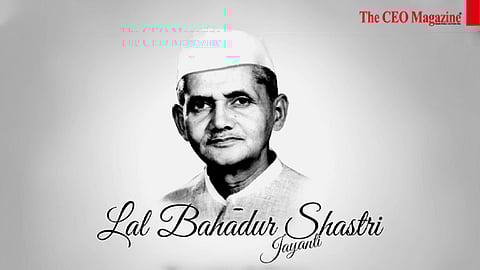
Lal Bahadur Shastri Jayanti

Lal Bahadur Shastri Jayanti is observed every year on 2 October to commemorate the birth anniversary of Lal Bahadur Shastri, India's second Prime Minister.
Born on 2 October 1904, Shastri emerged from a modest background to become one of the most respected leaders of independent India. His public life was characterised by personal simplicity, humility and a strong sense of responsibility towards the country.
In 2026, Lal Bahadur Shastri Jayanti will be observed on Friday, 2 October.
The occasion is especially significant because it falls on the same day as Gandhi Jayanti. While both leaders were deeply associated with India's public life and national movement, Shastri developed his own distinctive legacy—one built around quiet leadership, personal integrity, national unity and service.
His famous call of “Jai Jawan, Jai Kisan” continues to be remembered as a tribute to India's soldiers and farmers and as a reflection of the importance he placed on both national security and food production.
Lal Bahadur Shastri was born on 2 October 1904 in Mughalsarai, Uttar Pradesh, now known as Deen Dayal Upadhyaya Nagar.
His father, Sharada Prasad Srivastava, worked as a teacher and later as a clerk in the revenue department, while his mother, Ramdulari Devi, raised the family.
Shastri grew up in relatively modest circumstances. His early life shaped the simplicity and frugality that later became closely associated with his public image.
He became involved in India's freedom movement as a young man and was influenced by the ideas of Mahatma Gandhi and the broader national movement.
He participated in the Non-Cooperation Movement and later in the Civil Disobedience and Quit India movements, spending periods in prison during the struggle against British rule.
After independence, Shastri took on several important responsibilities in government and the Indian National Congress before eventually becoming Prime Minister.
Lal Bahadur Shastri was born Lal Bahadur Srivastava.
In 1926, he received the title “Shastri” after completing his degree at Kashi Vidyapeeth in Varanasi. The title, which refers to a scholar or person learned in the scriptures and traditional knowledge, subsequently became part of his name.
Later in life, Shastri also chose to drop the use of his caste surname, Srivastava, reflecting his belief in social equality.
His name therefore became simply Lal Bahadur Shastri.
Shastri joined the national movement while still a young man.
Inspired by Mahatma Gandhi's call for participation in the freedom struggle, he became involved in the Non-Cooperation Movement in 1921.
His participation resulted in imprisonment, beginning a long association with the freedom movement and the Indian National Congress.
He subsequently participated in other campaigns against British rule and spent several years in prison.
Shastri's contribution to the freedom movement was not based on dramatic public speeches or personal prominence. Instead, he developed a reputation for discipline, organisational ability and dedication.
These qualities later became important to his political career in independent India.
After India gained independence in 1947, Shastri became increasingly involved in the country's political and administrative development.
He held several important positions in the governments of Uttar Pradesh and later the Government of India.
Among his significant responsibilities was serving as Minister of Railways and Transport in the Union Cabinet.
His tenure as Railway Minister is particularly remembered for his decision to resign following a major railway accident. Although the constitutional and administrative responsibility for such incidents was more complex than personal culpability, Shastri believed that accepting moral responsibility was an important part of public office.
His resignation strengthened his reputation for personal accountability and integrity.
He later served as Minister of Commerce and Industry and Minister of Home Affairs, among other responsibilities.
Lal Bahadur Shastri became the second Prime Minister of India on 9 June 1964, following the death of Jawaharlal Nehru.
He inherited the leadership of a young republic facing significant challenges, including economic pressures, food shortages and security concerns.
Although his tenure as Prime Minister lasted only around 19 months, it became one of the important periods in India's early post-independence history.
Shastri's leadership style was markedly understated. He was known for consultation, discipline and a relatively simple personal lifestyle.
One of the most enduring contributions associated with Lal Bahadur Shastri is the slogan:
“Jai Jawan, Jai Kisan.”
The phrase means “Hail the Soldier, Hail the Farmer.”
Shastri used the slogan in 1965 at a time when India was dealing with both national-security challenges and serious food shortages.
The slogan acknowledged two groups whose contributions were vital to the country's well-being:
Jawan: the soldiers responsible for protecting the nation's security.
Kisan: the farmers responsible for producing the food on which the country depended.
The phrase became much more than a political slogan. It captured Shastri's vision of a country that needed both a strong defence and a secure agricultural foundation.
Its continued popularity reflects the enduring importance of India's armed forces and farming communities.
One of the defining moments of Shastri's premiership came during the India-Pakistan War of 1965.
Under his leadership, India responded to the conflict with Pakistan, while Shastri maintained a firm public position on India's security and sovereignty.
His leadership during the war significantly strengthened his reputation across the country.
The conflict eventually ended with a ceasefire, followed by negotiations between India and Pakistan.
Shastri's conduct during the war is remembered as an example of the quiet determination associated with his leadership style.
The mid-1960s were also a difficult period for India's agricultural sector.
The country faced food shortages and depended significantly on food imports. Shastri encouraged greater attention to agricultural production and urged citizens to contribute to national efforts to conserve food.
His government supported measures intended to increase agricultural productivity, while the broader agricultural transformation that followed involved major scientific, institutional and policy developments.
The period became an important chapter in India's journey towards greater food security and eventually contributed to the conditions in which the Green Revolution expanded.
Shastri's emphasis on farmers through the “Jai Jawan, Jai Kisan” message remains an important part of this legacy.
Lal Bahadur Shastri Jayanti is observed to commemorate Shastri's birth anniversary and remember his contribution to India's freedom movement and independent India.
The occasion is particularly associated with values that defined his public life:
Shastri maintained a modest lifestyle despite occupying some of the country's highest offices.
He became known for his strong sense of personal and public responsibility.
Unlike the larger-than-life political style often associated with leadership, Shastri was known for his quiet and restrained manner.
His tenure as Prime Minister included significant national-security challenges, including the 1965 war.
His public life was largely defined by a commitment to national service rather than personal grandeur.
These qualities continue to make him an important figure in India's political history.
Lal Bahadur Shastri Jayanti is observed across India through commemorative events and programmes.
The most prominent national tribute takes place at Vijay Ghat in New Delhi, the memorial dedicated to Shastri.
National leaders and public representatives pay their respects by offering floral tributes.
Schools and colleges organise speeches, essay competitions, quizzes, debates and other activities focusing on Shastri's life and contribution.
Cultural events, patriotic programmes and exhibitions are organised to introduce younger generations to his life and values.
The slogan associated with Shastri is often recalled during commemorative programmes, particularly in discussions about India's soldiers, farmers and national development.
Statues and memorials dedicated to Shastri are decorated with flowers and garlands, while institutions and organisations conduct remembrance programmes.
Vijay Ghat in New Delhi is the national memorial dedicated to Lal Bahadur Shastri.
The memorial is located near other important national memorials and becomes a focal point for official tributes on 2 October.
The name “Vijay Ghat” reflects Shastri's association with India's leadership during the 1965 war and his contribution to the country's national life.
Visitors can pay their respects at the memorial and learn more about one of India's early post-independence leaders.
Lal Bahadur Shastri died on 11 January 1966 in Tashkent, Uzbekistan, shortly after signing the Tashkent Declaration with Pakistan's President Ayub Khan.
The declaration followed the 1965 India-Pakistan War and was aimed at restoring peace and normal relations between the two countries.
Shastri's sudden death came less than two years after he had become Prime Minister.
He was subsequently awarded the Bharat Ratna posthumously in 1966, becoming one of the first recipients of India's highest civilian honour after his death.
His death remains an important and widely discussed event in India's modern political history.
Shastri's legacy is distinctive because it was built less around personal grandeur and more around character.
He lived relatively simply, maintained a modest public persona and emphasised responsibility in public life.
His leadership demonstrated that political authority did not necessarily have to be accompanied by extravagance or a larger-than-life personality.
The phrase “Jai Jawan, Jai Kisan” remains perhaps his most recognisable contribution to India's public vocabulary, but his legacy extends beyond those four words.
His emphasis on accountability, discipline, national unity, food security and service continues to shape the way he is remembered.
For many Indians, Shastri represents an idea of leadership rooted in integrity rather than spectacle.
The qualities associated with Shastri remain relevant in contemporary public life.
His belief in accountability raises questions about the responsibilities that accompany public office. His simple lifestyle offers a contrast to the privileges often associated with political power. His emphasis on farmers and soldiers highlights two communities that remain central to India's national life.
At a time when leadership is frequently judged by visibility and public presence, Shastri's example offers another perspective: that leadership can also be measured by character, responsibility and the ability to act decisively during difficult moments.
Remembering him today is therefore not only about revisiting history. It is also about reflecting on the qualities that society expects from those entrusted with public responsibility.
On 2 October 2026, India will observe the birth anniversary of Lal Bahadur Shastri alongside Gandhi Jayanti.
While both occasions share the same date, Shastri deserves to be remembered in his own right for his contribution to India's freedom movement, his service in independent India's government and his leadership as Prime Minister.
His tenure was brief, but the challenges he faced were substantial. From food shortages and economic pressures to national security and the 1965 war, Shastri led India through a demanding period with a reputation for calmness and determination.
His life continues to remind us that leadership is not always defined by power, visibility or grand gestures.
Sometimes, it is defined by the willingness to accept responsibility, remain grounded and put the country's interests before oneself.
May Lal Bahadur Shastri's life and legacy continue to inspire values of simplicity, integrity, courage and dedicated service to the nation.
Remembering Lal Bahadur Shastri on his Jayanti.
Follow us on Google News