
- News
- Women
- Magazine
- IndustryIndustry
- InsightsInsights
- Success Stories
- PublishPublish
- ContactContact
- Media KitMedia Kit

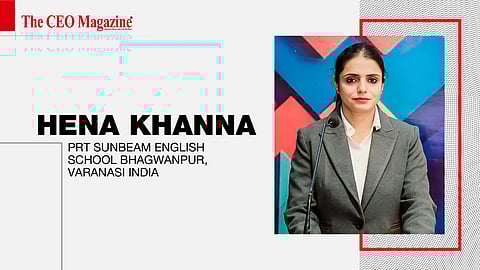
Hena Khanna - PRT Sunbeam English School Bhagwanpur, Varanasi India

In the heart of every vibrant classroom lies a silent power that precedes every word spoken and every idea shared—the Art of Listening. As educators, we recognize that listening is not a passive act, but a dynamic, creative force—the soil in which the seeds of communication are sown. When we cultivate a culture of deep listening, we are nurturing the soul of the next generation.
To listen is to give the gift of presence. We teach our students that true listening involves the "Whole Body." It is an immersive experience where the eyes seek connection, the heart seeks empathy, and the mind seeks understanding.
This reminds us of the timeless legacy of Abhimanyu from the Mahabharata. His story is the ultimate testament to the power of the ear; he learned the complex art of the Chakravyuh while still in the womb, simply by listening. This underscores a fundamental truth: Listening is the first stage of learning. Long before a child deciphers a letter, they absorb the world through sound and intent.
In alignment with NEP 2020 and the NCF, we view language acquisition as an organic process, much like the growth of a tree.
The Roots (Listening): This is the invisible strength. Without deep roots in listening, the tree cannot sustain itself.
The Trunk (Speaking): The first visible sign of growth, supported directly by the roots.
The Branches (Reading) and Leaves (Writing): The expansion and final output of a well-nourished system.
Listening and Reading are Receptive Skills (the input), while Speaking and Writing are Productive Skills (the output). These pillars are deeply interconnected; a child who is trained to listen deeply becomes a child who speaks with purpose.
In our school, we prioritize the "Input" through joyful classroom practices that turn listening into a lived experience:
Word of the Day: Every day begins with a new word. Our students listen to its sound, its texture, and its rhythm. By hearing it used in various contexts, they absorb it naturally, eventually using it in their own speech with confidence.
Audio Sessions: For our Kindergarten students, we use audio sessions and rhythmic rhymes to build Auditory Memory. Within these sessions, we focus on Voice Modulation—guiding children to hear the difference between a whisper of mystery and a shout of joy. Through "Listen and Repeat" exercises, they mirror these nuances, learning to identify patterns and phonetics, which is the first step toward true comprehension.
The Read-Aloud: When a teacher reads a passage with expression, it becomes an invitation to an auditory journey. Long before a child picks up a pencil, they participate in this immersive experience. This practice develops crucial thinking skills like critical analysis, problem-solving, and focus.
Questions arise naturally: As children begin to comprehend, their imagination skills flourish. They start visualizing scenarios, understanding different perspectives, and offering creative interpretations.
NEP 2020 strongly emphasizes experiential and inquiry-based learning, particularly in the foundational stage. In these moments, inquiry is not structured or forced—it is spontaneous, child-driven, and authentic.
The National Curriculum Framework (NCF) emphasizes that education should be life-affirming and child-centric. By prioritizing oral communication and listening, we move toward a Facilitator Model, where the teacher’s role is to bridge gaps and encourage inquiry.
The Holistic Progress Card (HPC) mirrors this shift. We no longer evaluate a child solely on written output. We now look at their Collaborative Spirit and Mindfulness:
Does the child listen to a differing opinion with respect?
Can they synthesize what they’ve heard to offer a creative solution?
Do they speak with clarity and empathy?
In today’s fast-paced world, listening is a form of Mindfulness. When we train students to be "present in the moment," we provide a powerful tool for Mental Health. A child who feels heard feels valued, which reduces anxiety and builds emotional resilience.
Furthermore, this practice is the engine of Critical Thinking. Problem-solving is a collective journey. When students listen to understand—rather than listening to respond—they connect disparate ideas, leading to "Eureka" moments. They become the problem solvers of the 21st century.
As educators, we are the architects of this environment. When we listen to a child with our "whole body," we model their worth. We create a space where "Inclusive" is a felt reality—where the child with the softest voice knows the room will grow quiet to hear them.
By anchoring our pedagogy in the art of listening, we prepare students for the mastery of life. We are building sanctuaries of sound and intentional silence, where the "Abhimanyus" of today can learn and lead.
This is a space where learning begins with listening, grows through shared experience, and flourishes through authentic relationships.
When we cultivate a child’s ability to listen with their whole being, we aren't just opening their ears—we are opening their world. A voice born from the depth of being heard is a voice that possesses the power to command the future. When every child knows their voice has a home, they will speak with a courage that can change the world.
Follow us on Google News