
- News
- Women
- Magazine
- IndustryIndustry
- InsightsInsights
- Success Stories
- PublishPublish
- ContactContact
- Media KitMedia Kit

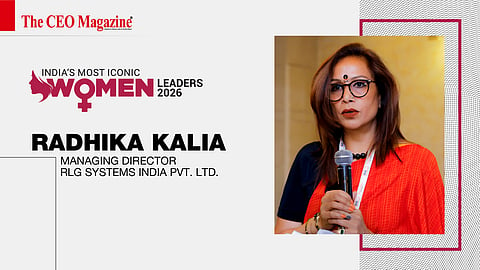
Radhika Kalia - Managing Director - RLG Systems India Pvt. Ltd.

Sustainability in India has moved beyond corporate messaging and into regulatory mandate. Environmental responsibility today is embedded in compliance frameworks, boardroom strategies, and measurable targets under Extended Producer Responsibility (EPR) norms. But policies alone do not build systems. Execution does. In a country where regulations shift and informal networks dominate waste collection, responsible reverse logistics requires discipline and clarity.
It is in this demanding space that Radhika Kalia, Managing Director of RLG Systems India Pvt. Ltd., has built her leadership. With over three decades of experience, she focuses on turning environmental intent into structured, practical systems that work on the ground. In a complex and traditionally male-dominated sector, she has built credibility through integrity, process discipline, and consistent execution.
Born and raised in Chandigarh, Radhika traces her leadership roots back to her early upbringing. She often credits her mother as the driving force behind her journey, someone who instilled discipline, ethics, and resilience in her from a young age. Mornings began at 4 a.m. with prayers. Attending Bal Vikas programmes and learning to take responsibility from a young age shaped her character in lasting ways.
She pursued her B.Com at Sri Sathya Sai Institute of Higher Learning, where the guru-shishya parampara emphasised values, integrity, and self-discipline. Later, while working and simultaneously completing her MBA in Finance, she became aware of the limited opportunities available to women in corporate leadership roles at the time.
“There was a realisation that circumstances would be difficult. But fortitude helped me stand my ground in the corporate domain with confidence and integrity,” says Radhika.
Radhika entered the corporate world in the early 1990s, at a time when leadership opportunities for women were limited. Over the years, she built depth across strategic business planning, corporate affairs, and sustainability, gradually expanding her responsibilities across multiple industries.
At Samsung and Haier, she gained deep exposure to product strategy and consumer behaviour. At HT Media, she managed large-scale revenue portfolios and go-to-market strategies. At Panasonic, she led Corporate Affairs and CSR, working closely with regulatory bodies such as CPCB and MoEF&CC on environmental regulations.
It was during this phase that a defining realisation emerged. “I saw a clear gap between policy formulation and on-ground implementation,” she says. “Leading RLG India gave me the opportunity to move from influencing rules to executing them.” Today, she channels that experience into building structured, compliance-driven systems that translate regulatory intent into measurable action.
Established in May 2017, RLG Systems India was created with a clear vision to contribute to India’s circular economy through structured Extended Producer Responsibility (EPR) compliance. A subsidiary of Munich-based RLG GmbH, the company manages e-waste, plastics, batteries, tyres, oil, and end-of-life vehicles in alignment with MoEF&CC and CPCB guidelines.
Their work spans the entire post-consumer lifecycle, from collection and aggregation to responsible recycling and material recovery. Producers are supported through data management, auditing, compliance frameworks, deposit refund systems, and track-and-trace mechanisms.
“We wanted to build systems with strong process integrity and documentation. Compliance must be transparent and measurable,” says Radhika.
Since inception, the organisation has enabled the recycling of over 400,000 metric tonnes of waste, working with more than 40 authorised recyclers. With ISO 9001, ISO 14001, and ISO 27001 certifications, it operates within a structured and accountable compliance framework.
Operating in India’s waste management ecosystem comes with structural complexity. The regulatory landscape is dynamic, with e-waste rules evolving frequently and implementation varying across states. Balancing strict compliance with commercial viability requires constant organisational agility.
Reverse logistics, by nature, is process-intensive. It requires rigorous documentation, adherence to Central Pollution Control Board norms, and zero tolerance for compliance gaps. Building that level of structure within a young workforce, many of whom were unfamiliar with such disciplined systems, required continuous mentoring and clarity of expectations.
Radhika’s transition from influencing environmental policy to implementing those regulations on the ground brought a different set of realities. Integrating the informal sector into a formal, compliance-driven ecosystem was operationally complex and culturally sensitive. Convincing small dismantlers to adopt GST compliance, structured documentation, KYC protocols, and safe handling practices required patience, negotiation, and sustained engagement.
Scaling the organisation from a small setup into an ISO-certified structure in a highly regulated and scrutiny-heavy environment added further pressure. There were moments of misplaced trust and people-management setbacks, experiences that shaped her leadership maturity and approach to delegation.
“When I began my career, leadership roles for women were limited,” she reflects. “Over time, I realised that preparation, clarity, integrity, and a focus on performance define leadership more than position.”
Despite the roadblocks, adaptability and a single-minded focus on a unified goal have helped her navigate both industry complexity and personal challenges, strengthening the organisation in the process.
When Radhika stepped into the organisation in 2017, operations began from a small office with a focused mandate. Today, the company operates with a team of over 80 professionals and more than 100 subcontract workers across India, with a valuation of approximately US$8 million. That expansion, she maintains, was never accidental. It was driven by discipline and clarity of purpose. Reverse logistics demands regulatory compliance, supply chain auditing, informal sector integration, and careful risk management, often simultaneously. Building structured processes, investing in compliance-focused technology, and earning the trust of recyclers, producers, and regulators became foundational priorities.
A particularly defining milestone has been the integration of the informal sector into a structured compliance ecosystem. Several dismantlers were transitioned into organised units with proper KYC and GST compliance, an effort that strengthened transparency while expanding operational capacity. This structured integration has been central to the organisation’s sustained growth.
Yet for her, growth metrics alone do not define achievement. “Success, for me, is measured by impact and integrity,” she says. Recognition such as the Green Globe Award 2023, presented by Hon’ble Minister Nitin Gadkari, and being named among the Top 10 Women Leaders in Logistics & Supply 2023 are milestones she considers humbling acknowledgements of that journey.
Her proudest achievement remains personal: raising her daughter to pursue a Master’s in Mechanical Engineering at the University of Waterloo with independence and confidence. To her, professional accomplishment must coexist with personal fulfilment.
Radhika’s commitment to sustainability, however, extends beyond corporate mandates. As President of the Clean to Green™ Society, a not-for-profit registered under the Societies Registration Act of 1860, she leads an environmental awareness movement focused on mobilising communities toward responsible action. Over the past four years, this initiative has reached over 4 million people across 26 states and 7 Union Territories, conducting more than 4,000 activities across schools, colleges, RWAs, office clusters, retailers, and the informal sector. In parallel, ‘E-Safai,’ implemented in partnership with GIZ India, works on building innovative value chains for responsible e-waste management.
“Behavioural change is as important as regulatory compliance,” she says. “Sustainability cannot scale without public awareness and cooperation.”
Reflecting on her journey, she offers measured advice to aspiring women leaders:
“Cultivate discipline, honesty, and a habit of continuous learning. Opportunities will not always present themselves clearly; you must learn to identify them and act decisively. Leadership is not about position; it is about the willingness to assume responsibility and own the consequences of your decisions. Focus on building your capability and character. The best leaders are defined by who they are, not by the titles they hold.”
Follow us on Google News