
- News
- Women
- Magazine
- IndustryIndustry
- InsightsInsights
- Success Stories
- PublishPublish
- ContactContact
- Media KitMedia Kit

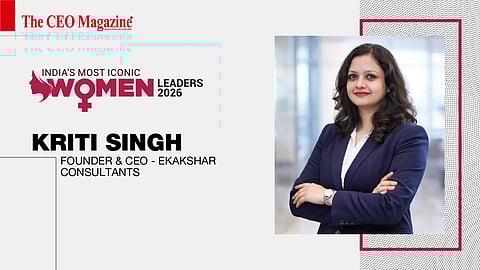
Kriti Singh - Founder & CEO - Ekakshar Consultants

In the current global economy, visibility is no longer the primary challenge for brands; clarity is. With the digital landscape saturated by AI-generated content and fleeting viral trends, enterprises increasingly face an attention trap: high impressions that fail to convert into revenue and noisy campaigns that do little to build long-term brand equity. Modern businesses don’t just need a marketing agency; they need a strategic growth partner.
This context shaped Kriti Singh’s approach at Ekakshar Consultants. Rather than increasing activity, the focus shifted to designing marketing around intent — understanding how customers arrive at a decision and making the brand reliably present at that moment. She refers to this as growth architecture: systems where discovery, trust, and conversion reinforce each other over time, allowing growth to compound instead of restarting every quarter.
Her view of marketing formed in real business environments, where outcomes were visible and assumptions were quickly tested. Her engineering background trained her to look for structure, and an MBA in Marketing & Finance added commercial context, but the most defining lessons came while working with clients as a Sales Director in environments where outcomes were directly tied to revenue. She began noticing a recurring reality — the quality of a product alone rarely determined business success; how clearly and consistently the market understood it often did.
“I realised good businesses don’t struggle because they lack capability — they struggle because the market doesn’t understand them in time,” she says.
In revenue conversations, she observed that marketing could either accelerate momentum or quietly restrict it. Strong offerings struggled when they were not positioned or discovered in time. This led to a lasting conviction: effective marketing cannot be standardised. Each company requires a demand-aligned, business-specific strategy built around how its customers evaluate and trust it, not a preset collection of channels.
This understanding eventually led to the creation of Ekakshar Consultants. The intent was to approach marketing as a structured business function rather than a set of activities — particularly for organisations that cannot sustain large in-house teams but still need clarity in reaching their market. The objective became reliability: enabling companies to translate capability into consistent demand through methodical communication.
Founded as a strategy-first powerhouse, Ekakshar functions as an embedded in-house partner for ambitious brands. Moving beyond mere campaign execution, the firm designs structured growth architecture. In a tech-driven marketplace, visibility is often mistaken for success. Ekakshar moves beyond the noise to address the more critical gaps of clarity, positioning, and conversion.
Each engagement begins with research into how buyers evaluate options, so the brand becomes consistently discoverable at the right moment rather than intermittently noticeable during campaigns. The emphasis is on building repeatable acquisition paths and decision-oriented journeys where growth accumulates over time instead of fluctuating with activity cycles.
For mid-size companies, the challenge is rarely lack of effort but fragmentation. The expanding number of platforms, formats, and creators has multiplied ways to communicate while also increasing confusion about where to invest attention.
“Attention is not demand. Revenue usually comes from the right audience understanding you, not the largest audience noticing you. Most growth comes from doing the basics well,” Kriti says.
The role of marketing therefore shifts from expanding presence to organising it — ensuring each touchpoint contributes to understanding instead of adding noise.
In the foundational years of Ekakshar, Kriti operated at the centre of execution, a hallmark of the first-generation entrepreneur. However, as the global landscape became increasingly complex, she recognized that sustainable scale is not a product of control, but of systems and leadership development. This realisation prompted a deliberate shift from being an active operator to a strategic enabler.
“Sustainable growth comes from building leaders and automation, not controlling outcomes.” - Kriti Singh
By transitioning toward intentional delegation, she strengthened organisational accountability, allowing innovation to flourish through a more resilient, decentralised structure.
In a marketing environment, this shift also influenced how ideas were developed. Effective marketing rarely emerges from strict instructions; it requires interpretation, testing, and iteration. By giving teams space to question assumptions and experiment responsibly, the work became more thoughtful and adaptive — allowing strategy to evolve with the market rather than remain fixed to a plan.
For Kriti, organisational strength is rooted in people, not just processes. At Ekakshar, talent management replaces rigid hierarchy with long-term growth and institutionalised flexibility. Informed by her own journey balancing motherhood with entrepreneurship, Kriti prioritises capability and intent over conventional availability. This approach creates high-impact opportunities for professionals—particularly women restarting their careers—who thrive in adaptable environments.
This “People Before Process” philosophy is balanced by a model of early ownership. By entrusting team members with real responsibility from day one, Kriti facilitates a natural transition into leadership. Here, accountability isn’t enforced through policing but through mutual respect. This culture has resulted in exceptional retention, proving that when employees are treated as stakeholders rather than operators, their commitment becomes a self-sustaining growth driver.
In an industry defined by volatility, Kriti maintains relevance through a “practice-meets-perspective” approach. By staying involved in active projects, she has identified a critical market pivot: the shift from attention-based marketing to intent-based resonance. In 2026, constant posting has been superseded by search visibility, problem-solving content, and high-trust credibility signals.
“I see AI as a catalyst for efficiency, not a substitute for strategy. It helps us analyse patterns and scale research, but judgement still shapes positioning. Technology should support long-term brand thinking, not drive reactive decisions.”- Kriti Singh
Looking toward the next five years, Ekakshar is set to scale its footprint across 50+ markets. Building on a foundation of 200+ global clients, Kriti is overseeing the establishment of dedicated offices in Dubai and the United States. This expansion aims to localise international relationships while maintaining the centralised strategic standards that have defined the firm’s success for the last six years.
Drawing from her journey, Kriti emphasises that leadership is not a title but a byproduct of responsibility and disciplined execution. To aspiring entrepreneurs and first-time leaders, her advice is grounded in the reality of sustainable growth:
“Seek equality, not special allowances, and ground confidence in competence. Business is rarely built through dramatic breakthroughs; it grows through disciplined execution. Most challenges are not solved by new ideas but by doing the fundamentals well repeatedly. Sustainable growth comes from systems, patience, and accountability. Build deep understanding in your domain and take ownership early because leadership grows through responsibility, not titles.”
She warns against the lure of temporary momentum, stressing that true business stability requires a long-term lens:
“Choose ideas you genuinely believe in rather than those driven purely by trends, because long-term resilience comes from conviction, not momentum. Many businesses don’t fail because they lack ideas; they fail because they chase excitement instead of endurance. The real discipline is choosing the slower path repeatedly: doing the work that doesn’t look impressive today but becomes undeniable tomorrow. When you build for longevity rather than applause, trust compounds and trust is the only advantage competitors cannot easily replicate.”
Follow us on Google News