
- News
- Women
- Magazine
- IndustryIndustry
- InsightsInsights
- Success Stories
- PublishPublish
- ContactContact
- Media KitMedia Kit





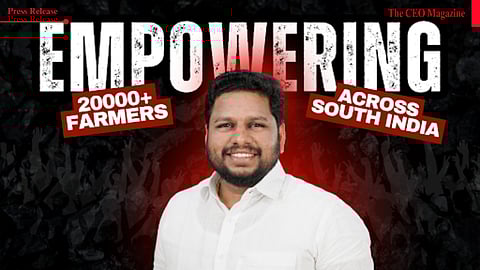
Kerala, Karnataka, Tamil Nadu: At a time when agriculture in India continues to face challenges around pricing volatility, fragmented supply chains, and market access, entrepreneur and agribusiness leader Rahul Chakrapani is building scalable, market-driven business models aimed at creating predictable incomes for farmers across South India.
Over the last 12 years, Chakrapani has focused on developing integrated enterprises across agriculture, fisheries, dairy, and farmer-led retail, moving beyond advocacy to create commercially viable systems that directly link producers with markets. As President of the Self Employed Farmers Association of India (SEFAI), he works closely with thousands of farmers across Kerala, Karnataka, and Tamil Nadu, while simultaneously running on-ground business operations that address structural gaps in the rural economy.
A key pillar of this approach is the Hill Producers Outlet Unit model, designed to support farmers in hilly regions who often face logistical barriers and price exploitation due to limited market connectivity. Currently operating 14 units across Kerala and Karnataka, the model enables direct sourcing, coordinated logistics, and stable pricing mechanisms. By reducing dependency on intermediaries, the initiative has helped hill farmers achieve more predictable returns and better control over their produce.
In coastal regions, Chakrapani has built a business ecosystem focused on fishing communities, particularly targeting value addition and market access for dried fish products. The model integrates procurement, financing, processing, and domestic and export-oriented marketing. A strong emphasis is placed on enabling women from fishing communities to participate in organised income-generation, thereby expanding economic participation within traditionally informal segments.
Inland and tank-based fish farming represents another fast-growing segment supported through Chakrapani’s initiatives. By providing structured market linkages and business support, the model currently works with more than 3,000 customers involved in fish farming, helping farmers scale production while reducing market uncertainty.
The dairy sector forms a significant part of the integrated ecosystem. Across 14 operational units in Kerala, particularly in South Kerala, Chakrapani’s initiatives supply cattle feed at subsidised rates and operate consistent procurement frameworks. This support system currently benefits over 10,000 dairy farmers by lowering input costs and stabilising monthly income. Extending the value chain further, Cochin Dairy, a farmer-first brand, sources milk directly from more than 150 active producers to manufacture traditional dairy products, including ghee made from cow milk, under transparent sourcing and ethical pricing practices.
To close the loop between producers and consumers, a network of Farmer’s Mart supermarkets has been established across Kerala and Karnataka. These retail outlets operate on a local sourcing model, enabling farmers to sell directly into organised retail. With seven stores currently operational, the network supports approximately 700 to 1,000 farmers each month, offering better margins to producers while providing consumers access to traceable, locally sourced products.
Collectively, these business models have supported an estimated 15,000 to 20,000 farmers over the past decade across multiple rural sectors. By combining procurement, processing, branding, and retail under farmer-centric frameworks, the initiatives aim to demonstrate that agriculture-led enterprises can be both socially impactful and commercially sustainable.
Through his work at SEFAI and ventures such as Royal Travancore Farmers Mart and associated farmer producer companies, Rahul Chakrapani continues to focus on building systems where farmers participate as economic stakeholders rather than beneficiaries. The underlying model emphasises long-term market participation, cost efficiency, and value-chain integration—positioning farming as a viable and future-ready profession driven by business fundamentals rather than dependency.
Follow us on Google News