
- News
- Women
- Magazine
- IndustryIndustry
- InsightsInsights
- Success Stories
- PublishPublish
- ContactContact
- Media KitMedia Kit

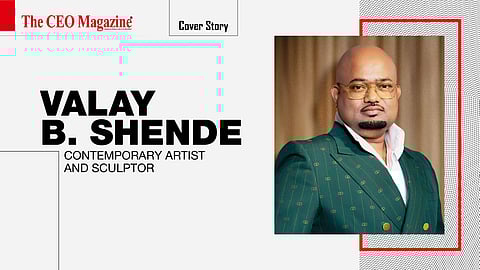
Valay B. Shende - Contemporary Artist and Sculptor

Art has always helped people make sense of the world through the simple act of noticing what others overlook. It remembers the feelings, struggles, and small truths that often slip past. And in a time when life is moving faster than ever, and when our days blur into routines, the need to pause and reflect becomes essential. The artists who shape our era are the ones who hold space for that reflection, capturing moments, behaviours, and emotions that tell future generations who we were and what we were trying to understand about ourselves.
Among these artists is Valay B. Shende, whose practice grew from observing life in its raw, unfiltered form. His journey began with a simple curiosity about people and the systems that influence how we live and move. What started as sketches of old mechanical parts from his father’s scrap business eventually expanded into large-scale sculptures that hold a mirror to society. His work remains anchored in the human condition, shaped by empathy, memory, and an attention to detail that comes from truly seeing the world.
Valay B. Shende
Valay’s artistic journey began long before he stepped into a formal art school. Growing up in Nagpur, he spent much of his childhood inside his father’s scrap business, surrounded by discarded automotive machines and mechanical parts. Their shapes, geometry, and hidden complexity captured his imagination. He would take small components home, draw them, and imagine new possibilities for their form and function. These early encounters created the foundation for the visual language he would later develop.
Alongside this fascination with machines, Valay was actively involved in community art, building installations for local festivals and creating small projects on social issues. Even at that age, he understood that art could be a space where society could be questioned, documented, and reimagined.After completing a Diploma in Art Teaching from the Government Chitrakala Mahavidyalaya in Nagpur, he moved to Mumbai in 2000 to pursue a Bachelor of Fine Arts in Sculpture at the Sir J.J. School of Art. During his time at J.J., he began experimenting with sculpture, video, and installations. A key work from this period was Scroll (2002), a video juxtaposing Mahabharat imagery with a running ticker of missing persons during the Gujarat genocide. The piece was later shown at I Love My India at the Total Museum of Contemporary Art in Seoul, his first international exhibition while still a student. More recognition followed. In 2004, his work was included in Seni: Art & Contemporary at the Singapore Art Museum, a significant moment for a young artist still completing his degree. By 2005, he was participating in domestic exhibitions, including Span at Sakshi Gallery, where Barbed Wire Woman marked his formal entry into the contemporary art scene. In 2006, an international residency at Point Éphémère in Paris became a turning point. Immersed in a new culture and working in unfamiliar conditions, he found himself questioning and refining his visual language. It was there that he developed his signature technique of using metal discs to create reflective sculptures that invite viewers to see themselves within the artwork.
Over the years, Valay’s works have travelled widely, appearing in institutions such as the Seattle Art Museum, MAXXI Rome, MAC-Lyon, the Singapore Art Museum, and the Museum of Contemporary Art in Taipei. His contributions have been acknowledged through recognitions like the Hello! Hall of Fame “Artist of the Year” (2016), the AISL Lumiere Awards Artist of the Year (2022), and his inclusion in the Hurun India Art List (2020) as one of the youngest contemporary artists featured. What began as a modest studio practice has evolved into a multidisciplinary space that now brings together over seventy artisans, fabricators, and technicians. This studio structure allows him to expand his practice while staying true to its human core. Today, Valay’s studio stands at the intersection of fine art, design, and public engagement. Each project, whether for a museum, a public space, or a private collection, becomes an opportunity to create impact, generate employment, and reflect the social, political, and environmental truths of our time. Through this journey, he continues to shape conversations within the contemporary art landscape, grounded in the same curiosity and clarity that first drew him to those discarded machine parts in his father’s warehouse.
Valay’s creative journey began with a habit of closely observing people, objects, and everyday situations. Early in his journey, he realised that understanding human behaviour offered a clearer view of society. This instinct guided him toward themes that would remain central to his work: labour, migration, identity, industrialisation, and the pressures of urban life. These concerns became the backbone of his artistic exploration.
His residency in Paris significantly shifted his perspective. Working in a new cultural and artistic environment pushed him to rethink his approach and experiment with scale. During this period, he created his first sculptures made of metal discs, two of which were monumental works displayed in exhibitions. The experience clarified his need for a dedicated space where ideas and materials could be tested with freedom. The studio grew naturally out of this realisation, a place where experimentation and human stories converge to create works that reflect the times we live in.
Transit
Valay’s practice is built on the belief that art can cross boundaries of language, culture, and class. Accessibility has always been central to his approach. He often uses familiar, found objects to draw people in, allowing viewers to recognise something from their own lives before engaging with deeper social commentary. Works like Farmer’s Suicide show how universally understood objects can sharpen the clarity of a critique and make complex ideas easier to grasp. Farmer’s Suicide presents a grand dining table, set with opulent silverware and crystal, symbolising the abundance enjoyed by the privileged. At its centre, however, lie tiny salt-and-pepper bottles filled with the ashes of a farmer who had tragically taken his own life and soil from that very same farmer’s field. The ashes and soil, though contained in something so ordinary and overlooked, carry immense weight: they embody the grief, labour, and exploitation of agricultural workers. The stark difference in scale between the imposing table and the minuscule bottles highlights the imbalance in our society—the enormity of wealth and consumption compared with the small, almost invisible presence of those who sustain it. For him, art carries value only when it resonates with people beyond gallery spaces. He often installs works in public or unconventional locations, seeing this as a more democratic way of sharing art in contemporary times. He aims to create sculptures that hold conceptual depth and aesthetic appeal—pieces people feel connected to, whether displayed in their homes or remembered long after an exhibition ends.
The stainless-steel discs in Valay’s sculptures represent atoms and molecules—the fundamental building blocks of all matter on the planet. They are central to his visual language, assembling into large figurative forms that reflect the idea that every individual is made of many small, interconnected parts. The discs also act as metaphors for the common person, whose identity is built from layered experiences and memories.
Their reflective surfaces capture the surrounding world, making the works inherently participatory: when no viewer is present, the discs appear as empty voids; when someone steps before them, their reflection activates the sculpture and completes its narrative. By mirroring their surroundings and the people who encounter them, the works remain in constant dialogue with their environment. They shift with light, movement, and human presence, ensuring they never turn decorative or static. Valay’s intention is always clear: to create artworks that serve the site, connect with its community, and remain alive and thought-provoking in the everyday world.
In Memory of Unknown Labours
Corporate Man Riding On The Bull
Mindfulness of everyday surroundings is central to Valay’s practice, shaping the way he interprets and expresses human stories. Human behaviour remains the core of his work, as he sees it as a reflection of the culture and systems people inhabit. Through a range of media, he addresses not only daily life but also the broader socio-political, economic, environmental, and religious forces that influence it.
Familiar materials allow him to create analogies with deeper social concepts, enabling viewers to grasp the commentary directly. His work EVM (Electronic Voting Machine), for example, takes the form of a trap—symbolising how a compromised EVM can kill democracy and snatch away a citizen’s fundamental right to vote. The trap exposes how machinery created to uphold our rights can instead be used to control them, turning a democratic tool into a political weapon. Through this work, Valay urges viewers to reflect on the dangers of manipulated electoral systems and calls for vigilance in safeguarding the sanctity of the democratic process.
Valay often draws inspiration from ordinary urban symbols—cattle, scooters, hanging clothes, irons, and especially Mumbai’s dabbawalas—objects and figures that seem familiar yet hold deep cultural significance. For him, these everyday systems form the invisible machinery that keeps the city alive, even though the people who sustain them rarely enter public memory. His sculpture, The Mumbai Dabbawala, reflects this philosophy: the figures are built from working clock faces to signify precision and time, while the lunchboxes become metaphoric stomachs, representing the countless individuals fed through this system. Through such reimagined forms, Valay transforms the ordinary into powerful metaphors, illuminating the social and cultural dynamics that shape contemporary India.
His relationship with space is equally thoughtful. Valay approaches every site contextually, beginning with an understanding of the client’s needs and the purpose of the space, and then conceptualising a narrative that will resonate within it. His work, Corporate Man Riding on the Bull, for instance, was shaped directly from observing the energy and interactions within the corporate environment it was created for. In this way, the work was not just placed in the space; it was born from it.
Selfie
One of the most persistent challenges Valay has faced is the broader absence of technological infrastructure in India. While the country celebrates its scientific achievements and rapid digital growth, the reality on the ground often tells a different story. Professionals across multiple industries still work without basic support systems, advanced tools, or sustained investment in innovation. India continues to lag in fundamental technological development—whether it’s the lack of high-speed systems or the absence of cutting-edge machinery in manufacturing, design, and other sectors. Even in Mumbai, the nation’s financial and cultural hub, Valay often struggled to access the equipment required for large-scale or precision-based work. For him, this gap made it evident that many sectors in India remain structurally unsupported, revealing a deeper national reluctance to commit to true innovation.
Instead of waiting for change, Valay built his own path. He created systems, designed tools, and developed machinery within his studio. Every sculpture that emerges from his studio carries that reality, the frustration of a system that refuses to support its artists and the resilience of one that refuses to stop creating. What distinguishes Valay’s art is the way he transforms complex social and political ideas into accessible visual forms. “My work is a synthesis of documentation, tribute, and protest,” he asserts. His practice brings forward the lived realities of urbanisation, migration and the daily struggles of commuters and the often-invisible workforce, the daily wage workers, the dabbawalas, and the very people that keep cities running.
By translating everyday human struggles and resilience into sculptural form, Valay preserves stories that might otherwise fade. His works carry cultural value, provoke reflection, and invite viewers to consider their own place within the systems. In this way, his art becomes testimony, an insistence that these human stories are vital to the understanding of our collective history and identity.
Dabbawala with stomach tiffin
At the heart of Valay’s practice is a commitment to truth, integrity, and social awareness. From the beginning, he has believed that creativity should have a purpose — to question, to communicate, and to draw attention to realities that matter. His work is grounded in honest expression, respect for life in all its forms, and a deep mindfulness of the world around him.
He sees his practice as a bridge between art, people, and society. He says, “Art, for me, is the way humanity remembers.” Art allows future generations to understand lives, struggles, and moments they did not personally witness. With this in mind, he aims to create works that endure, pieces that can hold meaning over time and keep human stories alive. Even as his scale and projects have grown, the belief that art and communication can contribute to real change has remained constant. These values continue to guide every sculpture and installation he creates, shaping a body of work that stays sincere, reflective, and rooted in its time.
Farmer's Suicide - Salt and Pepper bottles
One of Valay B. Shende’s most meaningful accomplishments as a leader has been building a large, self-sustaining creative ecosystem. He runs an 8,000-square-foot studio in Andheri, Mumbai, where a team of over 70 skilled artisans and technicians contribute to every project. For him, leadership is as much about nurturing livelihoods as it is about creative direction. The revenue generated from his artworks supports his team, enables continuous experimentation, and turns the studio into a space where creativity and economic stability coexist.
Managing this scale of practice has taught him how to balance vision with strategy and how to merge vision with execution. His international presence has also played a meaningful role in shaping his definition of success. A significant portion of his work is collected internationally, bringing revenue back into the country and placing Indian contemporary art on a global map. These experiences have reinforced his belief that leadership in the arts is about building systems that sustain others and ensuring that art continues to hold meaning.
Receiving the “Artist of the Year” title at the Hello! Hall of Fame Awards in Mumbai (2016) remain a significant recognition of his journey. His works have been featured in notable solo and group exhibitions across India and abroad, allowing him to engage with diverse audiences and cultural contexts. Equally important has been the development of a strong global collector base, including respected names from the art world and beyond. Their trust and enthusiasm affirm the universality of the themes he explores: labour, identity, migration, and the human condition. For him, true success lies in creating work that continues to hold cultural, emotional, and historical value long after it leaves the studio.
State Honor 21
Valay keeps his practice evolving by staying attentive to the shifts happening around him in behaviour, technology, and the larger social atmosphere. He often observes how the younger generation thinks, reacts, and engages with the world, because their actions usually signal where society is heading. This kind of mindfulness has always been part of his process, and every new change in attitude, environment, or technology becomes something he responds to through his work.
This way of working shapes the core focus of his practice today. His studio is currently dedicated to creating works that hold both visual appeal and social relevance, pieces that attract attention but also encourage viewers to think about the human, social, and environmental realities around them. Each project moves through research, experimentation, and a careful study of the space and audience it is meant for. Through public art commissions, international exhibitions, and collaborations with architects and institutions, he continues to position art as something that sparks dialogue and connects with people in meaningful ways. At the same time, he keeps refining his reflective stainless-steel disc technique, using it to draw viewers directly into the work and make them part of the story being told.
This commitment to responding to the present moment is also shaping the direction of his upcoming series. For his forthcoming museum exhibitions, Valay has been working on artworks centred on artificial intelligence and its growing influence on human life. These new pieces explore how advanced technology, in the hands of powerful systems, could potentially undermine the core of humanity and democracy. Through this series, he is examining the tension between machine intelligence and human wisdom, continuing his effort to capture the realities of our time with clarity and urgency.
Drawing from his own journey of exploration and perseverance, Valay shares, “For the young aspirants of this era, often perceived as alien in their innovative approaches and perspectives, it is important to commit to practice regularly, learn from others, embrace constructive feedback, and remain true to yourself. Balance your art and finances, be patient, and give yourself the time to grow and evolve.”
He believes that the purpose of art extends beyond creation, reflecting a deeper hope for society. “When asked what I hope for beyond art, my answer is simple: a world of sociopolitical, environmental, and economic peace. Nothing else matters more,” he concludes.
Follow us on Google News