
- News
- Women
- Magazine
- IndustryIndustry
- InsightsInsights
- Success Stories
- PublishPublish
- ContactContact
- Media KitMedia Kit
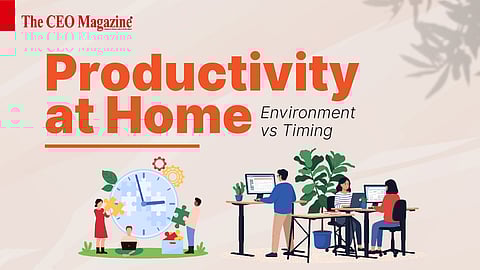
Productivity at Home: Environment vs Timing

The shift toward remote and hybrid work has redefined productivity in ways that few anticipated. Freed from the structure of traditional offices, individuals have gained flexibility but also inherited a new set of challenges.
Without clear boundaries, work has become both more accessible and more invasive. The lines between professional and personal life have blurred, often leading to longer hours without a corresponding increase in output.
In this new landscape, productivity is no longer determined solely by discipline or motivation. It is shaped by two critical, often underestimated factors: the environment in which work takes place and the timing of how work is structured.
Flexibility is often viewed as the greatest advantage of working from home. The ability to set one’s own schedule, avoid commutes, and create a personalised workspace seems inherently beneficial.
However, this flexibility can quickly become a source of inefficiency. Without predefined boundaries, work tends to expand to fill available time. Tasks that once had clear start and end points become open-ended.
This creates a paradox: more control over time but less clarity on how to use it effectively.
The home environment introduces a range of subtle distractions. These are not always obvious interruptions but include background noise, household responsibilities, and the constant availability of digital devices.
More importantly, the lack of spatial distinction between work and personal life creates cognitive overlap. When the brain associates the same environment with multiple activities, it struggles to maintain focus.
Over time, this leads to mental fatigue, even if the actual workload remains unchanged.
The physical workspace plays a foundational role in shaping productivity. A clearly defined work area signals the brain to enter a focused state, while a shared or undefined space dilutes this signal.
Even within limited space, creating a dedicated zone for work can significantly improve concentration. This does not require an elaborate setup. A consistent surface, a comfortable chair, and minimal distractions are often sufficient.
Lighting is another critical factor. Natural light enhances alertness and reduces strain, while poorly lit environments can lead to fatigue. Similarly, organisation reduces cognitive load, allowing attention to remain on tasks rather than surroundings.
Small details, such as the direction of seating, the positioning of screens, and the presence of clutter, can collectively influence how engaged and comfortable one feels.
While environment sets the stage, timing determines performance. Human energy levels fluctuate throughout the day, influenced by biological rhythms, sleep patterns, and external factors. Most individuals experience natural peaks in focus and periods of reduced energy. Aligning tasks with these patterns can significantly enhance efficiency.
Deep, cognitively demanding work is best performed during high-energy periods, while routine or administrative tasks can be scheduled during lower-energy phases. Ignoring these rhythms often results in unnecessary effort. Tasks take longer, errors increase, and frustration builds.
One of the most common mistakes in remote work is the attempt to replicate traditional office schedules without considering individual productivity patterns.
The “9 to 5” model was designed for organisational convenience, not personal efficiency. In a home setting, where autonomy is greater, it becomes possible to design schedules that align more closely with natural rhythms.
This does not mean abandoning structure entirely. It means redefining it; shifting from fixed hours to intentional allocation of time.
Productivity is not just about how long one works but also about how work is organised. Breaking tasks into focused intervals, setting clear priorities, and defining outcomes can improve efficiency. Equally important is the ability to transition between tasks. Without clear boundaries, it is easy to move from one activity to another without closure, creating a sense of constant incompletion.
Establishing start and end rituals—simple actions that signal the beginning or conclusion of work—can help create mental separation.
Working from home often leads to increased digital engagement. Notifications, messages, and emails create a continuous stream of interruptions. While each interruption may seem minor, their cumulative effect is significant. Frequent context switching reduces the ability to engage in deep work and increases cognitive fatigue.
Managing this requires intentional boundaries—designating periods of uninterrupted work and limiting unnecessary digital interaction.
A common misconception about productivity is that it requires sustained intensity. In reality, consistency is far more effective. Working in manageable, focused intervals and maintaining regular routines can lead to better outcomes than sporadic bursts of effort.
This approach also reduces burnout, making productivity sustainable over the long term.
There is no universal formula for productivity. Each individual has unique patterns of energy, focus, and preference. Experimentation is essential. Adjusting workspace setup, testing different schedules, and observing outcomes can help identify what works best.
Over time, these insights can be used to create a personalised system—one that supports both efficiency and well-being.
Productivity is often measured in terms of output, but this perspective is incomplete. True productivity includes quality of work, sustainability, and overall well-being. A system that maximises output at the cost of mental health is not effective in the long run.
By considering both environment and timing, it becomes possible to create a more balanced approach—one that supports performance without compromising stability.
Ultimately, productivity at home is not about replicating traditional work structures. It is about designing a system that aligns with individual needs and circumstances.
This involves intentional choices—creating a supportive environment, aligning work with natural rhythms, and maintaining consistent routines. When these elements come together, productivity becomes less of a struggle and more of a natural outcome.
Follow us on Google News