
- News
- Women
- Magazine
- IndustryIndustry
- InsightsInsights
- Success Stories
- PublishPublish
- ContactContact
- Media KitMedia Kit
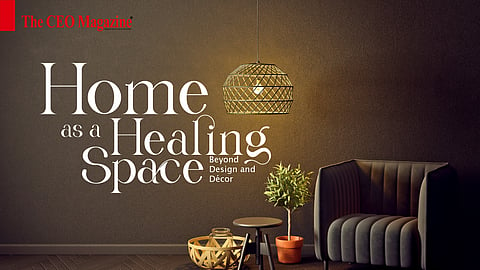
Home as a Healing Space: Beyond Design and Décor

In an age defined by constant motion, relentless connectivity, and blurred boundaries between work and personal life, the meaning of “home” has quietly but fundamentally changed. It is no longer just a place of return; it has become a space of recovery. Increasingly, the home is expected to restore what the outside world depletes: energy, focus, emotional balance, and a sense of control.
Yet, despite larger homes, better furniture, and carefully curated aesthetics, many people continue to feel restless within their own spaces. The issue rarely lies in how a home looks. It lies in how it functions on a deeper, less visible level, how it supports or disrupts the rhythms of everyday life.
The modern home, in many ways, has outgrown its original design logic. What was once built for limited, predictable use is now expected to accommodate complex, overlapping roles. As a result, the question is no longer how to make a home beautiful, but how to make it restorative.
For decades, the idea of a well-designed home revolved around aesthetics, comfort, and status. Spacious layouts, premium materials, and visually pleasing interiors were considered the markers of good living. While these elements still matter, they no longer define the full picture.
The shift began gradually but accelerated dramatically in recent years. As work moved into homes and digital life intensified, people began spending unprecedented amounts of time within the same walls. The home became an office during the day, a leisure space in the evening, and a place of rest at night, often without any meaningful transition between these roles.
This compression of functions exposed a critical gap. Most homes were not designed to support continuous mental engagement and recovery within the same environment. The result is a subtle but persistent fatigue, one that cannot be solved by better furniture or improved décor alone.
It is easy to assume that discomfort within a home is caused by obvious factors, clutter, noise, or lack of space. While these play a role, the deeper issue often lies in misalignment between the space and its usage.
A visually appealing room can still feel exhausting if it lacks clarity of purpose. For instance, a dining table that doubles as a workspace may appear efficient, but it blurs psychological boundaries. Over time, this creates confusion for the brain, which struggles to associate the space with a single function.
Similarly, poorly defined layouts can disrupt movement patterns. When spaces feel congested or require constant adjustment like moving items, navigating obstacles, or shifting positions, it creates micro-level friction. Individually, these interruptions seem insignificant. Collectively, they contribute to a sense of unease.
Lighting is another overlooked factor. Homes that rely heavily on artificial lighting, especially harsh or uneven sources, can interfere with natural rhythms. The absence of daylight or the overuse of bright lighting in resting areas can keep the mind in a state of alertness, making relaxation difficult.
Beyond visible design elements lies a more nuanced concept: spatial alignment. This refers to how different elements within a home such as layout, direction, light, and flow interact with each other and with the people living in the space.
Spaces that feel calming often share certain characteristics. They allow for uninterrupted movement, maintain visual balance, and create a sense of openness without feeling empty. Furniture is placed in a way that supports natural activity rather than obstructing it. Light enters in a manner that changes throughout the day, creating variation rather than monotony.
These qualities are not accidental. They reflect an underlying harmony between structure and function.
When alignment is absent, the opposite occurs. Rooms feel either too crowded or too sparse. Movement feels restricted or aimless. Even without consciously noticing it, individuals respond to these cues through restlessness, distraction, or fatigue.
A home is not just a physical structure; it is an emotional environment. Every element within it contributes to a broader psychological experience.
Colours, for example, have a measurable impact on perception. Neutral and muted tones tend to create a sense of calm, while overly vibrant or contrasting colours can stimulate the mind. This is not inherently negative, but it must align with the purpose of the space. A highly stimulating colour palette in a bedroom, for instance, can interfere with rest.
Textures also play a role. Soft materials like fabrics, rugs, and upholstery create a sense of comfort and warmth, while harder surfaces can feel more formal or cold. The balance between these elements shapes how inviting a space feels.
Sound is equally significant. Even low-level background noise like traffic, appliances, or constant digital notifications can prevent the mind from fully relaxing. Homes that incorporate elements of quiet, whether through layout or intentional design choices, tend to feel more restorative.
Among all areas of the home, the bedroom holds the greatest potential for healing—and the greatest risk of disruption.
In theory, the bedroom is a space dedicated to rest. In practice, it often becomes an extension of daily life. Laptops, phones, work documents, and even dining habits frequently enter this space, diluting its purpose.
This has a direct impact on sleep quality. The brain relies on environmental cues to transition into rest. When those cues are inconsistent, when the same space is associated with stress, activity, and relaxation, it becomes harder to disengage.
Creating a restorative bedroom does not require luxury or extensive redesign. It requires intentionality. Minimising distractions, maintaining a consistent layout, and ensuring a comfortable, uncluttered environment can significantly improve both the quality and depth of rest.
One of the most overlooked aspects of home design is its influence on behaviour. Spaces do not just accommodate actions; they actively shape them.
A cluttered environment makes it easier to continue accumulating clutter. A poorly defined workspace encourages procrastination. Conversely, a structured and organised space subtly promotes discipline and clarity.
This creates a feedback loop. The state of the environment influences behaviour, and behaviour, in turn, reinforces the state of the environment.
Breaking negative cycles often begins with small spatial changes. Clearing a surface, redefining a corner, or reorganising a frequently used area can create immediate, visible improvement. Over time, these changes accumulate, transforming not just the space but the habits associated with it.
Even the most well-designed home cannot function as a healing space without supportive routines. Space and behaviour are interdependent.
A living room designed for relaxation will not serve its purpose if it is constantly used for work. Similarly, a workspace will lose its effectiveness if it is used inconsistently or without structure.
Establishing simple routines—such as fixed work hours, designated eating areas, and screen-free periods—helps reinforce the intended function of each space. These routines act as signals, allowing the brain to transition more smoothly between activities.
Conversations around healing spaces often fall into two extremes. On one end are purely functional approaches that focus only on measurable factors. On the other are belief-driven systems that attribute outcomes to unseen forces.
A more balanced approach recognises that while not everything can be quantified, the impact of the environment on well-being is undeniable. Light, layout, organisation, and routine all play measurable roles in shaping how a space feels.
At the same time, personal perception matters. If a particular arrangement or practice creates a sense of comfort and confidence, it holds value—regardless of whether it can be scientifically validated.
The key is discernment. Instead of adopting ideas blindly, it is more useful to observe their impact. Does the change make the space feel calmer? Does it improve focus or rest? These questions provide more meaningful answers than rigid adherence to any system.
A home is not a finished product. It evolves with its occupants—their routines, priorities, and stages of life.
What works at one point may need to change later. A workspace may need to expand or contract. A room may shift from one function to another. Flexibility is not a compromise; it is a necessity. Viewing the home as a dynamic system allows for continuous refinement. It encourages awareness, experimentation, and adjustment.
Ultimately, the idea of comfort is being redefined. It is no longer limited to softness, luxury, or visual appeal. It now includes clarity, balance, and ease of living. A healing home does not eliminate stress entirely. Instead, it provides a counterbalance, a space where the mind can slow down, the body can recover, and a sense of stability can be restored.
In a world that constantly demands attention, such spaces are not a luxury. They are essential.
Follow us on Google News