
- News
- Women
- Magazine
- IndustryIndustry
- InsightsInsights
- Success Stories
- PublishPublish
- ContactContact
- Media KitMedia Kit
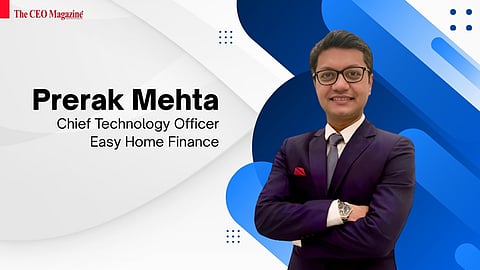
Prerak Mehta, Chief Technology Officer, Easy Home Finance

With rapid urbanisation and rising demand from Tier II and Tier III cities, India’s affordable housing market is witnessing accelerated growth. Industry estimates project the segment to grow at nearly 25% CAGR between 2022 and 2027. Today, India’s outstanding home loans have crossed ₹37 lakh crore, accounting for nearly 11% of GDP. These shifts are redefining how housing finance is built, delivered, and accessed. Yet, despite this momentum, access to housing finance remains uneven. For a large section of borrowers, especially those without formal income documentation, the process of securing a home loan continues to be time-consuming, documentation-heavy, and dependent on physical processes.
This is the gap that Easy Home Finance was founded to address. Founded by Rohit Chokhani, the company now operates at the intersection of rising housing demand and the need for more efficient, technology-led lending models powered by AI. Since its inception, the company has grown to manage an AUM of approximately ₹1500 crore, now operating across 14 states and 100+ cities. Nearly 80% of its business now comes from Tier II and Tier III markets. They recently raised $30 million in a Series C round led by Investcorp, taking total capital raised to around $80 million.
Prerak Mehta brings a technology-first lens to a sector that has traditionally relied on manual processes and physical infrastructure. Having studied Computer Science in the United States at Carnegie Mellon University, he began his career in the US technology ecosystem.
He worked with a digital lending company in the United States that was among the early pioneers to move payday lending from a physical, brick-and-mortar setup to a completely digital process, operating without physical paperwork, salary slips, or in-person visits. This role gave Prerak first-hand exposure to how technology could streamline credit delivery at scale, making lending faster, more efficient, and far more accessible than traditional processes ever allowed. After returning to India, Prerak dove headfirst into entrepreneurship, founding and building multiple startups from the ground up. It was during this intense, hands-on phase that he began to see a clear and persistent gap in real-world lending, one that traditional systems weren’t addressing effectively.
In the early years, there were no rigid job descriptions. Prerak wore every hat imaginable accounting, HR, coding, product development, customer conversations, and high-stakes business decisions. Those experiences didn’t just build companies; they built perspective. He learned how every moving part of a business connects, breaks, and scales.
Today, as CTO at Easy Home Finance, he brings far more than technical expertise to the table. He understands the pressures of sales, the constraints of operations, the nuances of finance, and the realities of execution. So when teams approach him with ideas or feature requests, the discussion goes deeper than code and timelines, it’s about impact, feasibility, and business value.
“Early on, I didn’t have the option to say, ‘That’s not my department.’ Doing every job myself taught me how decisions ripple across the organization. Now, when we build something, we build it with the whole business in mind,” says Prerak.
The idea for Easy Home Finance emerged from observing the challenges faced by individuals with informal income structures when accessing housing finance. Prerak recognised a stark inconsistency within the lending ecosystem: ₹10 Lakh -ticket home loans could take months to process, while a car loan of comparable value is often approved within hours. This imbalance, particularly within housing finance, an essential and long-term segment, highlighted the need for a different approach.
Founded in 2017, Easy Home Finance is an affordable housing finance company built with a focus on making home loans simpler and more accessible, especially for first-time homebuyers. The company was set up with the belief that housing finance, despite being a large and established segment, had not evolved at the same pace as other forms of lending.
The business is built around a digital-first approach. Instead of depending only on physical branches, Easy Home Finance uses technology to reach customers across different parts of the country. Prerak explains, “We realised that only if we go fully digital and use technology can we scale to different parts of India and actually reach Bharat, what we call Tier II and Tier III towns. Given India’s size and diversity, scaling through hundreds of thousands of branches would have taken forever. Technology allows us to reach a much larger audience, fulfil more dreams, and reach even the remotest parts of the country.”
Easy Home Finance operates in the home loan space. Its offerings include home purchase loans, loans against property, home construction loans, top-up loans, and balance transfer facilities. Over the years, the company has expanded into multiple states and operates through a mix of physical branches and a central technology platform. This setup helps manage differences in income patterns and property documentation while keeping the core process consistent.
Prerak considers housing finance as a long-term, evergreen business. His focus remains on building systems that can scale steadily, manage risk responsibly, and support customers through one of the most important financial decisions of their lives.
When Easy Home Finance began building a fully digital mortgage platform, the biggest challenges did not come from customers but from within the organisation. Moving a paper-heavy, regulation-driven process online required a shift in mindset that many initially found difficult.
In the early days, there was strong resistance from employees, including at senior levels. Teams were used to carrying paper forms, collecting physical documents, and meeting customers in person. Many believed that a digital-first approach would not work in India, particularly in non-metro locations where network connectivity was seen as a concern. The view was that India was not ready for it, that home loans were a “touch-and-feel” product, and that customers needed paper-based applications to feel confident about taking a loan.
What stood out, however, was the difference between internal hesitation and customer behaviour. Customers were far more open to change. They were willing to reduce paperwork, avoid document collection, and complete the process digitally with simple OTP-based confirmations.
For Prerak, this made one thing clear: while customers were ready for a simpler, digital experience, the bigger challenge lay in changing internal mindsets. The real work, especially in the early phase, was convincing teams that digital-first lending could work in India.
Beyond being a digital platform, what sets Easy Home Finance apart is the way its systems are designed around the customer. The starting point has always been the customer, rather than internal teams or legacy processes. Instead of assuming how a loan journey should work, the focus was on how a customer would actually apply for a home loan, whether they were doing it on their own or with assistance. The question was simple: how can that process be made easier?
This customer-centric approach is what differentiates them from traditional housing finance companies, where systems are often built for internal teams such as sales, credit, and operations. In such setups, customers are expected to adjust to complex workflows, with the assumption that internal teams will manage the process. At Easy Home Finance, the thinking is reversed. By viewing the process from the customer’s perspective, unnecessary steps are identified and removed. “If a customer could not realistically complete five different steps, the process had to be redesigned,” says Prerak.
The technology platform evolved from this mindset. Rather than building a system first and asking customers to adapt to it, the company focused on simplifying the journey and then using technology to support that simplicity.
At Easy Home Finance, technology has moved beyond experimentation and into day-to-day operations. According to Prerak, Artificial Intelligence is no longer just a buzzword within the company. Several AI-led tools have already moved from pilot stages into live production use.
Our lending platform is built as an AI-first system, not a digital layer added on top of legacy processes. From customer onboarding and document verification to credit scoring and risk monitoring, automation is embedded across the lifecycle. AI-driven underwriting models analyze structured and alternative data points to generate consistent credit decisions within minutes. This reduces dependency on manual evaluation, lowers operating costs, and allows us to serve customers who are often underserved by traditional financial institutions.
One of the most visible applications is the use of AI-led voice bots. These are used across lead calls, collection calls, and follow-ups for sanctioned but undisbursed loans. In many cases, the first four to five calls are handled by bots before a human steps in. This has helped reduce the size of the calling team significantly, while also enabling faster, real-time responses that help teams convert leads more efficiently instead of relying on repeated callbacks over several days.
Another major focus area has been AI-based underwriting. Easy Home Finance has worked on replicating how its credit teams assess loans by feeding rules, models, and historical decision-making patterns into an AI system. Today, this system is capable of auto-sanctioning loans within a minute, with an accuracy level of around 90 per cent. The goal, as Prerak explains, is to keep improving this accuracy while scaling the volume of automated decisions.
AI is also used to manage property-related complexity, which remains one of the harder parts of housing finance in India. Property records vary widely across states and local bodies, especially outside large cities. To handle this, customer documents are submitted digitally through the app, while property details are validated using government registry data and historical transaction records. AI tools help read documents, flag missing information, and create summaries that would otherwise require manual checks, with legal verification carried out in line with regulatory requirements.
Reflecting on what lies ahead, Prerak notes, “AI is finally moving from POC to production, which is exciting. At the same time, state governments are digitising land records and property data, and when this comes together with AI, we’ll have a much stronger system in the next one or two years, where property valuation, transactions, and records can be understood without human intervention”
By using AI to handle repetitive and time-consuming tasks, teams are able to focus more on credit judgement, risk management, and customer interaction, while keeping the process largely digital and controlled.
Over the past eight years, Easy Home Finance has steadily expanded its presence across India. The company today has over 1,000 employees and operates through around 85 physical branches. These branches support operations and collections and together cover close to 12,000 pincodes across about 12 states, covering majority parts of North, West, and South India. One of the milestones the company values most is the number of families it has been able to support. So far, Easy Home Finance has helped around 13,000 families purchase their first homes.
The journey has not been without challenges. Over these years, the company has navigated multiple disruptions, including the IL&FS and DHFL crises, followed by COVID-19. The period also marked a shift in how technology was adopted. Before COVID, they had to push their employees to use digital tools. Post COVID, customers themselves began asking for apps and digital payment options. What was once driven top-down gradually became demand-led from the ground up.
From a leadership standpoint, Prerak considers building complex systems in-house with a small team to be a key achievement. Instead of spending long periods refining a single module, the focus has been on building quickly, testing early, and learning fast. Over time, this approach has shaped a culture where teams are comfortable trying new ideas, going to market quickly, and improving based on outcomes rather than waiting for everything to be perfect.
At present the company’s focus is on two key areas. The first is underwriting, where the aim is to auto-sanction more and more loans while improving accuracy beyond the current 90 per cent level. The second is strengthening the property module. Together, these two areas form the most important initiatives the company is working on at present.
Looking ahead, Easy Home Finance plans to continue expanding steadily. The company is reinvesting its capital and profits each year to grow its presence and expects to become PAN-India over the next five years. The intention is to reach more customers while becoming increasingly digital, even with fewer branches compared to larger housing finance players.
There are also plans to go public in the next three to four years, subject to market conditions. Beyond that, the company expects to expand into new products once it reaches a certain scale. As Prerak puts it, “The idea is to expand geographically, product-wise, and technology-wise, so we can reach more parts of India with lesser employees and less branches.”
“Fail fast. Don’t overthink. The lessons you get from building and breaking something are far more valuable than getting it perfect on the first attempt. Mistakes are feedback, use them.”
He also cautions against becoming overly attached to tools or trends. “Don’t fall in love with a tech stack. Technology evolves every year. What feels cutting-edge today can become irrelevant tomorrow. Fall in love with the problem you’re solving, not the tools you’re using. Stay flexible.”
And above all, he emphasizes action. “Start. Start small, but start. If we keep waiting for the perfect idea, the perfect team, or the perfect funding round, we’ll spend our lives watching others build. India doesn’t need more copies of global products; it needs original builders. And that begins with taking the first step, even if it’s imperfect.”
Follow us on Google News




