
- News
- Women
- Magazine
- IndustryIndustry
- InsightsInsights
- Success Stories
- PublishPublish
- ContactContact
- Media KitMedia Kit
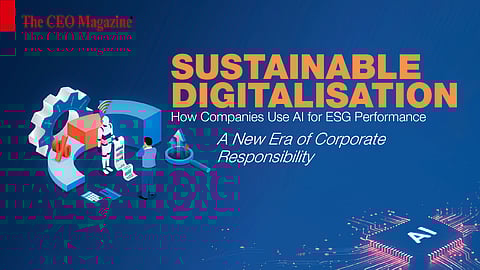
Sustainable Digitalisation: How Companies Use AI for ESG Performance

Corporate responsibility is evolving. Businesses are increasingly expected not just to generate profits but to create meaningful, measurable impact across environmental, social, and governance (ESG) dimensions. The challenge lies in managing complex data streams, monitoring diverse operations, and making strategic decisions that align with sustainability goals.
Enter AI—not as a tool for automation alone, but as a powerful enabler of sustainable digitalisation. Companies are now using artificial intelligence to measure, optimise, and report ESG performance in ways that were previously impossible. This shift is redefining corporate strategy and turning sustainability from a compliance exercise into a source of competitive advantage.
Tracking ESG performance has historically been a labour-intensive process. Calculating carbon footprints, analysing energy consumption, and monitoring resource use across operations were often slow, inconsistent, and prone to errors. AI changes this. Machine learning algorithms can now process vast datasets in real time, identifying trends, forecasting emissions, and highlighting areas for improvement. Companies can respond proactively, ensuring sustainability goals are met while maintaining operational efficiency.
AI doesn’t just collect data; it helps companies detect potential risks before they escalate. By analysing historical and real-time operational data, AI can flag anomalies such as unexpected spikes in energy use, irregularities in supply chain practices, or deviations from ESG compliance standards. Early detection enables businesses to act quickly, preventing reputational or regulatory damage and maintaining stakeholder trust.
Sustainable digitalisation extends beyond the corporate walls. AI enables businesses to evaluate ESG performance across their supply chains, from raw material sourcing to production and delivery. Algorithms can assess supplier practices, predict environmental and social risks, and highlight opportunities to improve efficiency and sustainability. This creates supply chains that are not only more resilient but also aligned with corporate ESG commitments.
AI also empowers companies to simulate the future impact of their operational decisions. For example, predictive models can estimate how climate events, regulatory changes, or resource scarcity might affect costs and emissions. These insights guide investment, planning, and innovation, allowing companies to make informed decisions that balance profitability with sustainability.
AI-generated insights provide a foundation for transparent ESG reporting. Companies can create dynamic dashboards and real-time updates for investors, customers, and regulators, demonstrating progress against targets and operational improvements. This transparency strengthens trust, enhances brand reputation, and positions companies as responsible leaders in their industries.
AI also helps organisations monitor public sentiment and emerging ESG issues. By analysing media coverage, social platforms, and regulatory developments, AI systems detect potential controversies and alert decision-makers. This allows companies to address challenges proactively and maintain a positive image while reinforcing their commitment to responsible business practices.
The true value of AI in ESG lies in its integration with corporate strategy. Beyond reporting and risk management, AI insights are informing long-term decision-making — from capital allocation to product innovation and workforce planning. By embedding sustainability into the core of strategic choices, companies transform ESG from a regulatory obligation into a driver of innovation, efficiency, and competitive advantage.
Sustainable digitalisation is not about replacing people with machines. It amplifies human decision-making by providing precise, actionable insights at scale. Leaders can focus on strategic thinking, creativity, and stakeholder engagement while AI handles data processing, forecasting, and pattern recognition. Together, humans and AI create a system capable of both driving profits and delivering meaningful societal impact.
As more companies adopt AI to support ESG performance, sustainable digitalisation will become a defining feature of modern corporate leadership. Organisations that leverage technology to optimise resource use, strengthen supply chains, and enhance transparency will not only meet regulatory expectations but also generate long-term value for shareholders, employees, and communities alike.
The companies of tomorrow will view AI not just as a technological asset but as a strategic partner in shaping a sustainable, resilient, and responsible future. In this new era, profitability and purpose are no longer opposing forces — they are two sides of the same coin.
Follow us on Google News




