
- News
- Women
- Magazine
- IndustryIndustry
- InsightsInsights
- Success Stories
- PublishPublish
- ContactContact
- Media KitMedia Kit

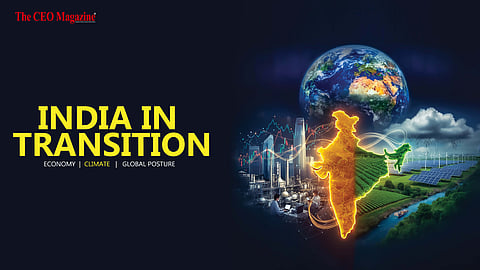
India in Transition
Economy, Climate & Global Posture

December 2025 didn’t deliver a headline-grabbing shock for India; it delivered something more telling: a quiet recalibration. Beneath steady GDP momentum, the country began shifting from easy growth to earned growth, from climate awareness to climate constraint, and from reactive diplomacy to strategic positioning. As India closed the year, the transition was no longer theoretical; it was visible across the economy, the environment, and its evolving role in a fractured world.
As 2025 drew to a close, India’s economic story stood apart from many global peers. While large economies grappled with sluggish growth, inflationary pressures, and geopolitical disruptions, India maintained momentum but not without visible shifts beneath the surface. December 2025 did not mark a dramatic economic turning point; instead, it revealed a deeper realignment in how growth is generated, sustained, and evaluated.
India entered the final quarter of 2025 with strong headline numbers. GDP growth remained among the fastest globally, supported primarily by domestic consumption, infrastructure spending, and services-led expansion. However, the composition of growth revealed a more nuanced picture than headline figures alone suggested.
Urban consumption showed signs of moderation, reflecting cautious discretionary spending and elevated cost pressures in metropolitan areas. In contrast, rural demand emerged as a stabilising force, particularly in sectors such as automobiles, consumer durables, and fast-moving consumer goods. This reversal of traditional urban-led demand patterns signalled a structural shift, one where government spending, agricultural income stability, and targeted welfare interventions began translating into purchasing power beyond city limits.
This divergence mattered. It indicated that India’s growth engine was no longer reliant on a narrow consumption base. Yet it also highlighted persistent inequalities in income distribution, employment quality, and access to capital across regions.
Manufacturing remained central to India’s long-term economic ambitions, especially under the broader objective of reducing import dependence and integrating into global supply chains. Throughout 2025, investments continued to flow into electronics, defence manufacturing, renewable energy equipment, and pharmaceuticals.
However, December exposed certain constraints. Export-oriented manufacturing faced headwinds as global demand softened and protectionist trade measures resurfaced in key markets. New export orders slowed, and cost pressures from logistics to compliance challenged margins.
This did not indicate failure. Instead, it underscored an important reality: India’s manufacturing transition is gradual, capital-intensive, and sensitive to global cycles. The focus began shifting from volume expansion to efficiency, localisation, and value addition.
India’s services sector, traditionally the backbone of its economy, showed signs of consolidation in late 2025. While still expanding, growth moderated in areas such as IT services, consulting, and professional services as global clients tightened spending.
This slowdown did not signal decline but rather a maturing phase. Firms prioritised profitability, automation, and higher-value contracts over aggressive expansion. Hiring slowed, attrition rates stabilised, and productivity became a renewed focus.
In effect, services growth was becoming more disciplined, mirroring trends already visible in global markets. The emphasis shifted from scale to sustainability.
Another defining feature of India’s economic transition was the evolving nature of capital. Credit availability improved across sectors, but lenders became more selective. Risk assessment frameworks tightened, and long-term viability gained prominence over short-term returns.
Equity markets reflected this maturity. Volatility increased, but speculative excesses diminished. Investors showed greater preference for balance-sheet strength, governance clarity, and predictable cash flows.
December 2025 thus marked a quiet but critical shift: India was moving away from easy growth driven by liquidity and momentum towards growth earned through execution and discipline.
If economic data revealed recalibration, climate signals conveyed urgency. December 2025 brought environmental trends into sharper focus, reminding policymakers and businesses alike that climate change was no longer a future risk; it was a present constraint.
December’s unusually dry conditions across large parts of India were not anomalies. They reflected a broader pattern of erratic rainfall, rising temperatures, and seasonal unpredictability observed throughout the decade.
Winter rainfall deficits raised concerns about groundwater replenishment, agricultural planning, and reservoir levels. Regions accustomed to predictable seasonal cycles faced new uncertainties, impacting both rural livelihoods and urban water security.
This volatility carried economic consequences. Agriculture, energy demand, insurance risk, and infrastructure resilience all came under scrutiny.
Climate stress manifested most visibly in cities. Air quality deterioration during winter months once again highlighted the limits of existing mitigation measures. Pollution episodes disrupted daily life, strained healthcare systems, and affected productivity.
Urban planning challenges, including construction intensity, vehicular density, and energy usage, intersected with climatic factors to create complex risk environments. Businesses increasingly accounted for environmental disruptions in continuity planning, logistics management, and workforce health strategies.
December 2025 also saw a noticeable rise in electricity demand, driven by a combination of climate variability and expanding economic activity. While renewable energy capacity continued to grow, dependency on conventional power sources remained significant.
This duality, expanding clean energy ambitions alongside rising overall demand, underscored a central challenge: India’s energy transition must balance speed with reliability.
Climate considerations began influencing capital allocation decisions more directly. Infrastructure projects, industrial clusters, and urban developments increasingly faced environmental scrutiny — not only from regulators but also from financiers and insurers.
Perhaps the most significant shift in December was conceptual. Climate change moved beyond advocacy into operational planning. Discussions focused less on long-term targets and more on adaptation — water management, resilient infrastructure, heat mitigation, and disaster preparedness.
For India, climate transition became inseparable from economic strategy. Growth could no longer be planned independently of environmental constraints.
India’s global posture in December 2025 reflected a world in flux. Alliances were under strain, trade norms were shifting, and geopolitical uncertainty persisted across regions. Against this backdrop, India continued to pursue a policy of strategic autonomy, not as rhetoric, but as practice.
High-level diplomatic engagements during the month reinforced India’s intent to maintain balanced relationships across power blocs. Rather than choosing sides, India focused on preserving space – diplomatic, economic, and strategic – to act in its own interest.
This approach was neither passive nor opportunistic. It reflected a calculated assessment of global fragmentation, where rigid alignments could limit flexibility and expose vulnerabilities.
India’s engagement with traditional partners continued alongside outreach to emerging regions, reflecting confidence in its independent standing.
Trade relations in late 2025 were marked by complexity. Tariff disputes, supply chain reconfigurations, and regulatory divergences tested global commerce. For India, this reinforced the importance of diversification in export markets, energy sourcing, and technology partnerships.
Technology emerged as a strategic domain. Semiconductor manufacturing, digital infrastructure, and AI governance became areas of both cooperation and competition. India positioned itself not merely as a market but as a participant in shaping global standards.
In its immediate neighbourhood and the broader Indo-Pacific, India continued to emphasise stability, connectivity, and rule-based engagement. Maritime security, trade routes, and regional infrastructure formed part of its strategic calculus.
December underscored a key reality: India’s global posture was no longer reactive. It was increasingly proactive, informed by economic strength, demographic scale, and geopolitical relevance.
What made December 2025 distinctive was not any single trend, but the convergence of transitions.
● An economy shifting from speed to substance
● A climate reality reshaping planning and investment
● A global posture defined by balance, not alignment
These forces did not operate independently. Climate stress influenced economic decisions. Global volatility affected capital flows. Domestic resilience strengthened diplomatic leverage.
India’s transition was thus not linear. It was layered, complex, and ongoing.
India closed 2025 not at a finish line, but at a threshold.
The country’s strengths – scale, consumption, innovation, and institutional continuity – remained intact. Yet the challenges were equally real: environmental constraints, global uncertainty, and the demand for more inclusive, resilient growth.
Transition, in this context, did not imply instability. It signified adaptation, the willingness to evolve economic models, rethink environmental priorities, and assert strategic independence in an unpredictable world.
As India moved into the next phase of its journey, the lessons of December 2025 offered clarity:
Growth would endure, but only if it remained grounded.
Global engagement would expand, but only with autonomy.
And progress would matter only if it proved sustainable.
Follow us on Google News