
- News
- Women
- Magazine
- IndustryIndustry
- InsightsInsights
- Success Stories
- PublishPublish
- ContactContact
- Media KitMedia Kit

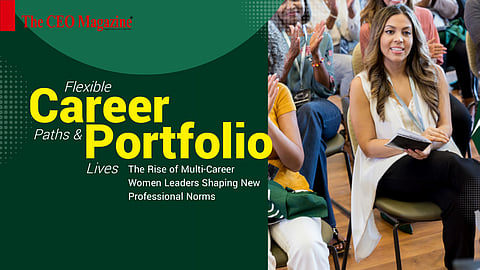
Flexible Career Paths & Portfolio Lives

For decades, the definition of a “successful career” followed a familiar script — choose a field early, stay consistent, climb steadily, and retire with depth in one domain. Stability was respected. Linear growth was rewarded. Changing directions too often was seen as distraction, not strategy.
That script is quietly dissolving.
Across industries, women leaders are redesigning what a career looks like. They are not abandoning ambition — they are expanding it. Instead of committing to a single professional identity, many are building portfolio lives: careers composed of multiple roles, evolving interests, and parallel pursuits that grow over time.
Consultant and creator. Founder and investor. Executive and mentor. Strategist and writer. Operator and educator.
The rise of multi-career women is not a trend driven by restlessness. It is a response to a changing economy, shifting personal priorities, and a deeper understanding of what fulfillment means over a long professional life.
Women entering the workforce today — and even those mid-career — are operating in an environment very different from previous generations. Industries transform quickly. Skills become obsolete faster. Digital platforms allow individuals to build visibility and influence beyond their job titles.
In this context, anchoring one’s identity to a single role feels limiting.
Many women are asking:
Who am I beyond my designation?
What skills do I want to develop beyond my job?
What work energizes me, not just sustains me?
These questions are leading to career designs that are fluid rather than fixed.
A marketing leader may also run a podcast. A corporate lawyer may teach at a university. A startup founder may invest in other ventures. A healthcare professional may write, mentor, and consult alongside clinical practice.
None of these paths dilute expertise. They deepen it.
Flexibility is not only philosophical; it is practical.
Economic uncertainty, evolving industries, and the rise of independent work models have pushed professionals to diversify income streams. Women, in particular, are building resilience by not relying on a single source of financial stability.
Portfolio careers allow:
multiple income channels
skill diversification
career pivots without starting from zero
greater control over time and energy
Entrepreneurship plays a significant role here. Many women are building side ventures before transitioning them into primary work. Others are combining advisory roles with operational leadership.
This layered approach reduces risk while increasing opportunity.
Traditional ambition often equated success with hierarchy — larger teams, bigger titles, greater authority. While these markers still matter, many women leaders are redefining ambition around autonomy and impact.
Impact might mean:
building a meaningful venture
mentoring the next generation
solving niche problems deeply
creating intellectual property
shaping industry conversations
Autonomy means choosing how work fits into life — not the other way around.
Portfolio lives allow both. They enable women to pursue multiple forms of impact simultaneously rather than sequencing them over decades.
Another reason flexible career paths are gaining momentum is the reality of life stages.
Women navigate phases that may include caregiving, relocation, entrepreneurship, advanced education, or health recalibration. Linear career models often fail to accommodate these shifts gracefully.
Portfolio careers provide adaptability.
A woman stepping back from a full-time corporate role may continue consulting, teaching, or advising. Someone transitioning into motherhood may build a knowledge platform or freelance practice. A senior leader approaching midlife may shift toward board roles, investment, or mentorship.
Work continues — but in redesigned forms.
This prevents the loss of identity that often accompanies rigid career interruptions.
Digital ecosystems have accelerated this shift.
Platforms allow professionals to build personal brands, share insights, create courses, write newsletters, consult globally, and collaborate across borders. Visibility is no longer limited to institutional affiliation.
Women are using technology to:
publish expertise
build communities
launch ventures, and
expand influence beyond organizational boundaries
This visibility supports credibility, which in turn opens doors to speaking, advisory, and partnership opportunities.
The career becomes an ecosystem rather than a ladder.
Multi-career women leaders often develop a distinctive leadership style.
They become integrators — connecting insights from different domains. They build pattern recognition across industries. They bring creative problem-solving shaped by diverse experiences.
Their decision-making is often more contextual. Their networks are broader. Their resilience is stronger because their identity is not tied to a single role.
This kind of leadership is increasingly valuable in a world that demands adaptability.
There is also a psychological liberation in portfolio living.
Women no longer feel pressured to “choose one version” of themselves. They can explore intellectual curiosity, creative interests, and professional expertise simultaneously. They can evolve publicly without feeling inconsistent.
This freedom encourages experimentation. It allows reinvention without apology.
It also creates space for purpose-driven work. Many women use portfolio careers to support causes, mentor emerging leaders, or contribute to sectors beyond their primary industry.
Work becomes multidimensional, not transactional.
Flexible careers are not without complexity.
They require disciplined time management, strong personal branding, financial planning, and the ability to handle ambiguity. Without clear structures, boundaries can blur. Burnout can appear if every opportunity is pursued simultaneously.
There is also societal inertia. Some organisations still value linear trajectories and single-role commitment. Multi-career professionals may be questioned about focus or loyalty.
But this resistance is gradually softening as more leaders demonstrate the effectiveness of diversified professional lives.
Companies are beginning to adapt.
Forward-looking organisations are creating flexible leadership roles, project-based engagements, and advisory pathways. They are recognising that professionals with varied experiences bring richer insights.
Instead of fearing side pursuits, some companies now see them as learning accelerators. Employees who write, teach, or build communities often strengthen the organisation's brand and knowledge base.
The employer-employee relationship is evolving from ownership to partnership.
The rise of portfolio careers suggests that the future of work will be less about fixed roles and more about evolving capabilities.
Women leaders are not waiting for institutions to redesign work. They are redesigning it themselves.
They are building careers that reflect:
Curiosity
Resilience
Financial intelligence
Creative expression, and
Long-term sustainability
This shift is shaping new norms for younger professionals who see flexibility not as instability but as strength.
Perhaps the most important transformation is internal.
Success is no longer defined by a single title or a predictable trajectory. It is defined by alignment — between work and values, ambition and wellbeing, and expertise and curiosity.
Multi-career women are demonstrating that professional life can be expansive rather than narrow. That growth can happen in parallel, not just sequentially. That reinvention is not failure — it is evolution.
Portfolio lives do not reject structure. They redesign it.
And as more women leaders step into these multidimensional careers, they are not just shaping their own futures. They are reshaping the expectations of what a meaningful professional life can look like for everyone who follows.
Follow us on Google News