
- News
- Women
- Magazine
- IndustryIndustry
- InsightsInsights
- Success Stories
- PublishPublish
- ContactContact
- Media KitMedia Kit
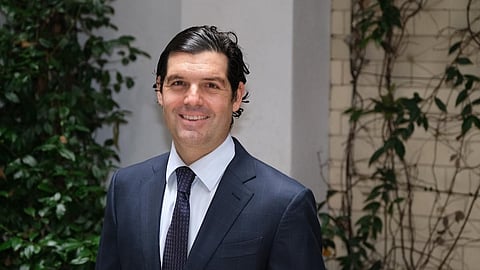
Alejandro Betancourt

Somewhere between the spinning jenny and the steam engine, the world changed forever. Factories replaced farms as the economic engine of society, cities swelled with workers, and entire industries vanished while new ones emerged from smoke and iron. That transformation took generations to unfold. According to Alejandro Betancourt López, the current wave of digital disruption will accomplish something similar—but at a pace that compresses decades into years.
"I think the digital revolution is going to be as world-changing as the industrial revolution, but even faster and more aggressive," Betancourt López said. "There are going to be a lot of winners, a lot of losers, and it's just interesting times to live through."
Global spending on digital transformation reached $2.5 trillion in 2024 and is projected to hit $3.9 trillion by 2027. Nearly 75% of business leaders now say investing in digital transformation
is essential within the next 12 months. Yet despite this flood of capital, only about 35% of companies accomplish their stated digital transformation objectives—a success rate that underscores both the difficulty and the high stakes involved.
Alejandro Betancourt López has built a career on anticipating where markets are headed before others catch on. His investment philosophy centers on identifying which segment of an industry's value chain will generate profits next—and positioning himself there first. With the digital revolution, he sees that same dynamic playing out across virtually every sector of the global economy.
"A lot of transformation is going to happen," he said. "A lot of new jobs are going to be created, but unfortunately a lot of traditional employment is going to be lost or replaced by this revolution."
His perspective carries weight. Betancourt López serves as president of Hawkers, the Spanish eyewear brand that disrupted the sunglasses market through digital marketing and direct-to-consumer sales. He also backed Auro Travel, a ride-sharing company in Spain that accumulated vehicle-for-hire licenses before major competitors entered the market. Both ventures reflect his broader investment thesis: those who recognize technological shifts early and act decisively stand to benefit enormously, while those who hesitate may find themselves displaced.
What makes the current technological shift different from previous waves of innovation is speed. Alejandro Betancourt López points to artificial intelligence as the primary catalyst—a technology that fundamentally changes how quickly problems get solved and decisions get made.
"What is AI? It's a machine that thinks faster and finds solutions faster," Betancourt López explained. "So AI just makes everything more efficient. It's not only in energy. In anything. So if you've got a good AI tool that will think faster, find a solution faster, and give a probability that where you have to do or implement a strategy that is going to give you a better result faster than trial and error that a human being can do, of course, it's just a matter of what tools are going to be out there and when they're going to be available."
That assessment tracks with broader market trends. Approximately 52% of U.S. businesses now rank AI at the top of their digital transformation priorities, while 55% of industrial product manufacturers already deploy generative AI tools in their operations. Companies across sectors are racing to integrate machine learning capabilities, recognizing that competitive advantage increasingly depends on computational speed and analytical sophistication.
Alejandro Betancourt López made his own bet on AI roughly five years ago, before the technology dominated mainstream business conversations. That early investment has appreciated significantly as the sector has exploded.
"I have a big investment I made about five years ago in AI, and now it's exploding," he said. "When I invested, it wasn't a big thing. So I think I got lucky. I'm not going to tell you I'm a visionary that I thought... But I thought it was a great idea. I did a big ticket on it and now it's 20 times its investment."
His willingness to commit substantial capital to an emerging technology before it reached widespread adoption reflects a broader investment philosophy. Betancourt López has described himself as "a very high risk taker, a massive risk taker"—but one with what he calls "a good batting average." His approach involves placing large bets on opportunities where he perceives asymmetric upside, accepting that some will fail while expecting the winners to more than compensate.
"When you have a portfolio of 10 investments and they're all very high stakes, big return or nothing, if two of them go well, they pay for the eight and make you a good profit for everything else," Betancourt López noted.
Questions about who wins and who loses in this technological reshaping depend heavily on timing and adaptability. Alejandro Betancourt López has observed these dynamics firsthand across his diverse portfolio of investments, from energy to fashion to transportation technology.
His analysis draws on historical parallels. Just as the industrial revolution shifted economic value from agriculture to manufacturing, and later from manufacturing to services, the digital revolution is redistributing profits across industry value chains in real time.
"If you can talk about the oil industry, at the beginning, the refiners, when the Rockefellers were in the business, were the ones making the profit," Betancourt López explained. "Then oil became a scarcity, and then the value was in the producer of the oil more than the refineries. Then shipping, when war came in the '40s, who had the means of transporting goods—that's how Onassis made his fortune because he had all the ships. It's the way you place yourself in any industry that can capture that margin and create that value."
That same logic applies to digital transformation. Alejandro Betancourt López sees opportunity in sectors where technology can dramatically improve efficiency or where artificial intelligence can accelerate decision-making. His investment group, O'Hara Administration, has begun shifting focus toward AI, manufacturing for technology, and robotics—areas he considers "high risk, high reward.”
For workers and businesses caught in this transition, Betancourt López offers a sobering but practical perspective. Adaptability matters more than any single technical skill, and those who can learn quickly will find opportunities even as traditional roles disappear.
"I consider myself a very fast learner, and that's why I call myself a good director for orchestra because I know how to play a little bit of every instrument, and that's key for success," he said.
"I understand the basics of my investments. And I surround myself with good talent and people that I think can run it efficiently."
Alejandro Betancourt López remains optimistic about what lies ahead, even as he acknowledges the disruption will create hardship for many. His advice for entrepreneurs and investors trying to position themselves for the coming changes reflects his broader philosophy: anticipate where value is moving, commit resources decisively, and never stop pushing forward.
"Don't be afraid of success. Don't be afraid of failure. You're going to fail for sure, but you're going to be successful at some point."
Follow us on Google News