
- News
- Women
- Magazine
- IndustryIndustry
- InsightsInsights
- Success Stories
- PublishPublish
- ContactContact
- Media KitMedia Kit


WhatsApp payment links offer D2C brands a powerful solution to combat the 74% cart abandonment rate that plagues e-commerce, delivering significantly higher recovery rates than traditional email campaigns.
WhatsApp messages achieve 98% open rates vs email's 15-25%, with payment link recovery rates of 25-40% compared to email's 5-11%
Set up requires WhatsApp Business API access through a BSP, payment gateway integration, and pre-approved message templates for compliance
Send personalized first reminders within 1-2 hours of abandonment, include product visuals, and save discounts for follow-up messages
Segment customers using RFM principles and track key metrics like delivery rate, click-through rate, and conversion rate for optimization
Avoid over-messaging and generic content - targeted campaigns achieve 50% higher conversion rates than broad approaches
This strategy transforms cart abandonment from a revenue leak into a conversion opportunity by meeting customers where they already spend their time and removing payment friction through native UPI integration. 74% of people who add products to their cart leave without buying. That's a massive revenue leak for any D2C brand.
Email recovery campaigns? They scratch the surface with 15-25% open rates. WhatsApp messages hit 98% open rates, and brands using a payment link strategy are seeing 3-5x higher conversion rates.
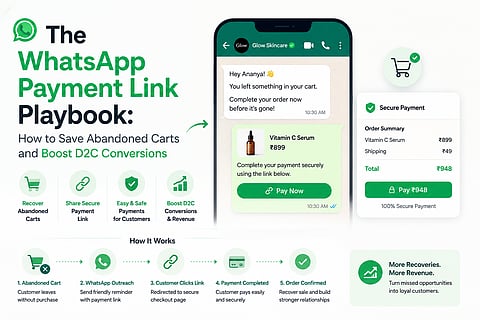
Here's what makes this powerful: generate a payment link through your payment gateway and send it via WhatsApp. You're meeting customers where they are. 500 million Indians use WhatsApp daily. This makes it the direct path to recovering lost sales.
This playbook will show you how to set up, optimize and scale your WhatsApp payment link system for maximum cart recovery.
Email campaigns face a fundamental visibility problem. Messages land in promotional tabs and compete with dozens of other notifications. They often arrive hours after the customer has moved on. Open rates hover between 20-35%. This means roughly 7 out of 10 recovery attempts never get seen. Even well-crafted sequences struggle to create urgency when the message sits unread in an inbox.
The bigger problem happens at the redirect itself. Customers click through from their cart to a browser-based checkout. That transition point creates friction. Mobile users abandon at this moment. The change from app to browser, the need to re-enter information, and the loss of conversation context all contribute to drop-off rates.
A payment link is a direct payment URL that you generate through your payment gateway and share via WhatsApp. Customers click this link and land on a secure payment page
without leaving the WhatsApp environment. The entire transaction happens within the in-app browser and maintains the conversational flow.
This connects to UPI for Indian customers, which is already their default payment behavior. The payment link eliminates the need for complex checkout logic and still provides secure transaction processing. You generate the link with a unique reference ID, amount, and expiration time, then embed it in your WhatsApp message.
UPI adoption has changed how Indians expect to pay. Removing the redirect to an external checkout eliminates the friction point where most mobile conversions fail. WhatsApp messages arrive as push notifications with 80-95% open rates. This creates immediate visibility that email can't match.
The cost factor matters too. Reactivating an existing customer through WhatsApp costs a fraction of acquiring a new one. Lower costs combine with higher visibility and native payment integration. The channel advantage becomes clear.
Cart abandonment recovery messages sent via WhatsApp convert at 8-15%. Email equivalents convert at 2-5%. Brands running a three-message WhatsApp sequence among email see recovery rates of 15-40%, compared to 5-15% for email-only flows. The biggest lift comes from the first WhatsApp message sent within the first hour of abandonment.
Ground results verify these measures. Flexnest dealt with 60% cart abandonment and implemented a three-message WhatsApp sequence. They achieved a 40% conversion rate. Brands switching from email-only recovery to WhatsApp-inclusive strategies report 45% more cart recovery.
WhatsApp Business API access is required to set up a WhatsApp payment link system. The standard WhatsApp Business App cannot be used for this. The API provides automated messaging, chatbots and customization features that payment workflows need.
A Business Solution Provider (BSP) must handle your integration with WhatsApp Business API. BSPs manage the technical implementation and help you go live within hours. Razorpay has partnered with major BSPs in India, and this makes integration simple with just a few clicks. Your payment recovery flows can begin once your BSP sets up the API connection.
Payment gateways like Cashfree, Razorpay, PayU and Stripe support WhatsApp integration. You need to link your payment gateway account with WhatsApp after integrating with the WhatsApp Business API through your BSP.
Self-owned WhatsApp Business Accounts require you to log into Facebook Business Manager, create a Direct Pay Method and select your payment gateway. The system redirects you to your payment gateway where you authorize Meta to request payments on your behalf. Your BSP creates the Direct Pay Method and shares a link with you to complete authorization if they own the WhatsApp Business Account.
Your payment provider dashboard generates payment links. Workflows can automate delivery, so a payment link is created and shared via WhatsApp the moment a customer abandons their cart.
WhatsApp requires pre-approved templates for all outbound messages. Templates must be categorized as authentication, marketing or utility. Cart recovery messages fall under utility category since they relate to user-initiated transactions.
Template names can only contain lowercase alphanumeric characters and underscores. WhatsApp reviews most templates within minutes, though some require human review that takes up to 48 hours.
You must get opt-in permission before messaging anyone on WhatsApp. Businesses need confirmation that customers wish to receive messages, and this must comply with local laws.
Phone numbers can be collected at checkout by adding a required field during the purchase flow. SMS campaigns with keywords and contact forms on your website are other effective methods. Store these numbers securely in your CRM for automated cart recovery workflows once collected.
Address customers by name and reference their specific abandoned items. A message like "Hey Priya, you left your tote bag behind" feels personal rather than automated. Send this first reminder within 1-2 hours of abandonment when intent remains fresh.
Your WhatsApp message should include product images and prices. Visuals help customers recognize what they want and reignite purchase intent. WhatsApp Business API supports rich media. This makes it easy to embed product photos with your payment gateway link.
Write messages the way you'd text a friend. Use conversational language without pressure tactics. Try "Still thinking it over? We saved your cart" rather than "Complete your purchase now". Keep the tone light, empathetic and helpful rather than pushy.
Hold discounts until the second or third message if the first reminder doesn't convert. Offer 10-15% for most categories. Instant discounts produce most important recovery rate lifts. Time-limit your offers to 24-48 hours. This creates urgency without conditioning customers to always expect discounts.
Enable chatbot responses to answer common queries about sizing, delivery or payment methods. Immediate assistance keeps the conversation active when customers reply with questions and supports faster conversions. This up-to-the-minute interaction removes hesitation that blocks purchases typically.
Track open rate, reply rate, click-through rate, and conversion rate for every payment link campaign. WhatsApp open rates reach 98%, higher than any other channel. Monitor your recovery rate by dividing recovered abandoned carts by total abandoned carts. Watch delivery rate too, which should stay between 95-99%.
WhatsApp cart recovery messages achieve 25-40% recovery rates within 30 minutes of abandonment. Email cart recovery averages 5-11%. WhatsApp delivers 45-60% click-through rates on targeted campaigns versus email's 2-3%. Keep in mind 88-95% of WhatsApp messages get read within 5 minutes. Email response times span hours or days.
Segment customers using the RFM principle: Recency, Frequency, and Monetary value. One brand saw a 15% recovery rate increase for high-value segments without offering any discount. Customer segmentation delivers 760% revenue increases and 77% ROI. Segmented campaigns achieve 50% higher conversion rates.
Payment gateway links sent at suboptimal intervals kill recovery potential. Avoid generic messaging in every segment, as 37% of marketing spend gets wasted on poor targeting. Over-messaging causes fatigue and opt-outs exceeding 3-5% per campaign.
You now have a system to recover abandoned carts and boost conversions through WhatsApp payment links. The setup is simple: connect your payment gateway, get API access and craft messages tailored to each customer. Your recovery rates will climb from single digits to 25-40%.
Test different timing intervals with your first reminder message and track what works with your audience. Cart abandonment doesn't have to mean lost revenue.
Q1. What is a WhatsApp payment link and how does it work?
A WhatsApp payment link is a secure payment URL generated through your payment gateway that you share directly via WhatsApp. When customers click this link, they're taken to a payment page within WhatsApp's in-app browser, allowing them to complete their purchase without leaving the app. The link connects directly to payment methods like UPI, making the checkout process seamless and friction-free.
Q2. Why do WhatsApp payment links have higher conversion rates than email?
WhatsApp messages achieve 98% open rates compared to email's 20-35%, meaning your recovery attempts actually get seen. Additionally, WhatsApp payment links keep customers within the app environment, eliminating the friction of redirecting to external browsers. This results in conversion rates of 8-15% for WhatsApp versus just 2-5% for email cart recovery campaigns.
Q3. Do I need special permissions to send payment links on WhatsApp?
Yes, you need WhatsApp Business API access (not the standard WhatsApp Business App) and must obtain opt-in permission from customers before messaging them. You'll also need to create pre-approved message templates that WhatsApp reviews, which typically takes minutes but can take up to 48 hours. Working with a Business Solution Provider simplifies this setup process significantly.
Q4. When should I send the first cart recovery message on WhatsApp?
Send your first reminder within 1-2 hours of cart abandonment when customer intent is still fresh. The biggest conversion lift comes from messages sent within the first hour. If the first message doesn't convert, follow up with a second message (potentially with a discount) and a third reminder if needed, spacing them appropriately to avoid over-messaging.
Q5. What metrics should I track to measure WhatsApp payment link success?
Monitor open rate, click-through rate, conversion rate, and overall recovery rate (recovered carts divided by total abandoned carts). Your delivery rate should stay between 95-99%, and opt-out rates should remain under 3-5% per campaign. Compare these metrics against your email performance to quantify the channel advantage and identify opportunities for optimization.
Follow us on Google News