
- News
- Women
- Magazine
- IndustryIndustry
- InsightsInsights
- Success Stories
- PublishPublish
- ContactContact
- Media KitMedia Kit

Why Travel Has Become a Form of Self-Expression

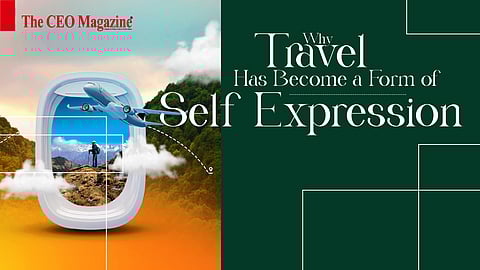
Travel has always been about distances — from one location to another, from routine to novelty, from familiarity to surprise. But in today’s world, travel is no longer only about geography. It has become about identity. Where people go, how they travel, what they document, and the stories they return with — all of it has become an expression of who they believe they are. For many urban Indians, travel is now a language: a way to express values, creativity, aspirations, and even their worldview.
This shift has quietly rewritten the very purpose of travel. From “I need a break” to “This trip defines me,” the motivations behind journeys are changing — and with them, the entire travel ecosystem is being reshaped.
One of the defining features of modern travel is the rise of narrative-driven journeys. People don’t just travel — they build stories around travel. Social media has accelerated this dramatically. Experiences are curated, not simply lived. Places that were once described are now captioned, filmed, clipped into short reels, and shared publicly. This digital documentation has created a new kind of traveler — one who does not simply explore the world but also showcases a version of themselves through it.
Instead of asking “Where should I go?” many people now ask, “What destination reflects my personality?” This emotional mapping has created interesting patterns in the tourism sector. Adventure seekers gravitate toward high-altitude treks and challenges. Wellness-focused travelers book retreats in the Himalayas or Ayurveda-based resort stays. Heritage enthusiasts seek quiet towns, architectural trails, and local culture. Even the choice of accommodation — hostels, luxury hotels, homestays, boutique villas — becomes part of one’s identity.
Travel has become less about itinerary and more about intention.
The idea of travel as self-expression is strongly shaped by identity. The place one visits communicates a message. Backpacking solo to Spiti signals independence. A beach villa in Phuket suggests leisure and luxury. A cycling trail in Vietnam reveals endurance. Each choice creates a personal brand — consciously or not. Even group trips reflect personality types: ad-hoc road trips often imply spontaneity, while carefully planned itineraries reflect structure and caution.
Consultants observing this trend note a key insight: travel choices are no longer random — they are reflective. People see destinations the way they once saw wardrobes: as something that defines them. Just like fashion evolved into a statement, travel has become a declaration.
Another major shift is the desire for purpose. Modern travellers want more than sightseeing — they want meaning. This has led to the growth of:
Voluntourism, where individuals travel to contribute to environmental or social initiatives.
Wellness travel, where meditation, Ayurveda, mindfulness, and digital detox take centerstage.
Educational trips, focused on history, design, architecture, or wildlife conservation.
Local immersion experiences, where travelers stay with host families, learn cooking, or participate in cultural rituals.
The idea is not only to leave a destination with photographs — but with a new perspective. This has resulted in a shift from tourism to transformation.
Work culture has also influenced the way India travels. Remote work, flexible schedules and the rise of digital professions have allowed people to travel for extended stays. “Workations” have turned into a genuine lifestyle shift for many professionals who are choosing to spend a month in Goa rather than a weekend. Homestays are replacing hotels. Cafés with strong Wi-Fi are replacing offices. A growing segment of urban Indians now plans a life around mobility rather than fixed residency.
This has led to a subtle rethinking of home itself — is home a location, or can it be temporary? For consultants evaluating evolving hospitality models, the answer is increasingly fluid.
Technology has become both map and companion. AI-generated itineraries, personalized travel suggestions, digital travel communities, and niche platforms for adventure or wellness holidays have begun shaping decisions faster than tourism advertisements ever did. Instead of brochures, people rely on reels. Even traditional brochure design is evolving, with travel brands blending print aesthetics and digital storytelling to create more immersive experiences for modern audiences. Instead of travel agents, they ask algorithms. Even travel planning has become a form of expression: minimalistic travelers favor lightweight planning tools, while detail-focused travelers rely on spreadsheets and digital maps.
Behind this transformation lies a deeper cultural change — a preference for autonomy, personalization, and story-centric exploration. Travelers want to control not only where they go, but how that journey is remembered.
Despite the influence of technology and trends, emotional experience remains at the heart of travel. A silent sunrise at a hill station, a conversation with a local artisan, a spontaneous street food experience — these moments shape what travelers take back with them. Travel, at its core, remains a form of discovery. But today, it is also a form of declaration: This is who I am when I am not defined by my daily life.
In many ways, travel is the one place where people reinvent themselves without judgment. Away from professional titles and personal responsibilities, individuals get to redefine their identity. And that freedom has become deeply valued.
For travel consultants and hospitality strategists, this landscape offers both challenge and opportunity. The task is no longer just designing packages or promoting destinations — it is about understanding psychology and behavior. The travel sector is not only being shaped by hotels and airlines, but also by storytellers, cultural experts, wellness practitioners, sustainability advocates, and digital content creators.
Experience has become a currency. Authenticity has become an expectation. And personalization has become non-negotiable.
Consultants will increasingly need to observe micro-trends: What does a traveler seek when they choose a small town over a big city? Why are young professionals taking heritage walks instead of mall outings? Why do pop-up travel retreats sell out in minutes? What makes a journey Instagrammable, meaningful, or unforgettable? The answers to these questions are not just market insights — they are glimpses into evolving human behavior.
The future of travel may not be defined by how far people go — but by how deeply they connect with where they go. Whether through culture, community, wellness, adventure, learning or storytelling, travel is becoming a form of self-expression — and a way to reclaim identity. In a world where daily life is often structured, branded, and automated, travel remains one of the last places where people can consciously choose who they want to be.
Consultants watching this shift closely understand that the next era of the travel industry will not be led by travel agents — but by curators of human experience. The road ahead is not only about destinations. It is about definitions — of self, aspiration, memory, and meaning.
And perhaps that is the real reason travel has become more than movement. It has become a mirror.
Follow us on Google News