
- News
- Women
- Magazine
- IndustryIndustry
- InsightsInsights
- Success Stories
- PublishPublish
- ContactContact
- Media KitMedia Kit

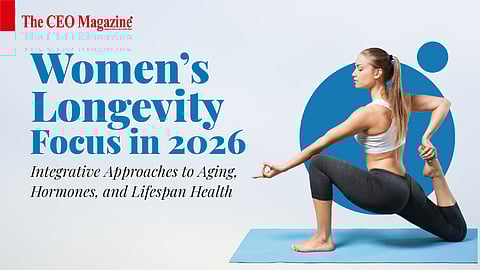
Women’s Longevity Focus in 2026

For years, conversations around women’s health were reactive. Treatment began after symptoms appeared, after fatigue set in, after bone density dropped, and after hormonal imbalance disrupted daily life. Ageing was something to "manage", often quietly, often privately.
In 2026, that mindset is shifting.
Women are no longer approaching health as crisis management. They are approaching it as a long-term strategy. Longevity is not being framed as simply living longer but living stronger — with cognitive clarity, metabolic stability, emotional resilience, and physical independence well into later decades.
This shift is being led by informed women—professionals, entrepreneurs, clinicians, and carers—who are asking deeper questions: How do I sustain energy over decades? How do I protect my brain health? How do I navigate hormonal transitions without losing performance or quality of life?
Longevity, for them, is not a medical topic alone. It is a life design priority.
The language itself is changing. Anti-ageing implied resistance — a battle against time. Longevity focuses on optimisation — working with the body’s natural rhythms and changes.
Women are no longer chasing youth. They are investing in vitality.
This includes understanding that ageing is not a single event. It is a continuum influenced by sleep, nutrition, stress, environment, hormones, movement, and emotional wellbeing. Each life stage requires recalibration, not fear.
Instead of reacting to decline, women are building resilience earlier.
One of the most significant developments in women’s longevity conversations is the central role of hormonal health.
For decades, hormonal changes — especially perimenopause and menopause — were under-discussed, misunderstood, or dismissed as inevitable discomforts. Many women navigated fatigue, mood shifts, metabolic changes, and sleep disruptions without structured guidance.
Today, awareness is rising.
Women are seeking education about oestrogen, progesterone, testosterone, insulin, cortisol, and thyroid function — not as isolated medical concepts, but as interconnected systems that influence energy, mood, weight, cognition, and long-term disease risk.
They are asking better questions:
Why am I suddenly exhausted despite sleeping?
Why does stress feel harder to recover from?
Why is weight distribution changing?
Why is focus different than it used to be?
This curiosity is reshaping healthcare engagement. Women are consulting endocrinologists, functional medicine practitioners, nutrition experts, and mental health professionals as part of a holistic approach.
Hormones are no longer a hidden topic. They are central to lifespan planning.
What defines the longevity movement in 2026 is integration.
Instead of addressing health in fragments — fitness separately, diet separately, mental health separately — women are adopting a systems perspective. They understand that sleep affects hormones, hormones affect metabolism, metabolism affects mood, mood affects productivity, and productivity affects stress.
Everything is connected.
Integrative longevity approaches often include:
Structured strength training to preserve muscle mass and bone density
Nutritional strategies focused on protein, micronutrients, and blood sugar stability
Sleep optimization as a non-negotiable foundation
Stress regulation through mindfulness, therapy, or restorative practices
Preventive screenings and biomarker tracking
These are not extreme interventions. They are steady practices repeated over years.
Longevity is being built through consistency rather than intensity.
One of the clearest shifts is the growing recognition that muscle is a longevity asset.
Strength training, once associated primarily with aesthetics or athletic performance, is now understood as protective. It supports metabolic health, balance, mobility, and independence later in life.
Women are reframing fitness goals. The objective is not just to look fit but to remain capable — to climb stairs comfortably at 70, to travel independently at 80, and to avoid preventable frailty.
This reframing is powerful. It moves the conversation away from appearance toward function.
Physical health is only one dimension.
Women are also investing in cognitive longevity. As professional careers extend and intellectual engagement continues longer, maintaining mental sharpness becomes essential.
Practices supporting brain health are becoming part of daily routines:
deep sleep hygiene
learning new skills
reading and intellectual engagement
social connection
stress management
Mental wellbeing is no longer separated from physical health. Burnout, chronic stress, and emotional suppression are recognised as longevity risks.
Women are normalising therapy, emotional reflection, and community support as part of health maintenance — not emergency response.
Nutrition conversations are evolving from calorie control to metabolic stability.
Women are paying attention to protein intake for muscle preservation, healthy fats for hormonal support, fibre for gut health, and micronutrients for cellular repair. They are also becoming more aware of how blood sugar fluctuations affect mood, focus, and energy.
Rather than following restrictive trends, many are building sustainable eating patterns that support long-term health.
Food is being reframed as fuel, repair, and protection.
Wearables, biomarker testing, and digital health tools are increasingly supporting longevity planning.
Women are tracking sleep quality, heart rate variability, activity patterns, and recovery indicators. Preventive screenings are gaining importance. Instead of waiting for symptoms, they are monitoring early signals.
This proactive engagement shifts the healthcare relationship from episodic to continuous.
Knowledge reduces fear. Data encourages action.
Perhaps one of the most important aspects of the longevity movement is community.
Women are sharing experiences about perimenopause, ageing parents, nutrition strategies, mental health journeys, and lifestyle changes. These conversations, once private, are becoming public and supportive.
This shared wisdom reduces isolation and accelerates awareness. Younger women learn earlier. Older women feel seen and supported.
Longevity becomes a collective conversation rather than an individual struggle.
The focus on longevity is changing how women see their future.
Midlife is no longer viewed as a decline phase. It is seen as a transition into a different form of strength — informed, grounded, and intentional. Careers are extending. Reinvention is common. Personal growth continues.
Health becomes the foundation that enables all of this.
Women are recognising that lifespan and healthspan are not the same. Living longer matters less if those years are limited by fatigue, illness, or dependence.
The goal is quality, not just quantity.
The longevity conversation will continue to deepen. Personalised medicine, hormone research, nutrition science, and preventive care will become more sophisticated. But the cultural shift is already visible.
Women are claiming ownership of their ageing process.
They are learning earlier, acting sooner, and speaking openly. They are investing in strength, resilience, emotional wellbeing, and metabolic health. They are designing lifestyles that support not just the next year, but the next three decades.
Longevity is no longer a distant medical aspiration. It is a daily practice.
And in 2026, women are leading that practice — not quietly, but consciously — shaping a future where ageing is not feared but prepared for with clarity, care, and confidence.
Follow us on Google News