
- News
- Women
- Magazine
- IndustryIndustry
- InsightsInsights
- Success Stories
- PublishPublish
- ContactContact
- Media KitMedia Kit
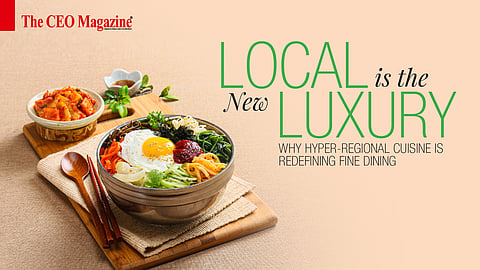
Local Is the New Luxury: Why Hyper-Regional Cuisine Is Redefining Fine Dining

For decades, luxury dining was defined by distance. The more exotic the ingredient, the more premium the experience. Imported cheeses, international wines, and global cuisines dominated menus that were designed to impress through rarity rather than relevance.
Today, that definition is quietly but decisively changing.
Across the world—and increasingly in India—luxury is no longer about how far food travels. It is about how close it comes to its roots. Hyper-regional cuisine, once considered niche or even restrictive, is now at the forefront of fine dining. What was once everyday food, tied to geography and tradition, is being rediscovered, reinterpreted, and elevated.
In this new landscape, the story behind the ingredient matters as much as the ingredient itself.
Hyper-regional cuisine goes beyond the broad labels of “Indian,” “Italian,” or “Asian.” It narrows the focus to specific regions, communities, and even micro-seasons. It celebrates ingredients that are native to a particular area and recipes that have been shaped by local history, climate, and culture.
This is not just about cooking local food—it is about preserving and presenting culinary identity in its most authentic form.
In India, this shift is particularly significant. A country known for its culinary diversity is now seeing a renewed appreciation for dishes that were once confined to homes and small communities. From forgotten grains and indigenous vegetables to age-old cooking techniques, chefs are turning to the past to create something that feels both nostalgic and new.
The rise of hyper-regional cuisine did not happen overnight. It evolved from earlier movements such as farm-to-table dining, which emphasised freshness and sustainability. But while farm-to-table is focused on sourcing, hyper-regional cuisine goes a step further—it focuses on storytelling.
Every dish becomes a narrative.
It tells the story of where the ingredient was grown, who cultivated it, how it has been traditionally prepared, and why it matters. This transforms dining from a transactional experience into an emotional one.
A simple millet-based dish, for instance, is no longer just about taste. It becomes a reflection of agricultural heritage, nutritional wisdom, and regional resilience. The diner is not just consuming food; they are engaging with culture.
In this movement, chefs are no longer just creators—they are curators.
Their role extends beyond crafting flavours to researching, preserving, and presenting culinary traditions. Many are travelling to remote regions, working with local communities, and bringing lesser-known ingredients into mainstream awareness.
This shift requires a different kind of creativity. It is not about reinventing dishes entirely but about respecting their origins while adapting them to contemporary settings.
The challenge lies in maintaining authenticity while meeting the expectations of a modern, often global, audience. Done right, it creates a balance where tradition is neither diluted nor rigid—it evolves.
One of the most interesting aspects of this trend is how “local” has transitioned from being ordinary to aspirational.
There was a time when imported ingredients carried a sense of prestige, while local food was seen as basic. Today, the narrative has reversed. Diners are increasingly seeking experiences that feel rooted, meaningful, and unique.
This shift is driven by several factors.
There is a growing awareness of sustainability. Locally sourced ingredients reduce the environmental impact associated with transportation and storage. There is also a renewed interest in health, with traditional diets being recognised for their nutritional value.
But perhaps the most powerful driver is the search for authenticity.
In an increasingly globalised world, where experiences often feel standardised, hyper-regional cuisine offers something distinct. It cannot be easily replicated because it is deeply tied to place.
India is uniquely positioned to lead this movement.
With its vast geographical diversity and rich culinary history, the country offers endless possibilities for hyper-regional exploration. What is particularly exciting is that this is not limited to high-end restaurants. It is influencing home kitchens, food startups, and even packaged food brands.
Ingredients like millets, once considered traditional staples, are now being reintroduced as superfoods. Regional dishes that were fading into obscurity are being revived and celebrated.
This is not just a trend—it is a cultural revival.
At the same time, it is creating opportunities for local farmers, artisans, and small producers. As demand for indigenous ingredients grows, so does the value of local ecosystems.
From a business perspective, hyper-regional cuisine is redefining how value is created in the food industry.
Restaurants are no longer competing solely on ambience or variety. They are differentiating themselves through narrative and authenticity. A menu that highlights seasonal, locally sourced ingredients can command attention—and often, a premium.
For consumers, the experience justifies the cost. They are not just paying for food but for a deeper connection to culture and place.
This also aligns with a broader shift in consumer behaviour. People are becoming more conscious of what they eat and where it comes from. Transparency is no longer optional—it is expected.
Despite its growing popularity, hyper-regional cuisine comes with its own set of challenges.
Authenticity, while valuable, is difficult to scale. Ingredients that are native to specific regions may not always be available in large quantities. Traditional methods of preparation can be time-intensive and require skilled knowledge.
There is also the risk of commercialisation. As more players enter the space, there is a temptation to dilute authenticity in favour of wider appeal. When that happens, the very essence of hyper-regional cuisine is compromised.
Maintaining integrity while expanding reach is a delicate balance—one that will define the future of this movement.
The rise of hyper-regional cuisine signals a broader shift in how we perceive luxury.
It is no longer about abundance or excess. It is about meaning, connection, and intention. It is about knowing where your food comes from and appreciating the journey it has taken to reach your plate.
This does not mean that global cuisines will lose relevance. Instead, it suggests a more balanced approach, where local and global coexist, each offering its own value.
What is changing is the lens through which we view them.
At its heart, the movement towards hyper-regional cuisine is a return to roots—but with a renewed sense of pride and purpose.
It reminds us that luxury does not always lie in what is rare or distant. Sometimes, it lies in what is familiar when seen through a different perspective.
As diners continue to seek experiences that are not just enjoyable but meaningful, hyper-regional cuisine is set to play a defining role in the future of food.
Because in the end, the most memorable meals are not always the most elaborate ones. They are the ones that tell a story—and make you feel a part of it.
Follow us on Google News

