
- News
- Women
- Magazine
- IndustryIndustry
- InsightsInsights
- Success Stories
- PublishPublish
- ContactContact
- Media KitMedia Kit




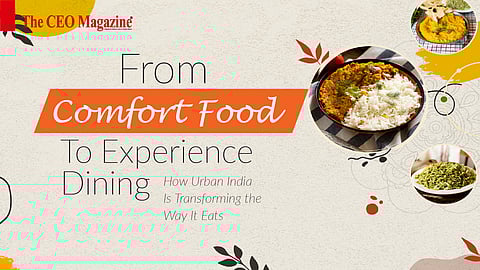
From Comfort Food to Experience Dining

Across Indian cities, food is no longer just about hunger or taste. It has become a medium of identity, nostalgia, exploration, and storytelling. In recent years, a dramatic shift has unfolded — diners are moving away from solely seeking comfort food and are increasingly drawn to experience dining. The transformation is subtle yet powerful: people want memories, not just meals.
This wave has altered the strategies of restaurants, cloud kitchens, chefs, food consultants, and even food technologists. Urban consumers are not simply asking “What’s for dinner?” anymore. They are asking, “What does this meal mean to me?” That singular shift has opened up an entirely new chapter in India’s culinary culture — and consultants across the food & cuisine segment are paying close attention.
Comfort food has always held a soft corner in Indian hearts. A plate of rajma-chawal after a tiring day, a bowl of Maggi on a rainy evening, dal khichdi when one is unwell — these are not dishes; they are emotions. For decades, comfort food shaped the daily eating patterns of urban India. Quick, familiar, homemade or easily ordered — convenience and nostalgia were the key ingredients.
But something has changed. Comfort food still dominates cravings, but consumers are no longer satisfied with familiarity alone. They want food that tells a story, that reflects their lifestyle, that educates and entertains. They still want their favorite meals — but now, they want to experience them.
Experience dining is not simply about eating outside. It is about dining as an event — immersive, creative, memorable. Across metros like Mumbai, Bengaluru, Delhi, Gurgaon, Pune and Hyderabad, restaurants are introducing themes and multi-sensory elements that go beyond ambiance. Chefs are becoming storytellers. Menus now read like journeys.
What once began with fine-dining concepts has now made its way into casual restaurants, street food spaces, and even pop-up culinary events. Dining has evolved into theatre — and the audience is willing to buy the ticket.
Consider these trends that reflect the growing appetite for experiences:
Chef’s Table & Open Kitchens — Diners watch their meals being created in real time.
Progressive Indian Cuisine — Regional dishes are reinvented using global techniques.
Ingredient Showcases — Menus revolve around one star ingredient across multiple courses.
Concept Cafés — Books, art, sustainability, wellness — each café carries a theme.
Culinary Pop-Ups & Food Trails — Limited-time events that blend travel and cuisine.
The message is clear: food is no longer just consumed — it is curated.
Why are people seeking dining experiences rather than simple meals? Several social and economic forces are at play.
1. Rising Disposable Income:
Urban professionals are more willing to spend on unique experiences than ever before.
2. Lifestyle Aspirations:
Dining out is not just an activity — it is a social statement. A post on Instagram is often as important as the meal itself.
3. Culinary Travel:
Travelling within India and abroad has widened palates. Consumers want what they’ve experienced elsewhere — or something better.
4. Stress & Escapism:
Dining out has become a form of escape. A well-crafted restaurant atmosphere serves as a break from city pressure.
5. Pandemic Impact:
Lockdowns taught people that home-cooked comfort food is valuable — but a thoughtfully designed dining experience is irreplaceable.
With this shift comes a new opportunity — one that lies not in kitchens, but in strategy rooms. Food consultants are helping restaurants define their identity, understand consumer psychology, and design menus that evoke emotions. They are involved in everything — menu engineering, flavor profiling, pricing logic, kitchen planning, interior storytelling, and even social media behaviour analysis.
Consultants today don’t just ask, What will people eat? They ask:
– What will they remember?
– What will they share?
– What will bring them back?
This is where data meets emotion. Experience dining is not accidental — it is carefully crafted, from the plate to the playlist.
Ingredients are not just ingredients anymore — they are symbols. Restaurants now highlight sourcing, traceability, origin, and sustainability. Diners are intrigued by menus that mention local farms, heirloom varieties, or artisanal producers. Labels like organic, cold-pressed, farm-to-fork, gluten-free, sourdough, homegrown, and zero-waste have become more than trends — they define identity.
And this is not limited to premium dining. Even street food vendors and small cloud kitchens are incorporating stories into their offerings. A butter chicken roll is appealing — but a butter chicken roll made from a recipe passed down three generations attracts deeper attention. A dosa is enjoyable — but a dosa made from hand-milled grains collected from tribal farmers sparks curiosity and loyalty.
The experience lies not only in taste — but in purpose.
Food photography has become a currency of influence. Diners judge dishes not just by reviews, but by visuals. Aesthetics now play a powerful role in menu decisions — from color combinations on plates to interior lighting. Restaurants increasingly involve social media consultants to craft “Instagram-friendly” dishes that encourage customer-led promotion.
Trends like “Instagrammable cafés”, “hidden bars”, “secret menus”, and “destination restaurants” reveal a new food ecosystem — one shaped as much by algorithms as by chefs.
Interestingly, experience dining isn’t confined to commercial spaces. A parallel trend is emerging — intimate, in-home dining experiences, where micro-chefs host curated meals for small groups. These private dinners often revolve around regional cuisine, fusion concepts, or storytelling. They offer exclusivity and connection — two elements missing from typical restaurants.
This has given rise to a new consulting niche: home dining entrepreneurs seeking help with compliance, menu development, pricing, branding, and digital positioning. Consultants in the culinary space are now supporting passion-driven food creators who don’t always own restaurants — but are reshaping food culture from living rooms and terraces.
Food tech is playing a major role in shaping what people eat. AI-powered apps are now suggesting meal plans based on health goals. Diet consultants are working with nutritionists to personalize cuisine at scale. Virtual food onboarding, blockchain traceability, digital ordering, AR menus, and ingredient recognition software are all slowly redefining dining experiences.
The intersection of tech + taste is becoming a powerful frontier — one where consultants, chefs, health specialists, designers, and data scientists must collaborate.
Despite all the evolution, comfort food has not disappeared. In fact, it has become stronger. People still return to it when they need reassurance, familiarity or emotional grounding. The difference is that now it is being treated with more dignity and creativity. Restaurants have begun curating heritage menus, reviving grandma-style recipes, and even mapping forgotten regional dishes onto modern plates.
Thus, instead of fading away… comfort food has become the foundation on which experience dining is being built.
The future of Indian dining lies at the intersection of memory and innovation. Consultants, chefs, and culinary thinkers will play a critical role in designing this journey. As consumers become more aware and discerning, restaurants will need to evolve from serving flavours to serving narratives. The question is no longer “What do people want to eat?” but “Why do they eat what they eat?”
Experience dining will grow — but comfort food will remain the anchor. Between the two, a vast space is emerging — a space full of stories, strategies, culture, data, nostalgia, and design. That space is not just where food is made — it is where food is imagined.
And that is exactly where the next chapter of India’s culinary revolution will begin.
Follow us on Google News