
- News
- Women
- Magazine
- IndustryIndustry
- InsightsInsights
- Success Stories
- PublishPublish
- ContactContact
- Media KitMedia Kit




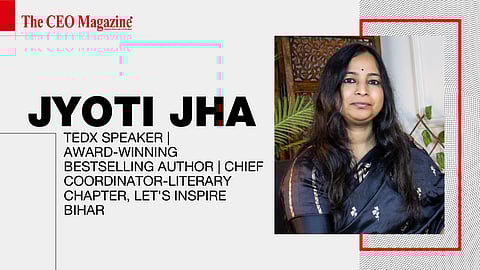
Jyoti Jha

For many professionals, life follows a predictable arc: education, career, family, and stability. But for Jyoti Jha, the most defining chapter of her life began when she stepped away from the conventional path.
Today as an author, columnist, and TEDx speaker, Jyoti has built a literary voice that blends storytelling with social consciousness. Yet her journey into writing was neither planned nor immediate. It emerged gradually, from years of observation, introspection, and an unexpected moment of recognition that would ultimately transform her life. For Jyoti, writing was a rediscovery of purpose.
Recognised for her powerful storytelling, bestselling works, and thought-provoking social narratives, Jyoti’s journey extends far beyond titles and accolades. At its heart lies a deeply personal transformation, from an HR professional and homemaker to a writer committed to inspiring social awareness and change.
Before becoming a writer, Jyoti spent years working as an HR professional. Life later took her across countries as she stepped into the role of a homemaker and traveller while supporting her family’s professional journey abroad.
Those years offered her a different education, one shaped by experiences, people, and cultures. Yet somewhere along the way, she felt a quiet urge to rediscover her own path.
That turning point arrived unexpectedly when she participated in The Times of India’s Write India Season 3, submitting a short story almost casually, without anticipating any recognition. To her surprise, the story went on to win the first prize under the mentorship of acclaimed author Upamanyu Chatterjee.
The moment proved transformative. “It gave me the confidence to believe that writing could be my path,” Jyoti reflects.
What began as a single story soon evolved into a new chapter of life, what she describes as her second innings. “As poetic as it may sound,” she says, “when I started writing, it felt as though I had started living again.”
Although writing became a professional pursuit later in life, Jyoti’s connection with literature began much earlier. She grew up in a home where books were not just objects but companions. Both her parents were educators and writers, contributing to literature in regional languages. Discussions about books, language, and ideas formed an integral part of her upbringing.
Even as a child, she found herself drawn to reading and writing, though the idea of becoming a professional author never crossed her mind at the time.
Years later, while living in the UK, she often spent hours in libraries after dropping her child at school. Surrounded by books and quiet reflection, a lingering thought would frequently return: one day, perhaps her name too might appear on the cover of a book.
At the time, she did not realise that this quiet aspiration would eventually shape her future. She describes herself simply as a storyteller, someone who captures human experiences, observations, and emotions, weaving them into narratives that readers can connect with and see reflections of their own lives in.
Among Jyoti’s most widely appreciated works is her novella Aanandi, a deeply moving narrative centred on women’s empowerment.
The inspiration for the book, she explains, came from real-life observations and lived experiences. Set against the socio-cultural backdrop of Bihar decades ago, the story follows the life of a woman who dares to think beyond the constraints placed upon her by society.
At a time when daughters were often undervalued and opportunities for women were limited, Aanandi chooses a different path, one defined by education, self-reliance, and resilience. Through determination and courage, she not only transforms her own life but also shapes the futures of her daughters and family.
The story resonated widely with readers and critics alike, earning significant appreciation within literary circles. For Jyoti, however, the most meaningful recognition came from readers themselves.
“Some people even began saving my contact as ‘Aanandi’,” she shares with a smile. “For a writer, being known through a character you created is one of the greatest achievements.”
While fiction allows Jyoti to explore social narratives, her writing also addresses issues that demand greater public awareness. Her book Spectrum and Beyond focuses on autism spectrum disorder, a topic that remains widely misunderstood in India.
The idea for the book emerged during a conversation with parents of a child on the autism spectrum. Despite being well-educated and widely exposed, Jyoti realised she herself had limited knowledge about the condition. That realisation prompted her to research deeply on the subject.
She connected with parents, institutions, therapists, and educators while spending time observing children and their experiences. The process involved extensive reading, interviews, and field visits.
Her goal was not to position herself as an expert, she says, but to act as a medium, bringing information and awareness to a wider audience. The result was a book aimed not at academic audiences but at ordinary readers, parents, educators, and individuals seeking greater awareness.
“I am not an expert,” she says. “I am simply a writer trying to bring attention to a subject that deserves more understanding.” In a country where many families still struggle to understand developmental conditions, she hopes the book helps start meaningful conversations.
For Jyoti, writing is deeply intertwined with emotional awareness. She believes that storytelling requires writers to absorb the emotions of both their own lives and the lives of others. Whether drawn from personal experiences, societal observations, or imaginative narratives, emotions form the foundation of meaningful literature.
Writers often find themselves immersed in their fictional worlds so completely that the emotions become real. She recalls moments while writing Aanandi when she found herself overwhelmed with emotion, only to realise later how deeply she had connected with the characters she created.
That emotional connection, she says, is what transforms a piece of writing into something memorable.
Beyond books, Jyoti’s literary journey also intersects with social initiatives. She is associated with Let’s Inspire Bihar, a movement led by IPS officer Vikas Vaibhav that aims to encourage social awareness and development in the state.
Within the campaign, Jyoti contributes through its literary wing, using literature as a medium to inspire reflection and dialogue. She strongly believes that literature has historically played a crucial role in shaping societies and driving change.
“Words have the power to travel far beyond their origin,” she explains. “A message written with sincerity can reach homes, influence minds, and inspire action.” Through literary festivals, discussions, and community engagement, the initiative seeks to revive Bihar’s rich literary culture while encouraging young people to reconnect with reading and writing.
Follow us on Google News