
- News
- Women
- Magazine
- IndustryIndustry
- InsightsInsights
- Success Stories
- PublishPublish
- ContactContact
- Media KitMedia Kit

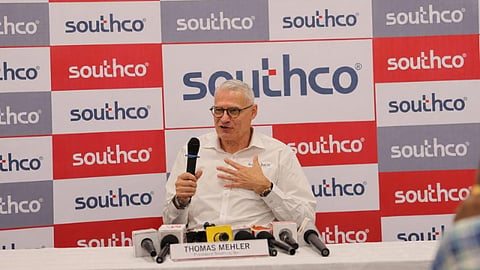
Thomas Mehler began his Southco career in 1990 as the company’s first sales account manager for Germany. He later led its businesses across Europe, Asia Pacific and the Americas, becoming president in 2016. The route from customer conversations to global management gives his October visit to Pune a distinctive lens. How does a specialist manufacturer grow while preserving the attention it gives each customer’s problem?
Southco makes engineered access hardware, including latches, hinges, locks and positioning solutions. The products appear in equipment as varied as aircraft seating, rail systems, off-highway machines and data centre enclosures. Their part in the finished product may be modest in size, yet a customer’s experience depends on whether they open, secure or adjust as intended. For Mehler, that relationship between the engineering and the experience has become a leadership question.
A product catalogue can tell an engineer what a component is designed to do. It takes a conversation to understand how the equipment will be used and what matters most to its maker. Mehler’s early customer-facing role gave him a close view of that exchange. As president, he must ensure that the same curiosity can inform decisions across a much larger business.
His first answer returns to the lesson of that early sales role: “A specification tells us what a part must do. The customer tells us why it matters in a real machine. We need both conversations early.”
A railway equipment manufacturer may focus on passenger use and repeated operation. A data centre manufacturer may need controlled access to valuable equipment. An off-highway OEM may place durability and service access high on the brief. The hardware and its users differ. The management challenge is to understand the purpose behind each request before a design choice becomes fixed.
The experience of leading businesses across regions adds another layer. A company can have a wide range of standard products and still need the judgement to select, adapt and support one for a particular application. Mehler’s career has put him on both sides of that exchange, hearing a customer’s requirement and deciding how a global organisation can respond.
Growth gives a company more experience to draw on. It also asks more of the way that experience travels. An insight from a customer-facing engineer is useful only if it reaches the people who can act on it. A manufacturing improvement has wider value when other teams can examine whether it suits their processes. Leadership, in this setting, is partly the work of making that exchange routine.
Southco’s operating approach combines regional responsibility with shared manufacturing and quality processes. Teams can assess whether an improvement developed in one location has wider use. That exchange relies on people explaining what they have learned, including identifying when a design or process needs another look.
A decision must stand up to the work that follows it. As Mehler explains, “It should work for the customer, the team making the product and the team supporting it later.”
This standard gives the conversation a more personal dimension. A drawing can show dimensions and tolerances. It cannot capture every question an operator, installer or maintenance technician will raise over the product’s life. Southco’s engineers, production teams and commercial teams each see a different part of that picture. The quality of the final answer depends on how well those views meet.
In India, that exchange has identifiable faces. Prakash T. John, Country Head of Southco India, considers how customer and market needs shape the business’s direction in the country. Veeresh Manrai, general manager for business development, works with the requirements equipment makers bring to the company. Their perspectives connect India’s priorities with the customer’s brief.
When the question turns to India, Mehler’s focus moves to Prakash T. John and Veeresh Manrai. “Veeresh brings the details of customer needs into focus. Prakash considers what those needs mean for our direction in India. My job is to make sure both perspectives shape decisions early.”
A customer may begin with a target price or a design constraint. The engineering team considers performance, the production team considers how it will be made consistently, and the commercial team understands the wider programme. None of these views carry the whole answer on their own. A company becomes more useful to its customers when those teams are part of one conversation.
The familiar measures of business growth tell only part of the story for a component supplier. Delivery reliability, product quality, safety and customer experience show whether a strategy works beyond the conference room.
For Mehler, growth means more when “customers can rely on what we deliver, our teams work safely, and people trust us with their next challenge.”
Mehler’s visit to Pune brought that leadership argument into focus. Southco’s value rests on technical expertise, but the way people share information and follow through on a customer's needs determines what reaches the finished equipment. He started out listening to customers one at a time. Now, as president, his job is to make sure a much larger organisation still hears them clearly.
Follow us on Google News