
- News
- Women
- Magazine
- IndustryIndustry
- InsightsInsights
- Success Stories
- PublishPublish
- ContactContact
- Media KitMedia Kit

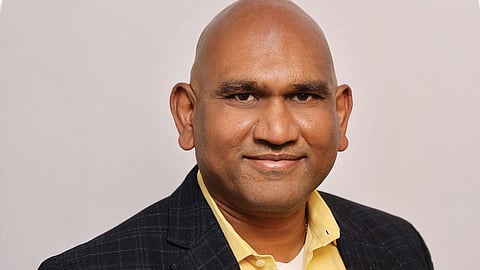
As India races ahead on AI, digital infrastructure and global capability centres, the scale of its cyber risk is expanding with it. Dr. Srinivas Mukkamala, CEO of Securin, believes the next phase of enterprise security will be defined by continuous validation, an attacker’s view of risk and the ability to respond at machine speed.
India’s digital transformation has reached a scale where cybersecurity can no longer be treated as a layer added after technology is built.
More than 1.45 billion Aadhaar numbers have been generated. Cumulative Direct Benefit Transfer payments have crossed ₹53.7 trillion. On the enterprise side, India’s global capability centre ecosystem generated approximately US$98.4 billion in FY26, as GCCs expanded their role across artificial intelligence, engineering, cloud, research and global business operations.
Behind those numbers lies a less visible consequence: an attack surface growing almost as rapidly as the digital economy itself.
Every additional identity, transaction, application, cloud environment and connected system creates another possible point of exposure. And as businesses integrate AI deeper into how software is developed and enterprises are run, the speed at which both opportunity and risk emerge is changing dramatically.
For Dr. Srinivas Mukkamala, CEO of cybersecurity company Securin, that makes the present moment an inflection point.
India may have formidable software and AI talent, he argues, but security still needs to become a more intrinsic part of how technology is designed. Secure architecture and secure coding cannot remain disciplines that enter the conversation only after development is complete.
The task now is to make cybersecurity mature at the same pace as the technology it is expected to protect.
One misconception continues to shape enterprise cybersecurity, according to Mukkamala: the assumption that more complexity can be solved simply by adding more people.
It is an understandable model in India, a market with deep technology talent and a long history of scaling operations through manpower. But the volume of vulnerabilities, alerts, identities, assets and signals that security teams must now interpret has changed the equation.
“Technology can now analyse, correlate and respond to risks at a speed and scale that human teams alone cannot match,” Mukkamala says.
That does not make human expertise redundant. It changes where that expertise is most valuable.
Automation and AI can take on scale, repetition and analysis, while security professionals focus on judgement, context and the decisions that require specialist knowledge. For enterprises, this represents a shift from a predominantly people-heavy security model towards one in which technology does more of the computational heavy lifting.
The implication extends beyond cybersecurity. As AI takes on a greater share of knowledge-intensive work, organisations will have to rethink how people and machines operate together rather than treating automation solely as a substitute for talent.
Enterprise security teams are hardly short of tools.
Vulnerability scanners, penetration tests, security platforms and compliance programmes have been standard components of cybersecurity for years. The problem is that many of these approaches provide a view of risk at a particular moment, while the environment they are evaluating rarely stands still.
Infrastructure changes. Applications are updated. Identities and permissions shift. New vulnerabilities are disclosed. Attackers adapt.
AI is speeding up that cycle further.
For Mukkamala, this is why vulnerability management has to evolve from periodic assessment to continuous validation.
Simply knowing that an organisation has vulnerabilities offers limited insight. Almost every enterprise does. The more consequential questions are which vulnerabilities can actually be exploited, whether several weaknesses can be combined, where an attacker could move after gaining access and what critical asset ultimately sits at the end of that path.
That distinction changes the economics of cybersecurity.
A security team staring at thousands of vulnerabilities does not have the luxury of treating each one as equally urgent. What it needs is a way to identify the exposures that create viable routes to critical data, systems or applications.
In other words, vulnerability counts matter far less than understanding what an attacker can actually do with them.
Attackers rarely approach an organisation as a checklist of individual weaknesses.
A relatively modest vulnerability may provide an initial foothold. Another weakness may allow an attacker to escalate privileges. A misconfiguration or compromised identity may create access to another part of the network. Individually, none may appear catastrophic. Together, they can form an attack path towards a high-value asset.
That is why Mukkamala advocates an attacker-centric view of security.
Security teams need to ask: If someone enters here, where can they go next? What can they access? Which exposures can be chained together? What is the potential business impact?
This approach changes prioritisation. Instead of directing teams to remediate enormous numbers of vulnerabilities with little distinction, organisations can concentrate first on the combinations that create genuine pathways to critical assets.
AI makes this capability more urgent because defenders are not the only ones gaining access to faster analysis.
Attackers can use AI for reconnaissance, vulnerability analysis and the exploration of combinations that might previously have required far more time and manual effort.
The contest is becoming one of speed as much as sophistication.
Much of the enterprise conversation about AI focuses on productivity. In cybersecurity, the equation is more complicated.
AI can dramatically increase the speed at which software is built. That creates enormous potential for businesses. But if secure design and secure coding are absent from the development process, vulnerabilities can scale just as rapidly as software production.
On the offensive side, AI gives adversaries another force multiplier.
Reconnaissance can become faster. Vulnerabilities can be analysed more quickly. Potential attack paths can be explored at greater scale. AI agents, capable of carrying out tasks with a degree of autonomy, introduce another variable that enterprises are only beginning to understand.
The result is a threat model in which adversaries may be capable of operating at a speed that purely human security operations cannot realistically match.
Defence therefore has to become continuous as well.
For organisations, that means maintaining a current understanding of their exposure, testing how those exposures could be used and reducing meaningful attack paths before an adversary gets there first.
The challenge becomes particularly consequential when applied to critical infrastructure.
For India, Mukkamala argues, the definition of critical infrastructure must reflect the country’s own economic and social architecture.
Railways move vast numbers of people and goods. The postal network reaches remote parts of the country. Financial services have become deeply digital. Electricity and telecommunications sit beneath almost every other connected service.
As these systems digitise, their interdependence becomes part of the security problem.
Cyber risk is still frequently examined organisation by organisation or department by department. But an attacker does not necessarily respect those administrative boundaries.
A stronger approach would examine exposure across the wider ecosystem.
At a state level, for example, finance, taxation, transport, public safety and other essential departments may need to be viewed collectively, extending down through districts and local administrative bodies. The objective is to understand where systems intersect, how risks travel between them and which exposures could create the largest consequences.
Regulation has a role to play here as well. Technology can change in months; regulatory frameworks often evolve far more slowly. Mukkamala believes India has an opportunity to develop a more adaptive framework that encourages continuous security validation rather than treating compliance at a single point in time as the end goal.
It is within this changing environment that Securin has positioned its own approach.
The company began with a relatively simple premise: find and validate the risk before the attacker does.
Organisations already had vulnerability scanners, penetration tests and multiple security products. The gap, as Securin saw it, was connecting those signals to the context of an organisation’s actual environment and understanding how an adversary might use them.
Mukkamala describes the philosophy through what Securin calls the 4Cs: Continuous, Context, Chaining and Customer.
Security validation has to be continuous because both enterprise environments and threats keep changing. Context determines whether the same vulnerability is relatively benign in one location and critical in another. Chaining reflects the way attackers combine weaknesses rather than exploiting them in isolation. And ultimately, the intelligence produced has to help the customer decide what action matters most.
Data becomes particularly important as AI enters the equation.
AI models are becoming easier to access. High-quality intelligence is harder to reproduce.
Securin has spent more than a decade building proprietary vulnerability intelligence and offensive-security expertise, with teams studying vulnerabilities, developing exploits and testing complex environments. Mukkamala sees that combination of structured security data, attacker knowledge and AI as central to moving from identifying problems towards understanding which ones are most likely to matter.
For Securin, the competitive benchmark is therefore less about another cybersecurity vendor than the adversary on the other side.
That positioning arrives at a significant moment for the Indian market.
Enterprises are operating larger cloud estates, connecting more infrastructure and adopting AI across more business processes. GCCs are taking responsibility for increasingly sophisticated global functions. At the same time, attackers have access to faster tools of their own.
Traditional models built around periodic scanning and point-in-time testing will find it harder to keep pace with that environment.
For business leaders, this makes cybersecurity less a technical exercise and more an issue of enterprise resilience.
Five years from now, Mukkamala frames that challenge through three Rs: Resilience, Recovery and Revolution.
Resilience is the ability to withstand disruption. Recovery is the ability to contain an incident and return to a safe state quickly. Revolution reflects the change cybersecurity itself will have to undergo as AI, autonomous agents and technologies such as quantum computing reshape the nature and speed of risk.
That future is unlikely to be built around an assumption that every cyber incident can be prevented.
The more important measure may be what happens once something does go wrong.
How quickly can an organisation understand what is happening? How rapidly can it contain the damage? How soon can it return to a safe operating state?
Where businesses today may measure recovery in hours or days, Mukkamala expects the next generation of cyber resilience to demand responses closer to machine speed.
Quantum computing adds another challenge on the horizon. Much of modern cybersecurity depends on cryptography, creating a need for organisations to understand where encryption exists across their technology environments and begin preparing for a post-quantum world.
For CEOs, the broader message is clear. As digital businesses become faster, more connected and more autonomous, cyber resilience cannot remain a periodic test of whether the right controls exist.
The organisations best equipped for what comes next will be those that can see their exposure continuously, understand it through the eyes of an attacker, identify what truly threatens the business and act before risk becomes impact.
Follow us on Google News